

50 Cents (Cook's Australian Voyage) – Australia
Circulating commemorative coins
Commemoration: 200th Anniversary of Cook's Australian Voyage
Australia
Context

Material
Diameter: 31.51 mm
Weight: 15.55 g
Thickness: 3 mm
Shape: Dodecagonal
Standard: Silver half ounce
Technique: Milled
Alignment: Medal alignment
flip
References
KM: #Click to copy to clipboard69
Numista: #6178
Value
Exchange value: 0.50 AUD = $0.36
Inflation-adjusted value: 7.32 AUD
Obverse
Description:
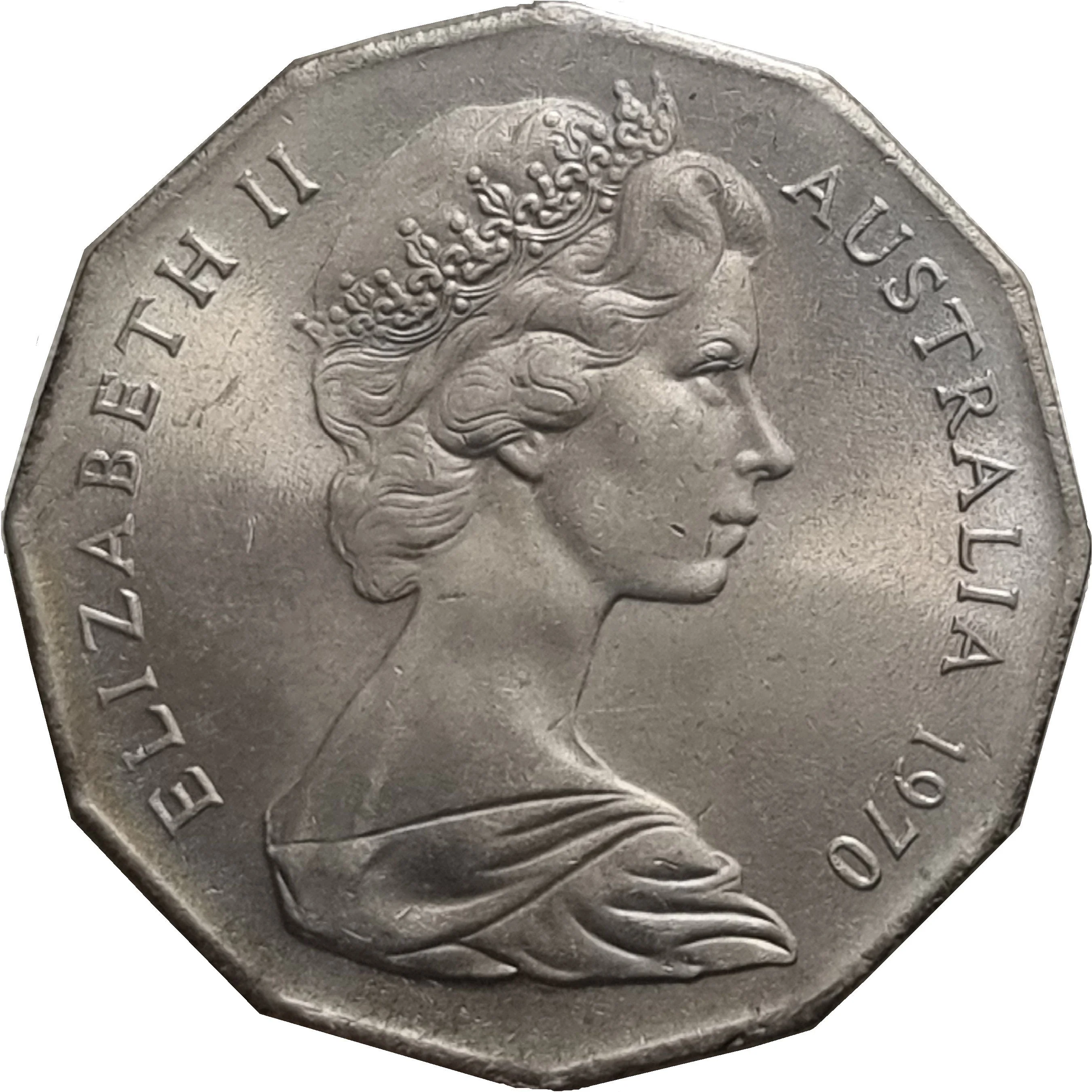
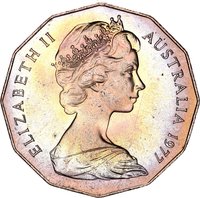
Second portrait of Queen Elizabeth II facing right in the Girls of Great Britain and Ireland Tiara.
Inscription:
ELIZABETH II
AUSTRALIA 1970
AUSTRALIA 1970
Script: Latin
Designer: Arnold Machin
Reverse
Description:
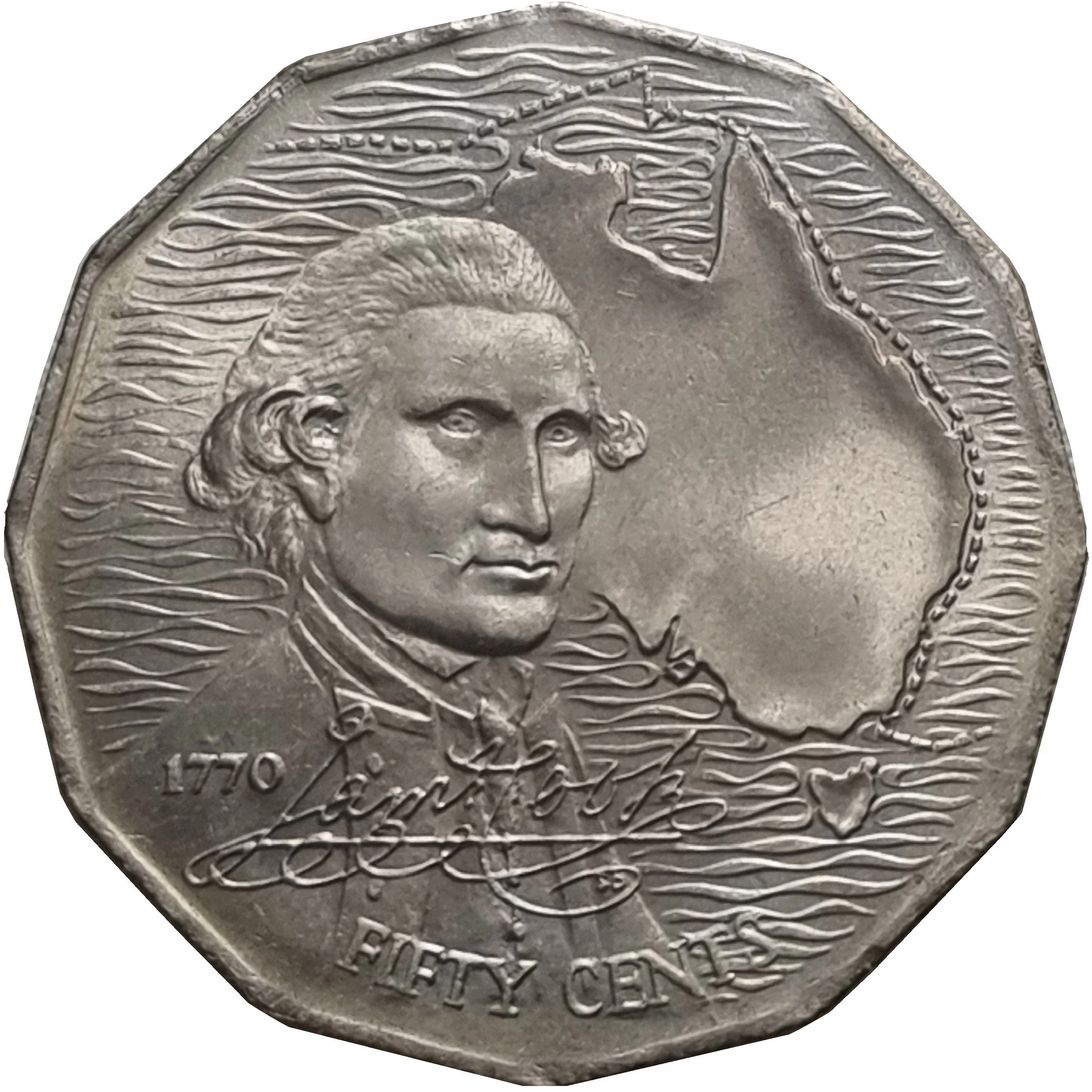
Captain Cook's bust beside a map of Australia.
Inscription:
1770 James Cook
SD
FIFTY CENTS
SD
FIFTY CENTS
Script: Latin
Designer: Stuart Devlin
Edge
12 Sided Smooth
Mints
| Name | Mark |
|---|---|
| Royal Australian Mint | — |
Mintings
| Year | Mint Mark | Mintage | Quality | Collection |
|---|---|---|---|---|
| 1970 | — | 556,888 | BU | |
| 1970 | — | 140 | Proof | |
| 1970 | — | 16,548,100 |
Historical background
In 1970, Australia's currency system was in a state of transition, firmly anchored to the global Bretton Woods framework. The Australian pound (denoted by £A) was the nation's official currency, a legacy of its British colonial past, and its value was pegged to the British pound sterling. More critically, through the sterling link and the Bretton Woods system, Australia's currency was indirectly fixed to the US dollar and ultimately to the price of gold. This arrangement provided stability for international trade but also meant Australia's monetary policy was largely reactive to decisions made in London and Washington, limiting domestic control over interest rates and money supply to manage the economy.
This system was under increasing strain by 1970. Global inflationary pressures, balance of payments challenges, and the rigidity of fixed exchange rates were creating economic headwinds. Domestically, the post-war economic boom was fading, and there was growing political and economic debate about the suitability of the imperial currency system for a nation seeking a more independent identity in the Asia-Pacific region. The cumbersome pounds, shillings, and pence system (12 pence to a shilling, 20 shillings to a pound) was also seen as increasingly anachronistic and inefficient for a modernising economy.
Consequently, 1970 served as the final full year of the old order. The groundwork for a profound change had already been laid with the Currency Act 1965, which introduced the decimal currency system. The transition itself had occurred in 1966 with the introduction of the Australian dollar (AUD), but the pound denomination was still in use for some time. The defining shift would come in 1971, when Australia, following the lead of other nations, effectively floated its currency after the collapse of the Bretton Woods system. Thus, the currency situation in 1970 was one of a pegged and inherited system in its final chapter, on the cusp of a decisive move towards a decimalised, independently managed, and soon-to-be floated Australian dollar.
This system was under increasing strain by 1970. Global inflationary pressures, balance of payments challenges, and the rigidity of fixed exchange rates were creating economic headwinds. Domestically, the post-war economic boom was fading, and there was growing political and economic debate about the suitability of the imperial currency system for a nation seeking a more independent identity in the Asia-Pacific region. The cumbersome pounds, shillings, and pence system (12 pence to a shilling, 20 shillings to a pound) was also seen as increasingly anachronistic and inefficient for a modernising economy.
Consequently, 1970 served as the final full year of the old order. The groundwork for a profound change had already been laid with the Currency Act 1965, which introduced the decimal currency system. The transition itself had occurred in 1966 with the introduction of the Australian dollar (AUD), but the pound denomination was still in use for some time. The defining shift would come in 1971, when Australia, following the lead of other nations, effectively floated its currency after the collapse of the Bretton Woods system. Thus, the currency situation in 1970 was one of a pegged and inherited system in its final chapter, on the cusp of a decisive move towards a decimalised, independently managed, and soon-to-be floated Australian dollar.
🌱 Very Common