

1 Florin – Australia
Circulating commemorative coins
Commemoration: Royal Visit of Elizabeth II
Australia
Context

Material
References
KM: #Click to copy to clipboard55
Numista: #5322
Value
Bullion value: $16.18
Obverse
Description:
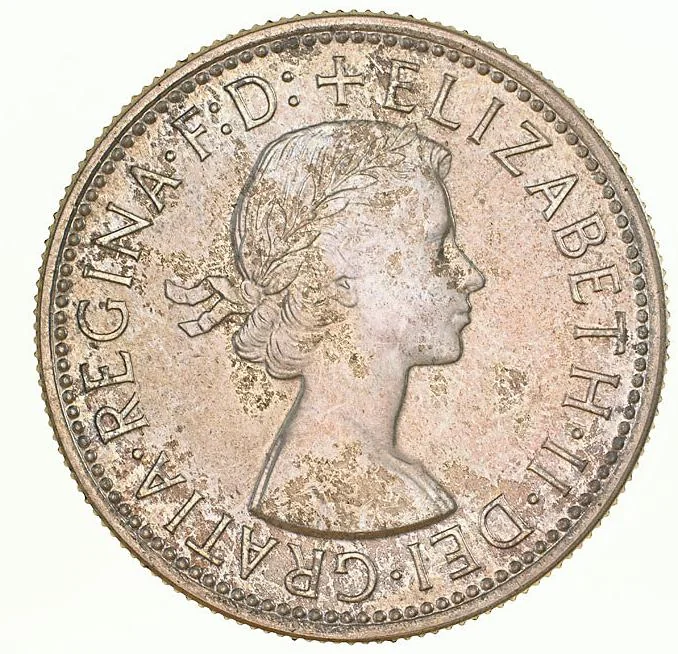
Young Elizabeth II in laurel wreath, facing right.
Inscription:
+ ELIZABETH·II·DEI·GRATIA·REGINA·F:D:
Translation:
Elizabeth II by the Grace of God Queen Defender of the Faith
Script: Latin
Language: Latin
Engraver: Mary Gillick
Reverse
Description:
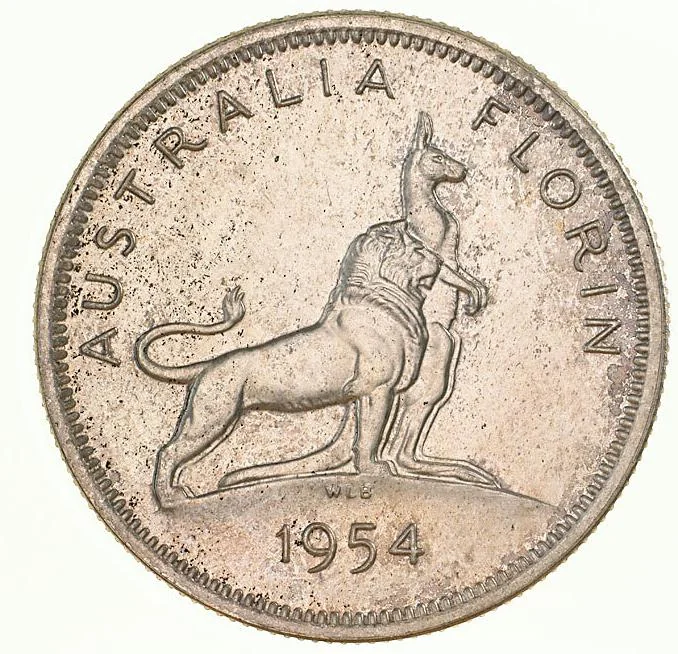
A lion and kangaroo stand together on a curved ground, facing right.
Inscription:
AUSTRALIA FLORIN
1954
1954
Script: Latin
Engraver: William Leslie Bowles
Edge
Milled
Mints
| Name | Mark |
|---|---|
| Royal Mint | — |
Mintings
| Year | Mint Mark | Mintage | Quality | Collection |
|---|---|---|---|---|
| 1954 | — | — | Proof | |
| 1954 | — | 4,000,000 |
Historical background
In 1954, Australia operated under a stable and tightly controlled currency system as a member of the Sterling Area. The Australian pound (A£) was pegged to the British pound sterling (GB£) at parity, meaning their values were fixed as equal. This arrangement, formalised in the 1930s, meant Australia held its foreign reserves predominantly in sterling and conducted most of its international trade and finance through London. The system provided predictability for trade with Britain, which was still a major partner, but also meant Australia's monetary policy was heavily influenced by British economic conditions and decisions.
Domestically, the currency was managed by the Commonwealth Bank of Australia (which acted as the central bank prior to the Reserve Bank's establishment in 1960) and was backed by a substantial gold reserve. The post-war economic boom was in full swing, driven by high wool prices and a growing manufacturing sector, which supported confidence in the currency. However, the fixed exchange rate and capital controls of the era meant there was little foreign exchange market as understood today; international transactions were strictly regulated to protect the sterling reserves and maintain the peg.
The period was one of monetary conservatism, with no significant devaluation or crisis affecting the currency in 1954 itself. However, underlying pressures were building. The economic dominance of Britain was waning, while trade and investment links with the United States and Japan were growing, creating a tension that the sterling peg would increasingly strain. These pressures would culminate in a major policy shift just a few years later, with the dramatic decision to break the parity with sterling and decimalise the currency, setting the stage for the introduction of the Australian dollar in 1966.
Domestically, the currency was managed by the Commonwealth Bank of Australia (which acted as the central bank prior to the Reserve Bank's establishment in 1960) and was backed by a substantial gold reserve. The post-war economic boom was in full swing, driven by high wool prices and a growing manufacturing sector, which supported confidence in the currency. However, the fixed exchange rate and capital controls of the era meant there was little foreign exchange market as understood today; international transactions were strictly regulated to protect the sterling reserves and maintain the peg.
The period was one of monetary conservatism, with no significant devaluation or crisis affecting the currency in 1954 itself. However, underlying pressures were building. The economic dominance of Britain was waning, while trade and investment links with the United States and Japan were growing, creating a tension that the sterling peg would increasingly strain. These pressures would culminate in a major policy shift just a few years later, with the dramatic decision to break the parity with sterling and decimalise the currency, setting the stage for the introduction of the Australian dollar in 1966.
🌱 Common