

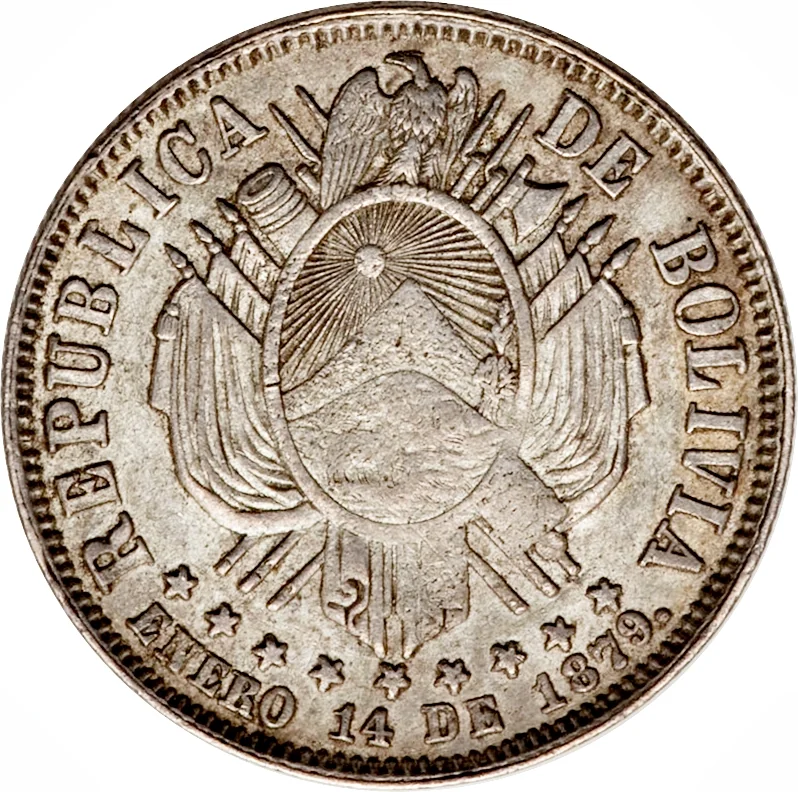
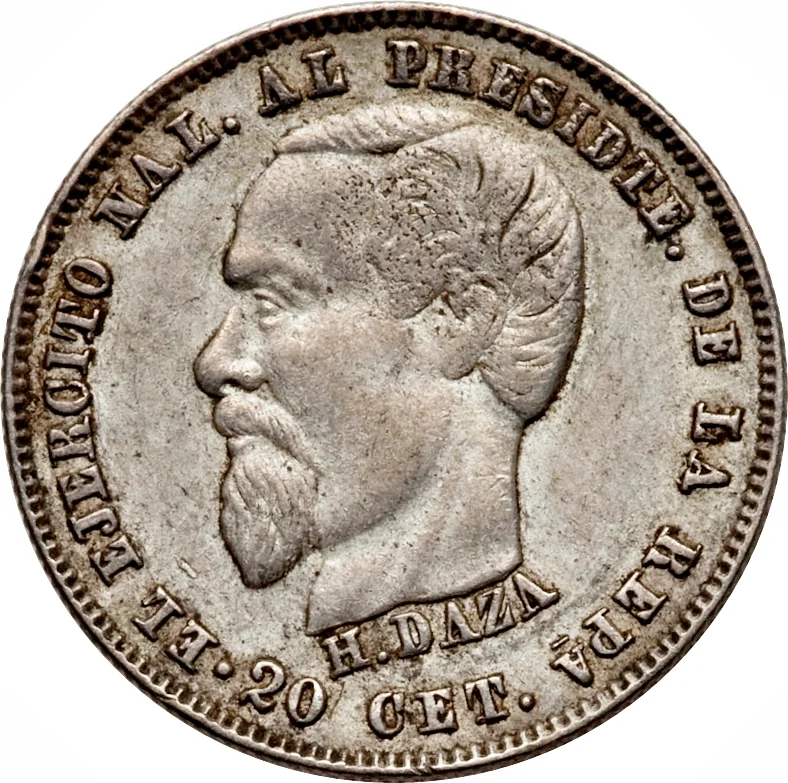
20 centavos – Bolivia
Add to wishlist
Circulating commemorative coins
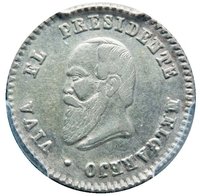
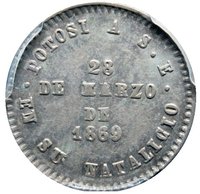
Commemoration: President Daza
Bolivia
Obverse
Reverse
Edge
Reeded
Categories
| Person> Military leader |
| Person> Politician |
| Symbol> Flag |
| Animal> Bird |
| Geography> Mountain |
| Mustache/Beard |
| Symbols> Coat of Arms |
| Symbol> Sun |
| Object> Firearms |
Mints
| Name | Mark |
|---|---|
| Potosi | — |
Mintings
| Year | Mint Mark | Mintage | Quality | Collection |
|---|---|---|---|---|
| 1879 | — | — |
Historical background
In 1879, Bolivia’s currency situation was characterized by profound instability and fragmentation, a legacy of its post-independence economic struggles. The country lacked a unified national currency, leading to a chaotic circulation of various foreign and domestic coins. The most commonly accepted medium was the Bolivian peso, also known as the boliviano, but its value was not standardized and it competed directly with Peruvian soles, Chilean pesos, and even older Spanish colonial coinage. This monetary anarchy was exacerbated by the government's chronic fiscal deficits and its reliance on debasing coinage (reducing silver content) to finance spending, which further eroded public trust in the currency.
This fragile financial system existed within a broader context of economic dependence on a single resource: nitrate. The revenue from nitrate mining in the coastal Atacama Desert, controlled by Chilean companies under a treaty with Bolivia, was a critical source of government income. The monetary instability was therefore both a cause and a consequence of weak state capacity; the government in Sucre had limited power to enforce fiscal or monetary policy nationwide, and regional economies often operated with relative autonomy, using whatever currency was most reliable for trade.
The outbreak of the War of the Pacific in February 1879, when Chile invaded the Bolivian coast, catastrophically exacerbated these monetary problems. Bolivia lost its primary source of nitrate revenue almost immediately, plunging its already precarious finances into crisis. The war effort demanded massive expenditure, leading to increased money printing and further currency debasement, which spiraled into severe inflation. Thus, the currency situation of 1879 moved from one of chronic disorder to one of acute crisis, setting the stage for profound economic hardship in the conflict's aftermath.
This fragile financial system existed within a broader context of economic dependence on a single resource: nitrate. The revenue from nitrate mining in the coastal Atacama Desert, controlled by Chilean companies under a treaty with Bolivia, was a critical source of government income. The monetary instability was therefore both a cause and a consequence of weak state capacity; the government in Sucre had limited power to enforce fiscal or monetary policy nationwide, and regional economies often operated with relative autonomy, using whatever currency was most reliable for trade.
The outbreak of the War of the Pacific in February 1879, when Chile invaded the Bolivian coast, catastrophically exacerbated these monetary problems. Bolivia lost its primary source of nitrate revenue almost immediately, plunging its already precarious finances into crisis. The war effort demanded massive expenditure, leading to increased money printing and further currency debasement, which spiraled into severe inflation. Thus, the currency situation of 1879 moved from one of chronic disorder to one of acute crisis, setting the stage for profound economic hardship in the conflict's aftermath.

💎 Extremely Rare