

50 centavos – Bolivia
Add to wishlist
Circulating commemorative coins
Commemoration: Installation of Electric Machinery at the Potosi Mint
Bolivia
Obverse
Description:
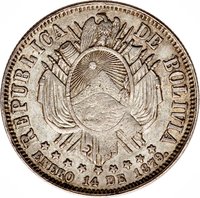
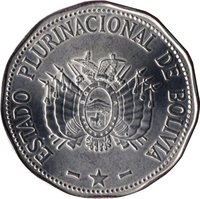
Bolivian coat of arms with nine stars below and the country name flanking it.
Inscription:
REPUBLICA BOLIVIANA
Script: Latin
Reverse
Description:
A text-only event description appears here across five lines.
Location and date listed below.
Location and date listed below.
Inscription:
INSTALACION DE MAQUINARIA
ADMINISTRACION
DEL
EXMO. DR.
ISMAEL MONTES
• POTOSI AGTO. 6 DE 1906 •
ADMINISTRACION
DEL
EXMO. DR.
ISMAEL MONTES
• POTOSI AGTO. 6 DE 1906 •
Script: Latin
Edge
Reeded
Categories
| Symbols> Coat of Arms |
Mints
| Name | Mark |
|---|---|
| Potosi | — |
Mintings
| Year | Mint Mark | Mintage | Quality | Collection |
|---|---|---|---|---|
| 1906 | — | — |
Historical background
In 1906, Bolivia’s currency situation was characterized by profound instability and transition, rooted in decades of economic turmoil. Following the collapse of the global silver price in the late 19th century, the nation’s silver-based boliviano had severely depreciated, leading to rampant inflation and a loss of public confidence. The government had resorted to issuing fiduciary (paper) money without sufficient metallic backing, resulting in multiple competing currencies in circulation, including devalued silver coins, unstable banknotes, and even foreign currencies like the Peruvian sol and Chilean condor in border regions. This monetary chaos crippled domestic commerce and complicated international trade, highlighting an urgent need for comprehensive reform.
The pivotal response was the Monetary Law of December 28, 1906, enacted during the presidency of Ismael Montes. This legislation established the gold standard, pegging a new currency unit—the boliviano de oro (gold boliviano)—to the British pound sterling at a fixed rate of 12.5 bolivianos to £1. The law aimed to create a stable, uniform, and convertible currency by mandating that paper money issuance be backed by at least 50% gold reserves, with the remainder in secure bonds. To facilitate this, the government arranged a £1.7 million foreign loan, primarily through European banks, to build the necessary gold reserve fund and retire the old, discredited paper money from circulation.
The reform of 1906 was a landmark attempt to impose fiscal discipline and integrate Bolivia into the global financial system. While it succeeded in temporarily stabilizing the currency and restoring some international creditworthiness, the gold standard proved difficult to maintain in the long term. Bolivia’s economy remained heavily dependent on single-commodity exports (first silver, then tin), making it vulnerable to external price shocks. The strictures of gold convertibility, combined with persistent budget deficits, would eventually lead to renewed pressures, foreshadowing the challenges of maintaining monetary stability in a developing, resource-dependent nation.
The pivotal response was the Monetary Law of December 28, 1906, enacted during the presidency of Ismael Montes. This legislation established the gold standard, pegging a new currency unit—the boliviano de oro (gold boliviano)—to the British pound sterling at a fixed rate of 12.5 bolivianos to £1. The law aimed to create a stable, uniform, and convertible currency by mandating that paper money issuance be backed by at least 50% gold reserves, with the remainder in secure bonds. To facilitate this, the government arranged a £1.7 million foreign loan, primarily through European banks, to build the necessary gold reserve fund and retire the old, discredited paper money from circulation.
The reform of 1906 was a landmark attempt to impose fiscal discipline and integrate Bolivia into the global financial system. While it succeeded in temporarily stabilizing the currency and restoring some international creditworthiness, the gold standard proved difficult to maintain in the long term. Bolivia’s economy remained heavily dependent on single-commodity exports (first silver, then tin), making it vulnerable to external price shocks. The strictures of gold convertibility, combined with persistent budget deficits, would eventually lead to renewed pressures, foreshadowing the challenges of maintaining monetary stability in a developing, resource-dependent nation.
✨ Legendary