

⅛ Melgarejo – Bolivia
Circulating commemorative coins
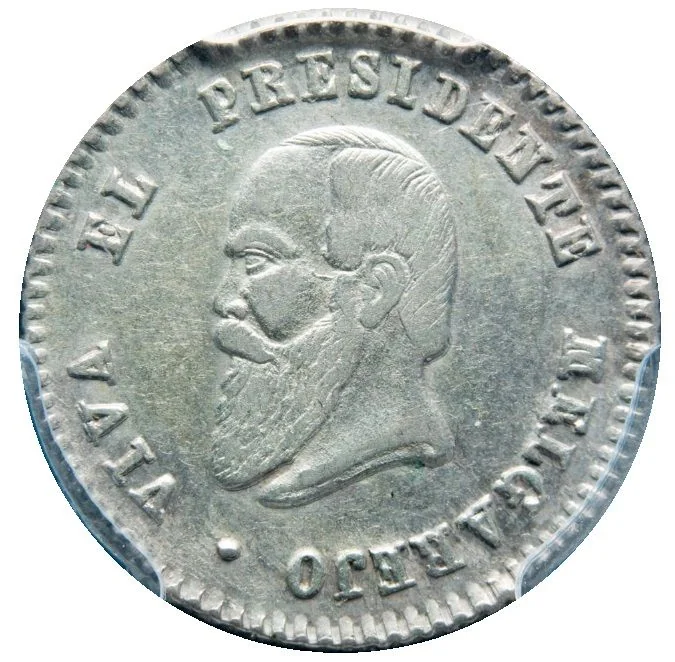
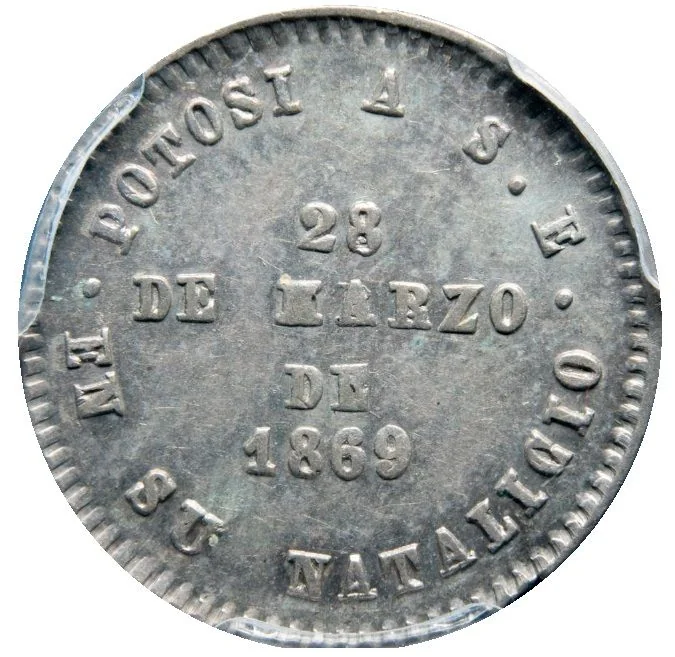
Commemoration: POTOSÍ TO GENERAL MELGAREJO
Bolivia
Obverse
Description:
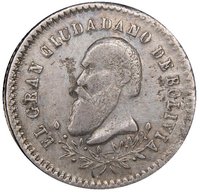
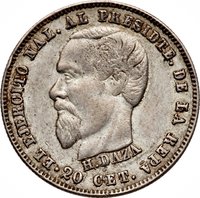
Bust of General Melgarejo encircled by legend.
Inscription:
VIVA EL PRESIDENTE MELGAREJO
Script: Latin
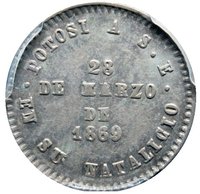
Reverse
Edge
Milled
Categories
| Person> Military leader |
| Person> Politician |
| Mustache/Beard |
Mints
| Name | Mark |
|---|---|
| Potosi | — |
Mintings
| Year | Mint Mark | Mintage | Quality | Collection |
|---|---|---|---|---|
| 1869 | — | — |
Historical background
In 1869, Bolivia's currency situation was characterized by profound instability and fragmentation, a direct legacy of the economic devastation following the War of the Pacific (which would begin a decade later) had not yet occurred, but the nation was still reeling from earlier conflicts and internal strife. The country operated on a bimetallic system legally tied to the French franc standard under the 1863 Monetary Law, which defined the Boliviano (also called the "boliviano de plata") in relation to both silver and gold. However, the government lacked the fiscal discipline and bullion reserves to maintain this standard, leading to a chronic shortage of hard currency in circulation.
The economy was instead dominated by a chaotic mix of foreign coins, particularly Peruvian and Chilean pesos, alongside fractional silver and debased Bolivian coinage. Crucially, the most common medium of exchange for everyday transactions was not silver but billetes fiscales (fiscal notes), unbacked paper money issued directly by the Treasury to cover persistent state deficits. These notes circulated at a significant and fluctuating discount against their nominal value in precious metal, creating a dual-price system and eroding public trust. This fiat paper money, while alleviating immediate fiscal pressures, fueled inflation and hindered both domestic commerce and foreign trade.
President Mariano Melgarejo (1864-1871), in power during this period, exacerbated the monetary crisis through reckless fiscal policies. His regime increased the printing of billetes fiscales to finance his rule and military campaigns, further decoupling the paper currency from its theoretical silver backing. The result was a deeply unstable monetary environment where the value of money was uncertain, credit was scarce, and the state's financial credibility was severely weakened. This prefigured the more severe collapses to come, setting a troubled stage for the economic shocks of the later 19th century.
The economy was instead dominated by a chaotic mix of foreign coins, particularly Peruvian and Chilean pesos, alongside fractional silver and debased Bolivian coinage. Crucially, the most common medium of exchange for everyday transactions was not silver but billetes fiscales (fiscal notes), unbacked paper money issued directly by the Treasury to cover persistent state deficits. These notes circulated at a significant and fluctuating discount against their nominal value in precious metal, creating a dual-price system and eroding public trust. This fiat paper money, while alleviating immediate fiscal pressures, fueled inflation and hindered both domestic commerce and foreign trade.
President Mariano Melgarejo (1864-1871), in power during this period, exacerbated the monetary crisis through reckless fiscal policies. His regime increased the printing of billetes fiscales to finance his rule and military campaigns, further decoupling the paper currency from its theoretical silver backing. The result was a deeply unstable monetary environment where the value of money was uncertain, credit was scarce, and the state's financial credibility was severely weakened. This prefigured the more severe collapses to come, setting a troubled stage for the economic shocks of the later 19th century.
✨ Legendary