

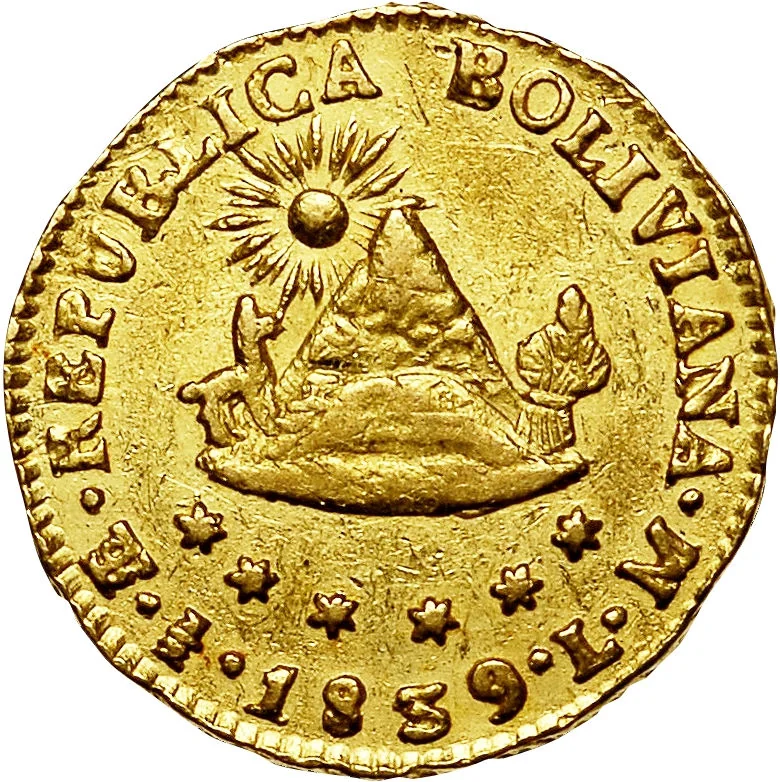
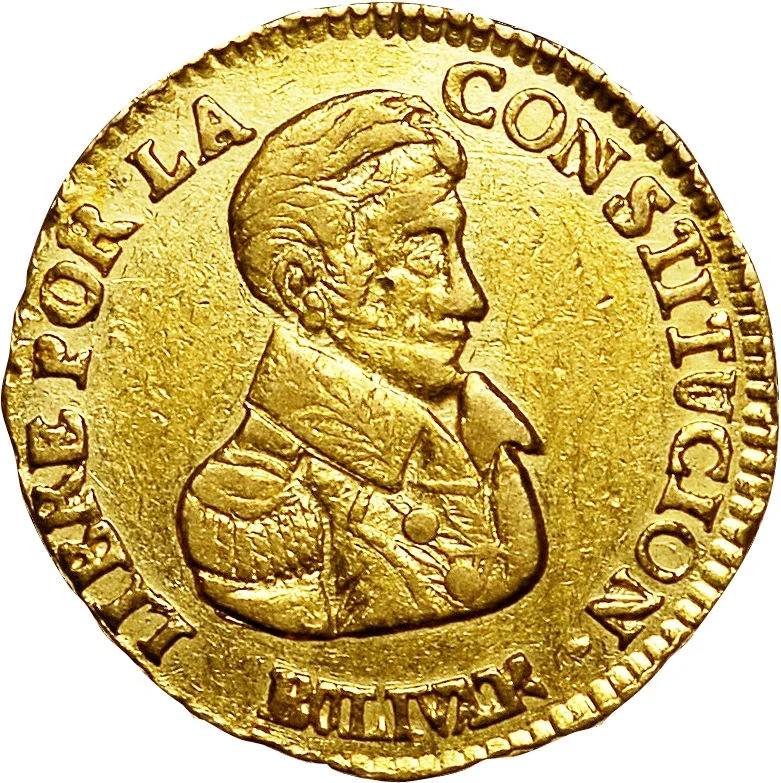
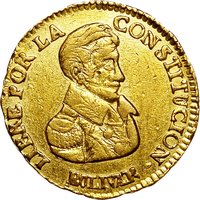
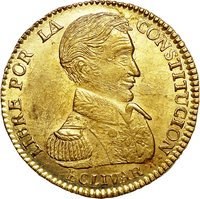
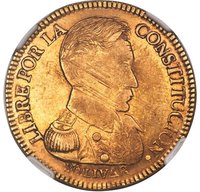
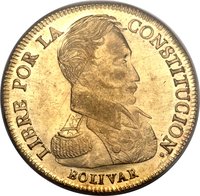
Obverse
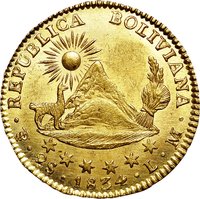
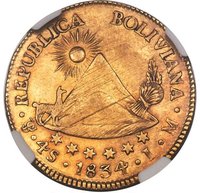
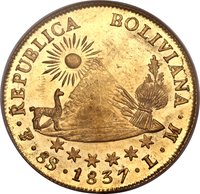
Reverse
Edge
Categories
| Animal> Camel |
| Person> Military leader |
| Person> Politician |
| Geography> Mountain |
| Symbol> Sun |
Mints
| Name | Mark |
|---|---|
| Potosi | — |
Mintings
| Year | Mint Mark | Mintage | Quality | Collection |
|---|---|---|---|---|
| 1834 | LM | — | ||
| 1838 | LM | — | ||
| 1839 | LM | — | ||
| 1840 | LR | — |
Historical background
In 1834, Bolivia's currency situation was characterized by profound instability and scarcity, a direct legacy of the destructive Wars of Independence (1809-1825) and the subsequent early years of the republic. The national treasury was virtually empty, and the mining sector, the traditional source of Bolivia's wealth in silver, was severely depressed. While the Spanish colonial "real" and pesos remained in circulation, the actual money supply was insufficient for the needs of the economy, leading to widespread use of foreign coins, particularly Peruvian and Argentine silver, and even crude silver ingots or pastillas in internal trade.
This monetary chaos was exacerbated by the government of President Andrés de Santa Cruz, who, despite his generally effective administrative reforms, struggled to establish a unified national currency. His ambitious project to create a stable coinage at the Potosí mint was underway, but in 1834, the system was still in transition. The first Bolivian coins, bearing the republic's coat of arms, had been minted in the late 1820s, but they competed with a heterogeneous mix of older and foreign coins of varying purity and value, causing confusion and hindering commerce.
Consequently, the monetary landscape in 1834 was one of ad-hoc adaptation and regional variation. The lack of a strong, universally accepted currency reflected the broader challenges of state-building in post-colonial Bolivia. It underscored the difficult task of transitioning from a colonial extractive economy to a functioning national one, where economic sovereignty and a reliable medium of exchange were prerequisites for stability and growth that were yet to be fully realized.
This monetary chaos was exacerbated by the government of President Andrés de Santa Cruz, who, despite his generally effective administrative reforms, struggled to establish a unified national currency. His ambitious project to create a stable coinage at the Potosí mint was underway, but in 1834, the system was still in transition. The first Bolivian coins, bearing the republic's coat of arms, had been minted in the late 1820s, but they competed with a heterogeneous mix of older and foreign coins of varying purity and value, causing confusion and hindering commerce.
Consequently, the monetary landscape in 1834 was one of ad-hoc adaptation and regional variation. The lack of a strong, universally accepted currency reflected the broader challenges of state-building in post-colonial Bolivia. It underscored the difficult task of transitioning from a colonial extractive economy to a functioning national one, where economic sovereignty and a reliable medium of exchange were prerequisites for stability and growth that were yet to be fully realized.
✨ Legendary