

50 haléřů – Bohemia and Moravia
Add to wishlist
Czechia
Context
Years: 1940–1944
Country: Czechia
Issuer: Bohemia and Moravia
Period:
(1939—1945)
Currency:
(1939—1945)
Demonetization: 29 February 1948
Total mintage: 53,270,000
Material
References
KM: #
Numista: #6091
Obverse
Description:
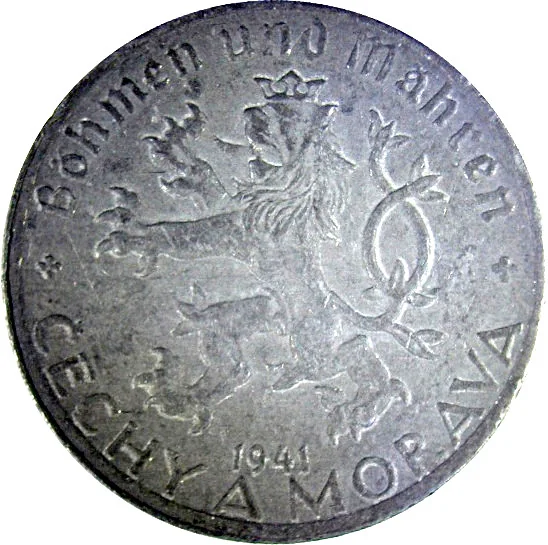
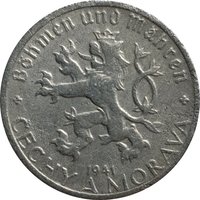
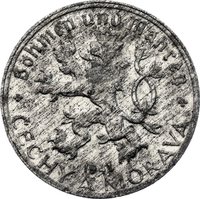
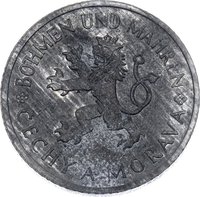
A crowned left-rampant lion (Czech coat of arms) over the issue year. Semicircular inscriptions: German "BÖHMEN UND MÄHREN" above, Czech "ČECHY A MORAVA" below.
Inscription:
Böhmen und Mähren
ČECHY A MORAVA
1940
ČECHY A MORAVA
1940
Translation:
Bohemia and Moravia
Bohemia and Moravia
1940
Bohemia and Moravia
1940
Scripts: Latin, Latin (Fraktur blackletter)
Engraver: Jaroslav Eder
Reverse
Description:
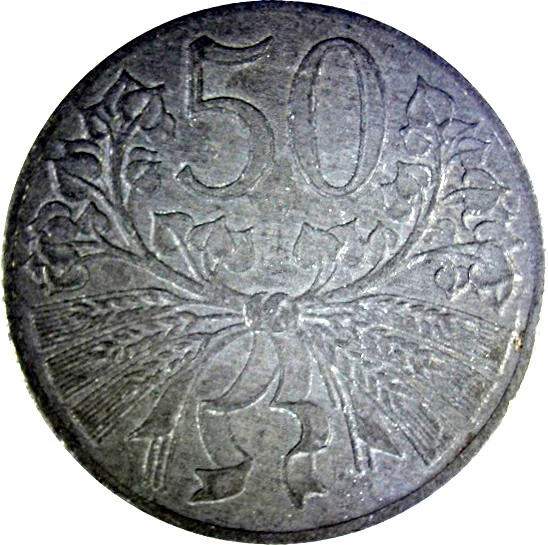
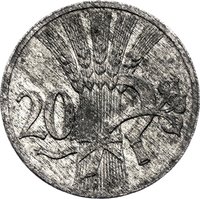
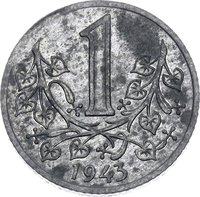
Linden branches over wheat.
Inscription:
50
Translation:
Of the Emperor Caesar Marcus Aurelius Commodus Antoninus Augustus, Conqueror of the Germans, Conqueror of the Britons, Pius, Felix.
Script: Latin
Language: Latin
Engraver: Otakar Španiel
Edge
Reeded
Mints
| Name | Mark |
|---|---|
| Vichr a spol. | — |
Mintings
| Year | Mint Mark | Mintage | Quality | Collection |
|---|---|---|---|---|
| 1940 | — | 53,270,000 | ||
| 1941 | — | — | ||
| 1942 | — | — | ||
| 1943 | — | — | ||
| 1944 | — | — |
Historical background
By 1940, the currency situation in the Protectorate of Bohemia and Moravia was a complex system of controlled coexistence, designed to facilitate Nazi economic exploitation. Following the German occupation in March 1939, the Czechoslovak koruna (Kč) remained the official legal tender, but it was artificially pegged to the German Reichsmark (RM) at a highly advantageous rate for the occupiers: 1 RM = 10 Kč. This overvalued the Reichsmark, making Czech goods, raw materials, and industrial output cheap for Germany and enabling systematic plunder of the Protectorate's economy to fuel the German war effort.
Alongside the koruna, the Reichsmark was introduced as a second, parallel currency. Its use was mandated for transactions with German state authorities, arms purchases, and for the growing number of German personnel and institutions within the Protectorate. This created a two-tier monetary system where the Reichsmark, backed by political power, was the preferred and stronger currency. The Czech National Bank in Prague lost its autonomy, coming under the direct control of the Reichsbank, which dictated monetary policy, managed foreign exchange, and ensured the Protectorate’s financial resources were directed toward Berlin.
The primary goal of this arrangement was to tightly integrate the Protectorate’s economy into Greater Germany’s war economy while preventing inflation in the Reich itself. Prices and wages were frozen, and strict currency regulations prevented capital flight. While ensuring relative day-to-day stability for the Czech population, the system was fundamentally extractive, draining wealth and resources. The koruna’s continued circulation masked the underlying economic subjugation, as the occupied territories were forced to bear a heavy financial burden through occupation costs and clearing debts that would never be repaid.
Alongside the koruna, the Reichsmark was introduced as a second, parallel currency. Its use was mandated for transactions with German state authorities, arms purchases, and for the growing number of German personnel and institutions within the Protectorate. This created a two-tier monetary system where the Reichsmark, backed by political power, was the preferred and stronger currency. The Czech National Bank in Prague lost its autonomy, coming under the direct control of the Reichsbank, which dictated monetary policy, managed foreign exchange, and ensured the Protectorate’s financial resources were directed toward Berlin.
The primary goal of this arrangement was to tightly integrate the Protectorate’s economy into Greater Germany’s war economy while preventing inflation in the Reich itself. Prices and wages were frozen, and strict currency regulations prevented capital flight. While ensuring relative day-to-day stability for the Czech population, the system was fundamentally extractive, draining wealth and resources. The koruna’s continued circulation masked the underlying economic subjugation, as the occupied territories were forced to bear a heavy financial burden through occupation costs and clearing debts that would never be repaid.
🌱 Very Common