

1 koruna – Bohemia and Moravia
Add to wishlist
Czechia
Context
Years: 1941–1944
Country: Czechia
Issuer: Bohemia and Moravia
Period:
(1939—1945)
Currency:
(1939—1945)
Demonetization: 31 December 1951
Total mintage: 102,817,000
Material
References
KM: #
Numista: #3063
Obverse
Description:
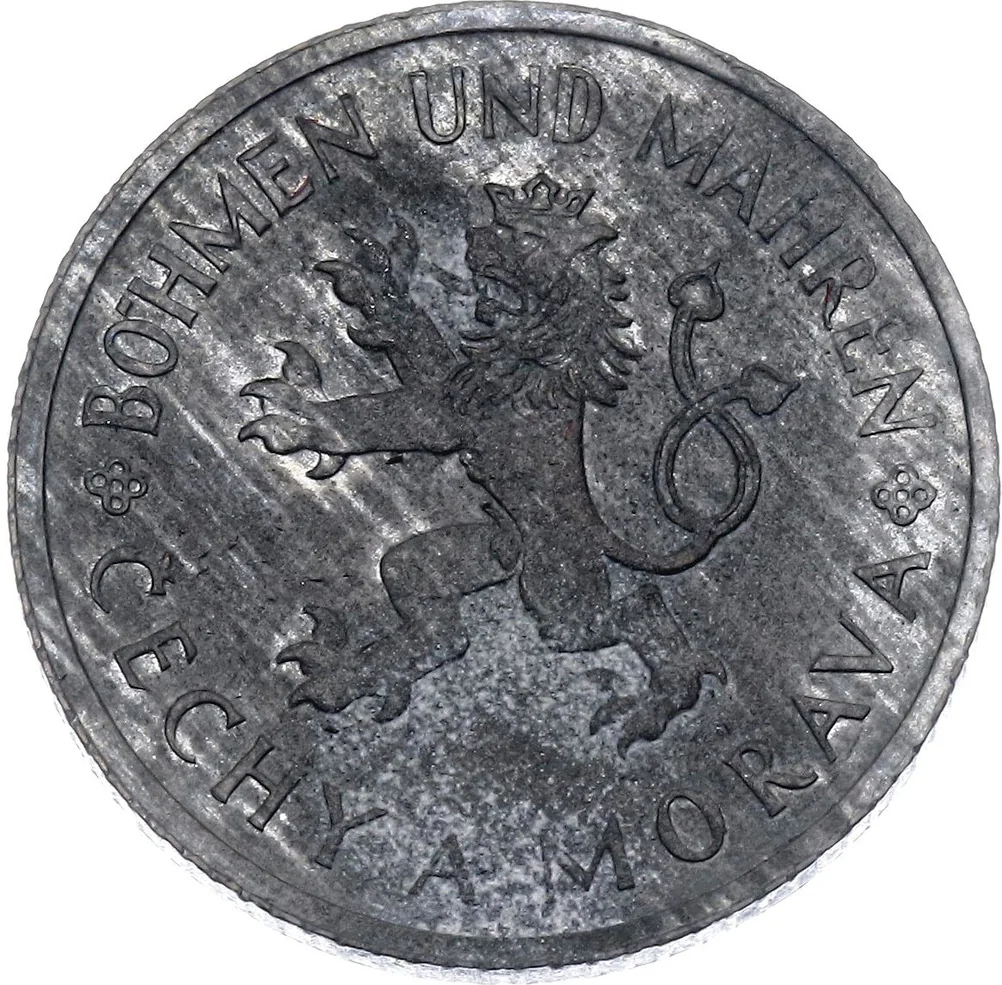
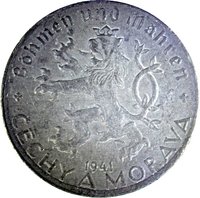
Center: Coat of arms of the Protectorate of Bohemia and Moravia (a crowned left-rampant lion). Semicircular inscriptions: German "BÖHMEN UND MÄHREN" above, Czech "ČECHY A MORAVA" below.
Inscription:
BÖHMEN UND MÄHREN
ČECHY A MORAVA
ČECHY A MORAVA
Translation:
Bohemia and Moravia
Bohemia and Moravia
Bohemia and Moravia
Scripts: Latin, Latin (Fraktur blackletter)
Engraver: Jaroslav Eder
Reverse
Description:
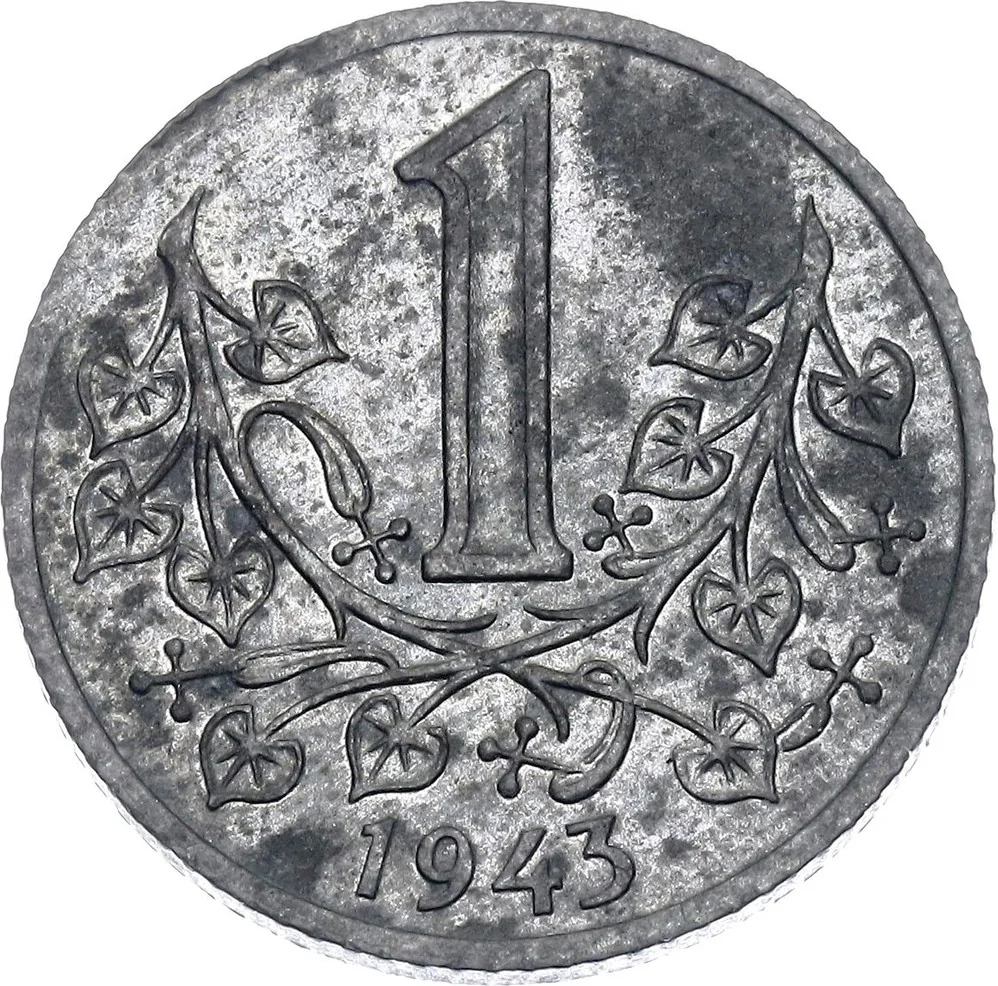
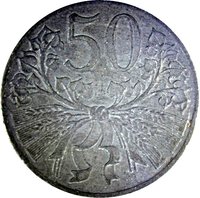
Linden branches flank value, date beneath.
Inscription:
1
1944
1944
Script: Latin
Engraver: Otakar Španiel
Edge
Reeded
Mints
| Name | Mark |
|---|---|
| Vichr a spol. | — |
Mintings
| Year | Mint Mark | Mintage | Quality | Collection |
|---|---|---|---|---|
| 1941 | — | 102,817,000 | ||
| 1942 | — | — | ||
| 1943 | — | — | ||
| 1944 | — | — |
Historical background
By 1941, the currency situation in the Nazi-occupied Protectorate of Bohemia and Moravia was a tightly controlled mechanism designed to facilitate economic exploitation for the German war effort. Following the dismemberment of Czechoslovakia in 1939, the Protectorate retained the Czechoslovak koruna (Kč) as its official currency, but it was artificially pegged at a fixed and highly disadvantageous exchange rate to the German Reichsmark (RM). This rate, set at 10 Kč to 1 RM, significantly overvalued the Reichsmark, creating a legalized system of financial plunder that allowed German authorities and businesses to cheaply purchase Czech goods, services, and industrial output.
The monetary system operated under the strict supervision of the Prague-based Emissionsbank in Böhmen und Mähren (Issue Bank in Bohemia and Moravia), which replaced the former National Bank of Czechoslovakia. This institution, controlled by Berlin, functioned primarily to print currency to cover the costs of the occupation and to extend massive "clearing credits" to Germany. In practice, this meant the Protectorate was forced to finance its own subjugation, as the occupying authorities ran enormous deficits paid for by newly printed koruna, leading to growing inflationary pressures that were suppressed by strict price controls and rationing.
Furthermore, a dual-currency environment existed. While the koruna was used for daily transactions within the Protectorate, the Reichsmark circulated in parallel, especially within German military and administrative circles and in border areas earmarked for Germanization. This arrangement underscored the region's intended economic integration into Greater Germany. The entire financial structure served to systematically drain the Protectorate's resources, redirecting its formidable industrial production to the Nazi war machine while carefully managing the money supply to prevent economic collapse that could disrupt this vital supply zone.
The monetary system operated under the strict supervision of the Prague-based Emissionsbank in Böhmen und Mähren (Issue Bank in Bohemia and Moravia), which replaced the former National Bank of Czechoslovakia. This institution, controlled by Berlin, functioned primarily to print currency to cover the costs of the occupation and to extend massive "clearing credits" to Germany. In practice, this meant the Protectorate was forced to finance its own subjugation, as the occupying authorities ran enormous deficits paid for by newly printed koruna, leading to growing inflationary pressures that were suppressed by strict price controls and rationing.
Furthermore, a dual-currency environment existed. While the koruna was used for daily transactions within the Protectorate, the Reichsmark circulated in parallel, especially within German military and administrative circles and in border areas earmarked for Germanization. This arrangement underscored the region's intended economic integration into Greater Germany. The entire financial structure served to systematically drain the Protectorate's resources, redirecting its formidable industrial production to the Nazi war machine while carefully managing the money supply to prevent economic collapse that could disrupt this vital supply zone.
🌱 Very Common