

Obverse
Description:
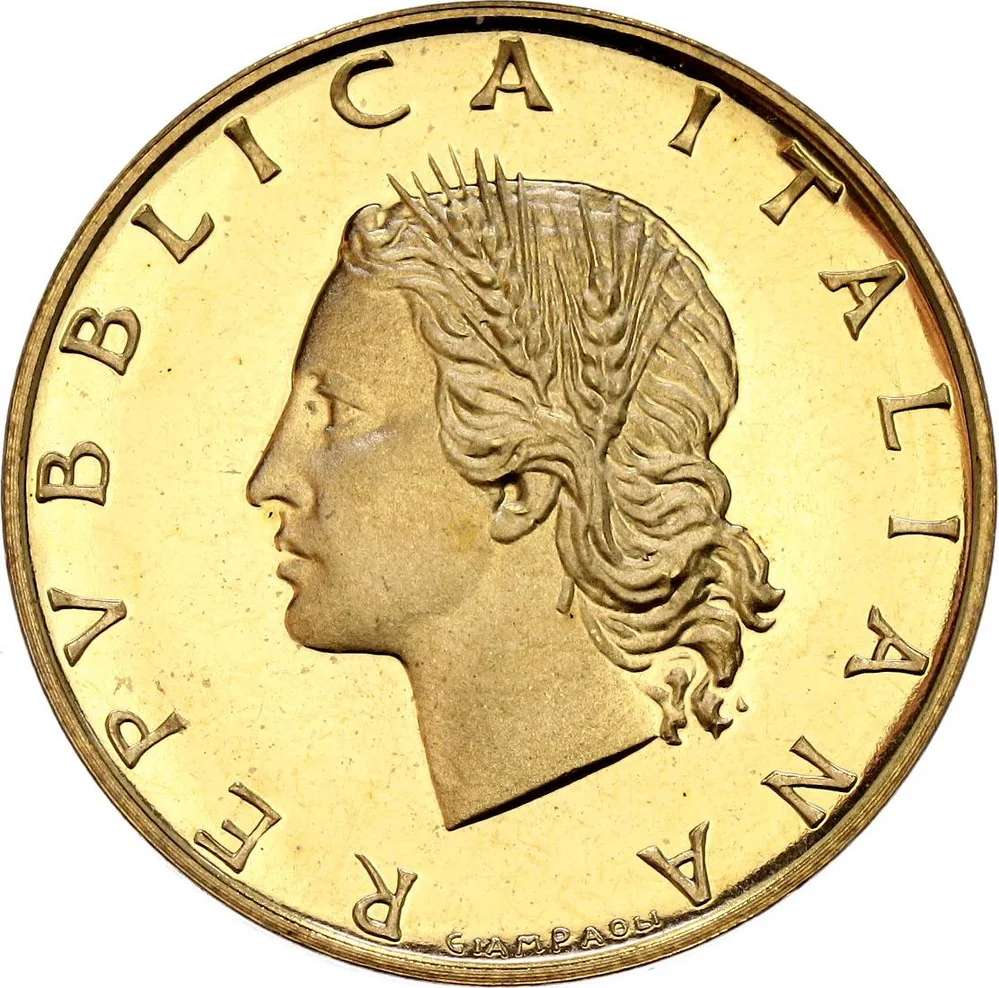
Woman facing left, wheat in curly hair. Designer below.
Inscription:
REPVBBLICA ITALIANA
GIAMPAOLI
GIAMPAOLI
Translation:
Italian Republic
Giampaoli
Giampaoli
Script: Latin
Engraver: Pietro Giampaoli
Reverse
Description:
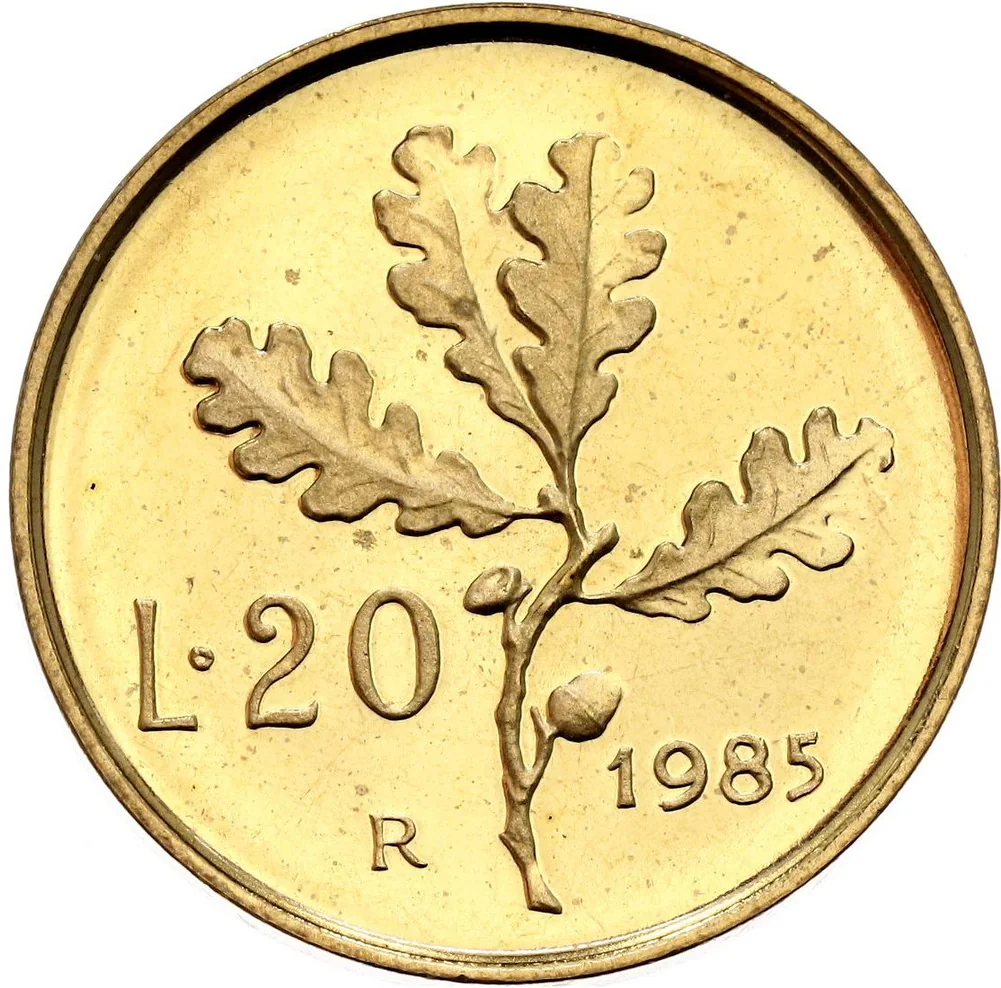
Oak branch center, denomination left, date right, mintmark below.
Inscription:
L.20
R 1971
R 1971
Translation:
Lire 20
Rome 1971
Rome 1971
Script: Latin
Engraver: Pietro Giampaoli
Edge
Reeded (1957-1959)Smooth (1968-2001)
Mints
| Name | Mark |
|---|---|
| Rome | R |
Mintings
| Year | Mint Mark | Mintage | Quality | Collection |
|---|---|---|---|---|
| 1957 | R | 60,075,000 | ||
| 1958 | R | 80,550,000 | ||
| 1959 | R | 4,005,000 | ||
| 1968 | R | 100,000 | BU | |
| 1969 | R | 16,735,000 | ||
| 1969 | R | 310,000 | BU | |
| 1970 | R | 32,511,000 | ||
| 1971 | R | 12,375,000 | ||
| 1972 | R | 34,400,000 | ||
| 1973 | R | 20,000,000 | ||
| 1974 | R | 17,000,000 | ||
| 1975 | R | 24,750,000 | ||
| 1976 | R | 17,325,000 | ||
| 1977 | R | 9,900,000 | ||
| 1978 | R | 13,521,000 | ||
| 1979 | R | 32,000,000 | ||
| 1980 | R | 61,795,000 | ||
| 1981 | R | 81,500,000 | ||
| 1982 | R | 34,500,000 | ||
| 1983 | R | 15,110,000 | ||
| 1984 | R | 5,122,000 | ||
| 1985 | R | 15,000,000 | ||
| 1985 | R | 20,345 | Proof | |
| 1986 | R | 17,500 | Proof | |
| 1986 | R | 13,000,000 | ||
| 1987 | R | 2,766,000 | ||
| 1987 | R | 10,000 | Proof | |
| 1988 | R | 13,000,000 | ||
| 1988 | R | 9,000 | Proof | |
| 1989 | R | 9,260 | Proof | |
| 1989 | R | 16,000,000 | ||
| 1990 | R | 15,500,000 | ||
| 1990 | R | 9,400 | Proof | |
| 1991 | R | 13,000,000 | ||
| 1991 | R | 11,000 | Proof | |
| 1992 | R | 2,500,000 | ||
| 1992 | R | 9,500 | Proof | |
| 1993 | R | 1,000,000 | ||
| 1993 | R | 8,500 | Proof | |
| 1994 | R | 1,000,000 | ||
| 1994 | R | 8,500 | Proof | |
| 1995 | R | 7,960 | Proof | |
| 1995 | R | 1,000,000 | ||
| 1996 | R | 1,000,000 | ||
| 1996 | R | 8,000 | Proof | |
| 1997 | R | 1,000,000 | ||
| 1997 | R | 8,440 | Proof | |
| 1998 | R | 1,000,000 | ||
| 1998 | R | 9,000 | Proof | |
| 1999 | R | 8,500 | Proof | |
| 1999 | R | 500,000 | ||
| 2000 | R | 61,400 | BU | |
| 2000 | R | 8,960 | Proof | |
| 2001 | R | 100,000 | BU | |
| 2001 | R | 10,000 | Proof |
Historical background
In 1957, Italy's currency situation was fundamentally shaped by its participation in the European Payments Union (EPU) and its ongoing "economic miracle" (il miracolo economico). The national currency, the Italian Lira (ITL), was operating under a fixed but adjustable exchange rate system established by the Bretton Woods Agreement, pegged to the US Dollar. Domestically, the Bank of Italy, under Governor Guido Carli (appointed in 1960, but part of the technocratic circle), maintained a policy of monetary stability, but the lira faced persistent underlying pressures. These included a structural trade deficit and higher inflation than key trading partners like Germany, leading to frequent speculation about a potential devaluation.
The year was particularly significant as Italy became a founding member of the European Economic Community (EEC) with the signing of the Treaty of Rome on March 25, 1957. This commitment to European integration introduced a new long-term framework for monetary policy, implicitly aligning Italy's currency future with its new partners. While the immediate exchange rate regime remained under Bretton Woods, the treaty laid the groundwork for future cooperation and stability, aiming to reduce the economic imbalances that plagued the lira. Italy's entry into the EEC also boosted confidence and attracted investment, indirectly supporting the currency.
Despite the booming industrial economy, the lira's stability in 1957 was somewhat artificial, propped up by capital controls and EPU mechanisms that facilitated multilateral settlement of trade balances. The country's rapid growth was fueled by cheap labor and export-led expansion, but this model created internal tensions, including a growing north-south divide and public spending pressures. Consequently, while the lira held its official parity, experts recognized its overvaluation. This precarious balance would eventually force a difficult adjustment, culminating in a major devaluation of the lira in the early 1960s to restore Italy's international competitiveness.
The year was particularly significant as Italy became a founding member of the European Economic Community (EEC) with the signing of the Treaty of Rome on March 25, 1957. This commitment to European integration introduced a new long-term framework for monetary policy, implicitly aligning Italy's currency future with its new partners. While the immediate exchange rate regime remained under Bretton Woods, the treaty laid the groundwork for future cooperation and stability, aiming to reduce the economic imbalances that plagued the lira. Italy's entry into the EEC also boosted confidence and attracted investment, indirectly supporting the currency.
Despite the booming industrial economy, the lira's stability in 1957 was somewhat artificial, propped up by capital controls and EPU mechanisms that facilitated multilateral settlement of trade balances. The country's rapid growth was fueled by cheap labor and export-led expansion, but this model created internal tensions, including a growing north-south divide and public spending pressures. Consequently, while the lira held its official parity, experts recognized its overvaluation. This precarious balance would eventually force a difficult adjustment, culminating in a major devaluation of the lira in the early 1960s to restore Italy's international competitiveness.
🌱 Very Common