

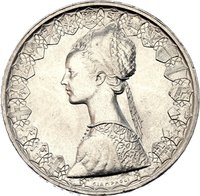
Obverse
Description:
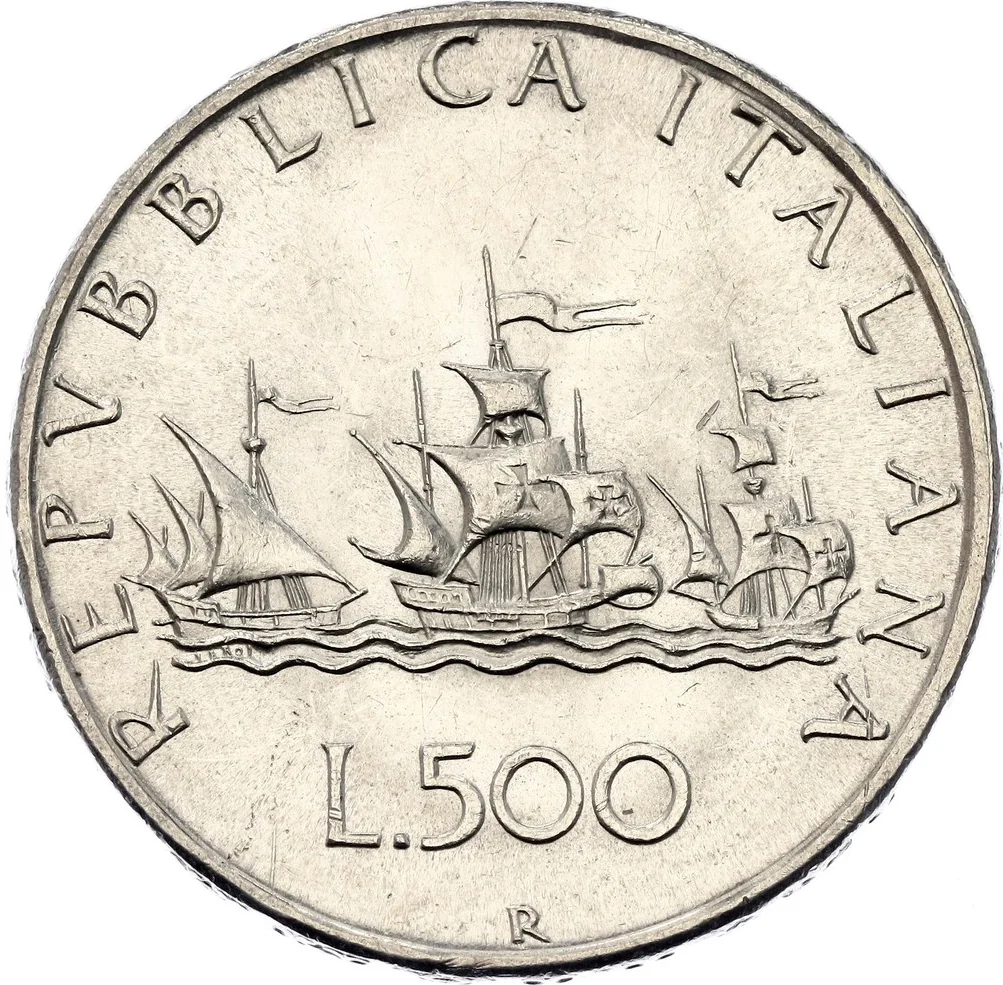
Columbus's ships sailing right. Below value, mint mark, and author (within waves).
Inscription:
REPVBBLICA ITALIANA
VEROI
L. 500
R
VEROI
L. 500
R
Script: Latin
Engraver: Guido Veroi
Reverse
Description:
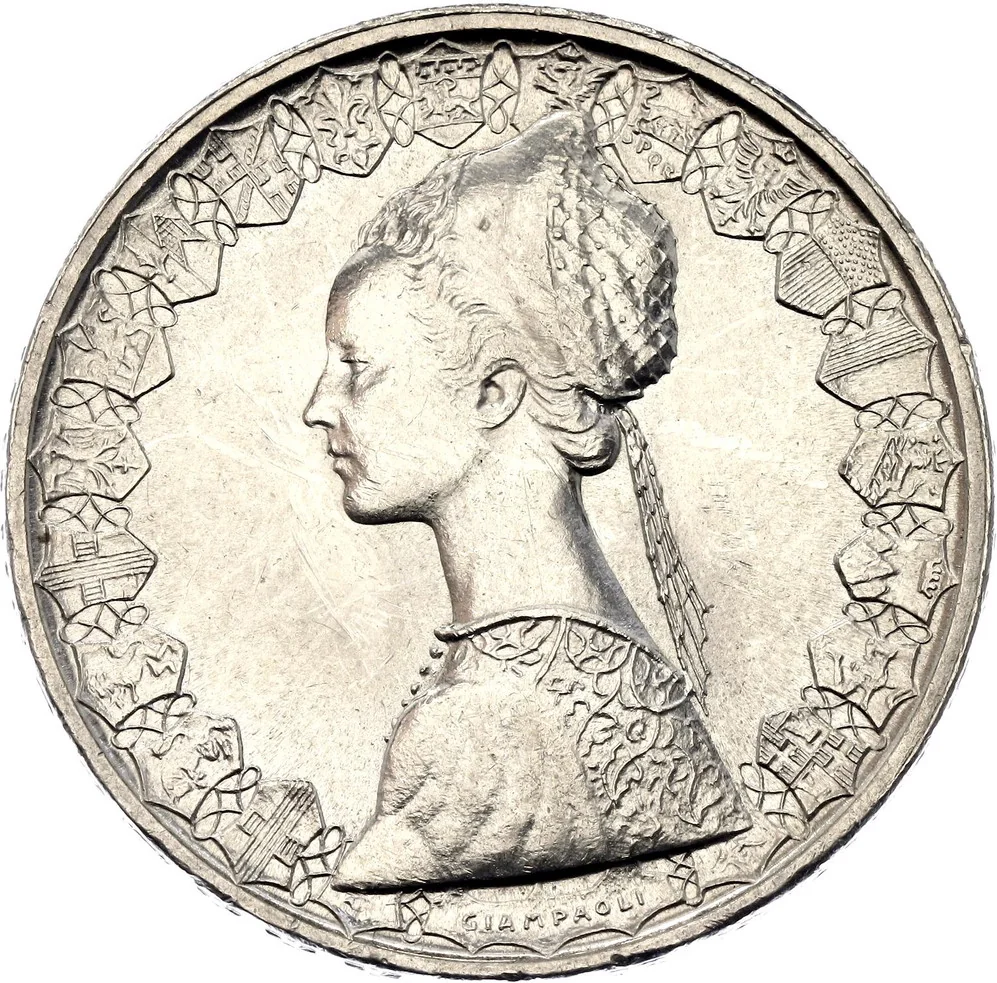
Renaissance-style bust of a woman, representing Italy, encircled by 19 shields of Italian cities (Genova to Cagliari, the last two hidden). It emulates Pisanello's Medaglia di Cecilia, replicating the hair net and similar dress. Engraver's name below.
Inscription:
GIAMPAOLI
Script: Latin
Engraver: Pietro Giampaoli
Edge
Raised lettering with the date within six stars (three for each sides)
Legend:
REPVBBLICA ITALIANA ***1960***
Categories
| Symbols> Coat of Arms |
| Transportation> Watercraft |
Mints
| Name | Mark |
|---|---|
| Rome | R |
Mintings
| Year | Mint Mark | Mintage | Quality | Collection |
|---|---|---|---|---|
| 1958 | R | 24,240,000 | ||
| 1959 | R | 19,360,000 | ||
| 1960 | R | 24,080,000 | ||
| 1961 | R | 6,560,000 | ||
| 1964 | R | 4,880,000 | ||
| 1965 | R | 3,120,000 | ||
| 1966 | R | 13,120,000 | ||
| 1967 | R | 2,480,000 | ||
| 1968 | R | 100,000 | BU | |
| 1969 | R | 310,000 | BU | |
| 1970 | R | 1,140,000 | BU | |
| 1980 | R | 257,270 | BU | |
| 1981 | R | 162,794 | BU | |
| 1982 | R | 119,950 | BU | |
| 1983 | R | 76,552 | BU | |
| 1984 | R | 77,041 | BU | |
| 1985 | R | 15,385 | Proof | |
| 1985 | R | 93,218 | BU | |
| 1986 | R | 73,200 | BU | |
| 1986 | R | 17,500 | Proof | |
| 1987 | R | 57,500 | BU | |
| 1987 | R | 10,000 | Proof | |
| 1988 | R | 51,050 | BU | |
| 1988 | R | 9,000 | Proof | |
| 1989 | R | 9,260 | Proof | |
| 1989 | R | 51,200 | BU | |
| 1990 | R | 52,300 | BU | |
| 1990 | R | 9,400 | Proof | |
| 1991 | R | 11,000 | Proof | |
| 1991 | R | 54,000 | BU | |
| 1992 | R | 52,000 | BU | |
| 1992 | R | 9,500 | Proof | |
| 1993 | R | 50,200 | BU | |
| 1993 | R | 8,500 | Proof | |
| 1994 | R | 44,500 | BU | |
| 1994 | R | 8,500 | Proof | |
| 1995 | R | 44,558 | BU | |
| 1995 | R | 7,960 | Proof | |
| 1996 | R | 8,000 | Proof | |
| 1996 | R | 45,000 | BU | |
| 1997 | R | 8,440 | Proof | |
| 1997 | R | 43,600 | BU | |
| 1998 | R | 55,200 | BU | |
| 1998 | R | 9,000 | Proof | |
| 1999 | R | 51,800 | BU | |
| 1999 | R | 8,500 | Proof | |
| 2000 | R | 61,400 | BU | |
| 2000 | R | 8,960 | Proof | |
| 2001 | R | 10,000 | Proof | |
| 2001 | R | 100,000 | BU |
Historical background
In 1958, Italy's currency situation was fundamentally defined by its participation in the European Payments Union (EPU) and the Bretton Woods system, operating under a fixed exchange rate for the Italian Lira. The country had emerged from the post-war period with strict capital controls and a managed currency, a legacy of the "Economic Miracle" (il miracolo economico) that was fueling rapid industrial growth. The Lira's external value was pegged to the U.S. Dollar at a rate of 625 Lire per Dollar, a parity established in 1949 and maintained through the Bank of Italy's interventions and a complex system of import-export regulations to protect the country's growing but still vulnerable reserves.
Domestically, the economic boom was creating new pressures. Strong industrial output and rising exports, particularly in manufacturing, were generating a balance of payments surplus. However, this growth also stoked inflationary tendencies, as domestic demand increased and wage pressures mounted. The government and the Bank of Italy, under Governor Guido Carli (who took office in 1960), therefore walked a tightrope: fostering the export-led expansion while cautiously managing internal inflation to prevent it from undermining the Lira's fixed parity and competitiveness.
Looking ahead, 1958 was a year of stability but also a precursor to change. Italy's robust economic performance and solidifying reserves within the EPU framework built confidence in the Lira and set the stage for the broader European currency cooperation that would follow. This period of stability was crucial, as it preceded the major steps toward European economic integration, including the creation of the European Monetary Agreement in 1958 (succeeding the EPU) and, ultimately, Italy's role as a founding member of the European Economic Community under the 1957 Treaty of Rome, which began to shape a new financial landscape.
Domestically, the economic boom was creating new pressures. Strong industrial output and rising exports, particularly in manufacturing, were generating a balance of payments surplus. However, this growth also stoked inflationary tendencies, as domestic demand increased and wage pressures mounted. The government and the Bank of Italy, under Governor Guido Carli (who took office in 1960), therefore walked a tightrope: fostering the export-led expansion while cautiously managing internal inflation to prevent it from undermining the Lira's fixed parity and competitiveness.
Looking ahead, 1958 was a year of stability but also a precursor to change. Italy's robust economic performance and solidifying reserves within the EPU framework built confidence in the Lira and set the stage for the broader European currency cooperation that would follow. This period of stability was crucial, as it preceded the major steps toward European economic integration, including the creation of the European Monetary Agreement in 1958 (succeeding the EPU) and, ultimately, Italy's role as a founding member of the European Economic Community under the 1957 Treaty of Rome, which began to shape a new financial landscape.
🌱 Very Common