

10 centesimi – San Marino
Add to wishlist
San Marino
Context
Years: 1875–1894
Issuer: San Marino
Period:
(since 301)
Currency:
(1864—2001)
Demonetized: Yes
Total mintage: 450,000
Material
References
KM: #
Numista: #6087
Value
Exchange value: 0.10 SML
Obverse
Description:
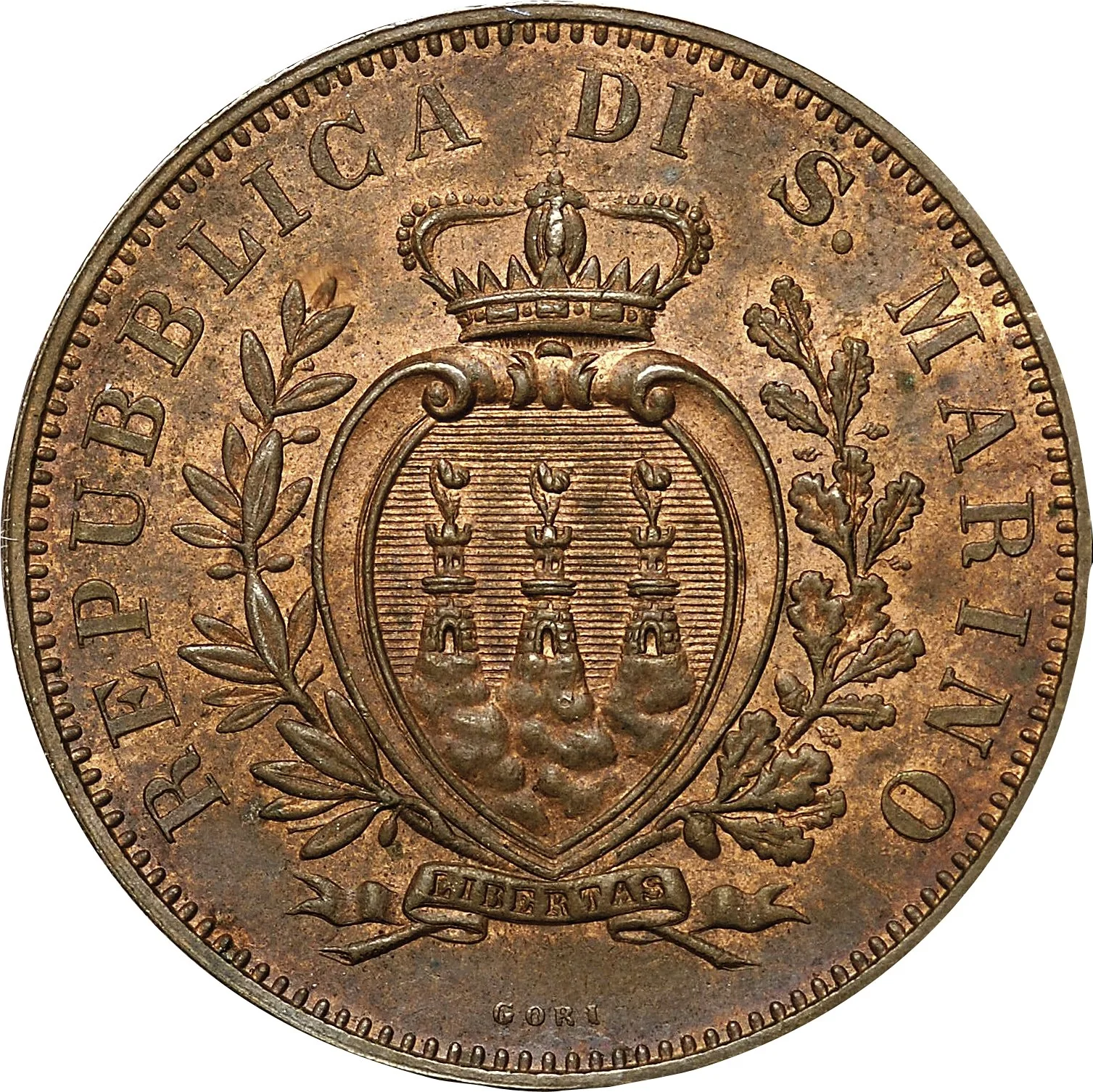
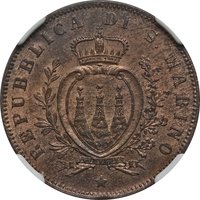
Coat of arms of San Marino featuring its three towers, framed by olive and oak branches. A crown tops the shield, symbolizing sovereignty, while a cartouche below bears "LIBERTAS" and the author's name, GORI. The design is encircled by "REPUBBLICA DI S. MARINO."
Inscription:
REPUBBLICA DI S. MARINO
LIBERTAS
GORI
LIBERTAS
GORI
Translation:
Liberty
Republic of San Marino
Republic of San Marino
Script: Latin
Engraver: Luigi Gori
Reverse
Edge
Plain
Historical background
In 1875, San Marino's currency situation was intrinsically tied to its complex relationship with the surrounding Kingdom of Italy. Having previously used the Papal States' scudo, the Sammarinese government formally adopted the Italian Lira as its official currency in 1862, following Italian unification. This decision was a pragmatic necessity for economic survival, ensuring seamless trade and financial stability with its vastly larger neighbor, which completely enveloped its territory. However, this adoption was governed by a series of bilateral conventions that recognized San Marino's sovereignty while binding its monetary system to Italy's.
Despite using Italian coinage, San Marino possessed the limited right to issue its own small-denomination coinage for internal circulation. These distinctive Sammarinese coins, minted in limited quantities, were legal tender within the republic and had a fixed parity (1:1) with the Italian lira. The 1870s saw the issuance of such coins, primarily copper centesimi and silver 5 lire pieces, which bore Sammarinese symbols and served as important markers of national identity. Their circulation was largely local, as Italian currency remained dominant for all major transactions.
The period around 1875 was one of relative monetary stability for San Marino, but this stability was entirely dependent on Italy's economic policies. The republic had no central bank and could not control monetary policy, interest rates, or the money supply. Its financial system was effectively an extension of Italy's, leaving it vulnerable to any inflationary or deflationary trends across the border. Thus, while the currency situation was orderly on the surface, it underscored a deeper reality of constrained economic sovereignty, with San Marino navigating its autonomy within the strict confines of its monetary union with Italy.
Despite using Italian coinage, San Marino possessed the limited right to issue its own small-denomination coinage for internal circulation. These distinctive Sammarinese coins, minted in limited quantities, were legal tender within the republic and had a fixed parity (1:1) with the Italian lira. The 1870s saw the issuance of such coins, primarily copper centesimi and silver 5 lire pieces, which bore Sammarinese symbols and served as important markers of national identity. Their circulation was largely local, as Italian currency remained dominant for all major transactions.
The period around 1875 was one of relative monetary stability for San Marino, but this stability was entirely dependent on Italy's economic policies. The republic had no central bank and could not control monetary policy, interest rates, or the money supply. Its financial system was effectively an extension of Italy's, leaving it vulnerable to any inflationary or deflationary trends across the border. Thus, while the currency situation was orderly on the surface, it underscored a deeper reality of constrained economic sovereignty, with San Marino navigating its autonomy within the strict confines of its monetary union with Italy.
🌱 Common