

1 rupee – Nepal
Add to wishlist
Nepal
Context
Material
Diameter: 28.5 mm
Weight: 11.6 g
Shape: Round
Composition: Copper-nickel
Technique: Milled
Alignment: Medal alignment
flip
References
KM: #
Numista: #11128
Value
Exchange value: 1 NPR
Obverse
Description:
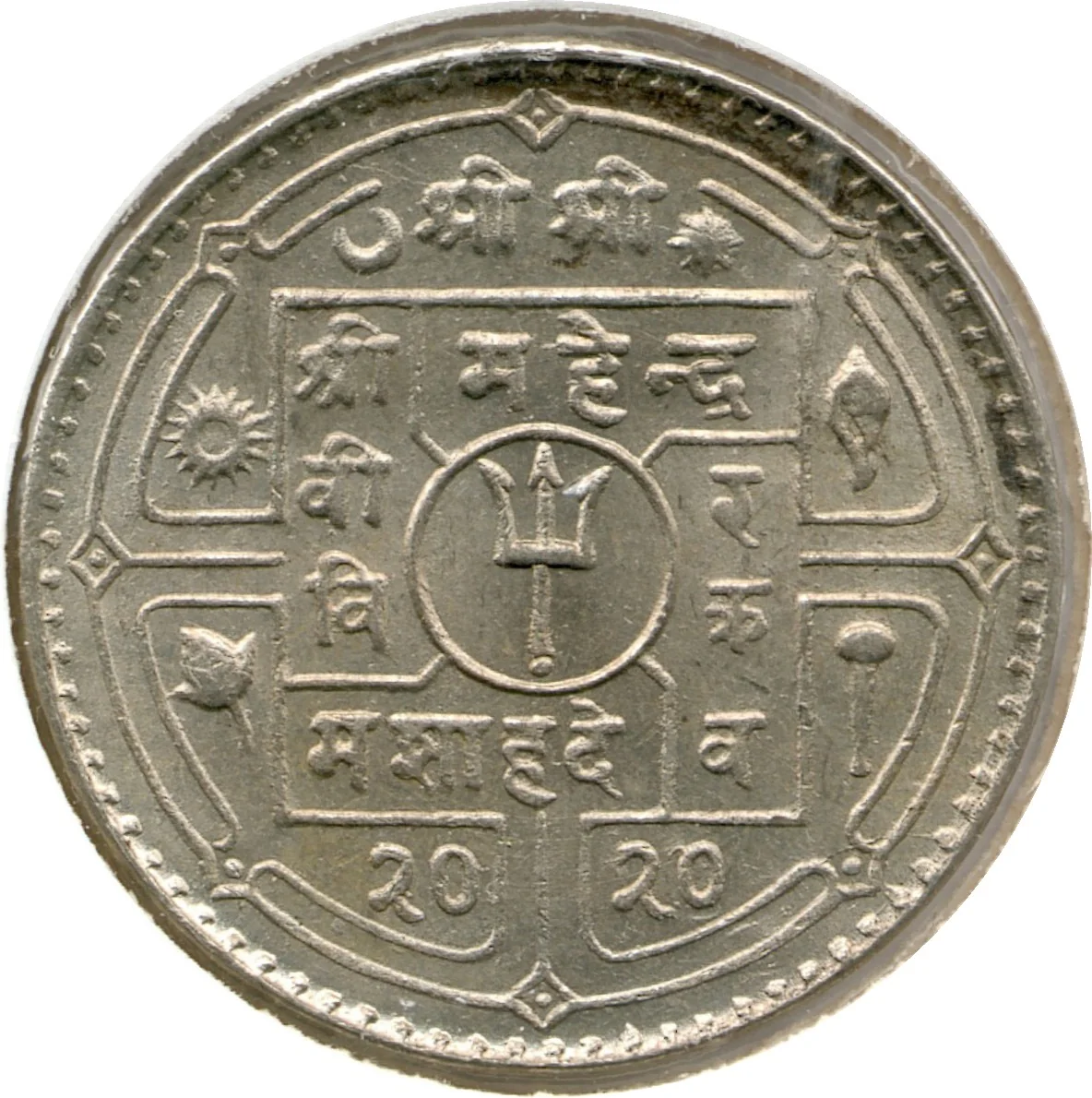
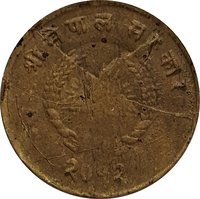
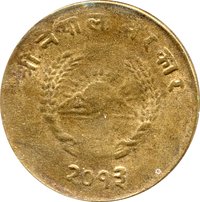
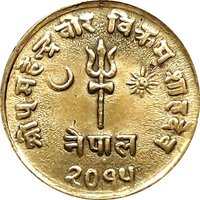
Central circle: Trident. Square interior: King Mahendra's name. Exterior: Hindu icons (clockwise from top left): Chakra, Shank, Gadha, Padma. Top: Crescent, Sri symbol, Sun. Bottom: Year.
Inscription:
श्री श्री
श्री ५महेन्द्र
वी र
वि क्र
म शाहदे व
२०२०
श्री ५महेन्द्र
वी र
वि क्र
म शाहदे व
२०२०
Translation:
Shri Shri
Shri 5 Mahendra
Veera
Vikrama
Shahadeva
2020
Shri 5 Mahendra
Veera
Vikrama
Shahadeva
2020
Reverse
Edge
Mintings
| Year | Mint Mark | Mintage | Quality | Collection |
|---|---|---|---|---|
| 1955 | — | — | ||
| 1956 | — | — | ||
| 1957 | — | — | ||
| 1958 | — | — | ||
| 1959 | — | — | ||
| 1961 | — | — | ||
| 1963 | — | — |
Historical background
In 1955, Nepal's currency situation was characterized by a complex dual-system, heavily influenced by its economic and political ties with India. Following the 1951 revolution that ended the Rana autocracy, King Mahendra ascended to the throne and the country began a cautious opening to the world beyond the Indian subcontinent. However, the Nepalese rupee (NPR) remained pegged to the Indian rupee (INR) at a 1:1 parity, a legacy of the 1924 Nepal-India Treaty. This peg facilitated open-border trade but effectively ceded monetary sovereignty to India, as Nepal's money supply and economic stability were directly dependent on India's monetary policy and trade balances.
Domestically, the currency system was in a state of transition. While the government-issued paper notes and coins were in circulation, the Indian rupee continued to be legal tender and was widely used, especially in the southern Terai region and for significant commercial transactions. Furthermore, the historical use of Mohar coins had not been fully phased out, creating a multi-currency environment. This period saw the initial efforts of the newly established Nepal Rastra Bank (founded in 1956, but planned in the mid-1950s) to formulate a unified national monetary policy and establish full control over the currency.
The year 1955 was a pivotal prelude to significant change. As Nepal established diplomatic relations with China and sought to join the United Nations, there was a growing national desire for economic independence. The limitations of the Indian peg became a point of discussion among emerging Nepalese policymakers, who recognized that true sovereignty required monetary autonomy. Therefore, the currency situation in 1955 was one of lingering colonial-era dependency, but set against a backdrop of nascent political and economic awakening that would soon lead to the creation of a central bank and the deliberate, though gradual, pursuit of an independent monetary framework.
Domestically, the currency system was in a state of transition. While the government-issued paper notes and coins were in circulation, the Indian rupee continued to be legal tender and was widely used, especially in the southern Terai region and for significant commercial transactions. Furthermore, the historical use of Mohar coins had not been fully phased out, creating a multi-currency environment. This period saw the initial efforts of the newly established Nepal Rastra Bank (founded in 1956, but planned in the mid-1950s) to formulate a unified national monetary policy and establish full control over the currency.
The year 1955 was a pivotal prelude to significant change. As Nepal established diplomatic relations with China and sought to join the United Nations, there was a growing national desire for economic independence. The limitations of the Indian peg became a point of discussion among emerging Nepalese policymakers, who recognized that true sovereignty required monetary autonomy. Therefore, the currency situation in 1955 was one of lingering colonial-era dependency, but set against a backdrop of nascent political and economic awakening that would soon lead to the creation of a central bank and the deliberate, though gradual, pursuit of an independent monetary framework.
🌟 Uncommon