

1 Paisa – Nepal
Nepal
Context
Years: 1957–1963
Issuer: Nepal 
Ruler: Mahendra Bir Bikram Shah
Currency:
(since 1932)
Demonetized: Yes
Material
References
KM: #Click to copy to clipboard746
Numista: #15223
Value
Exchange value: 0.01 NPR
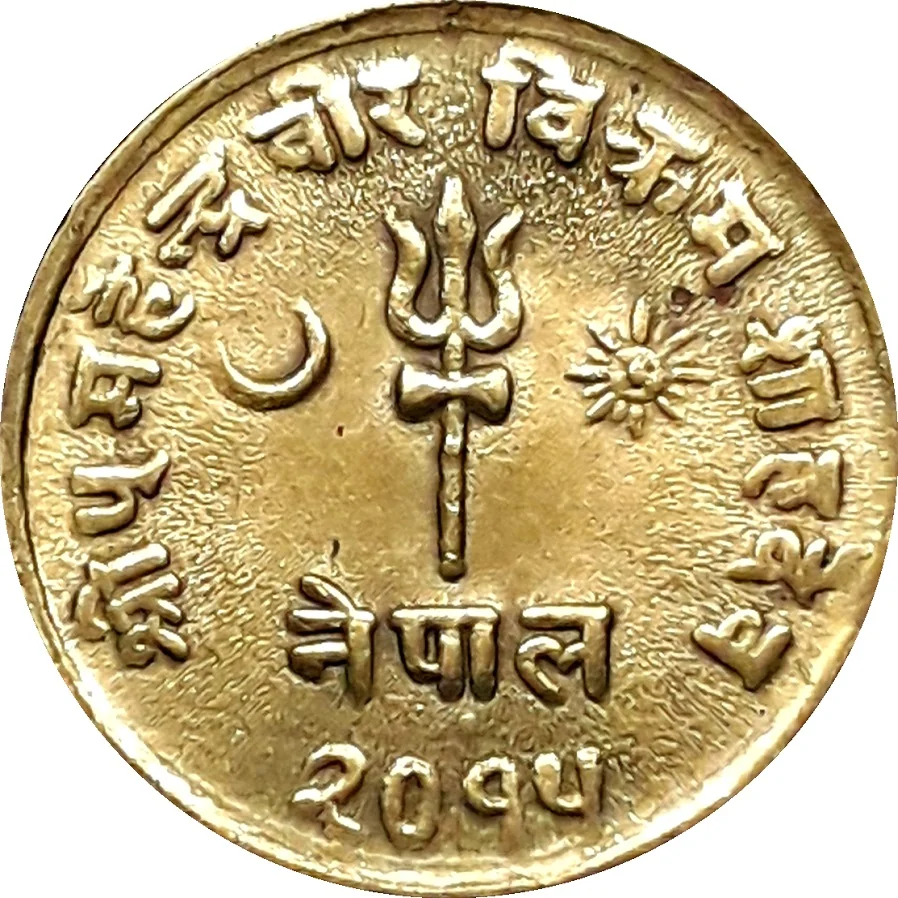
Obverse
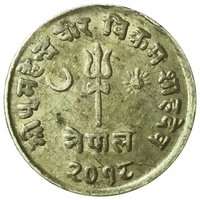
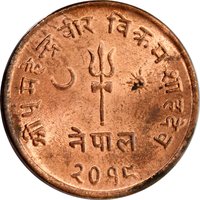
Description:
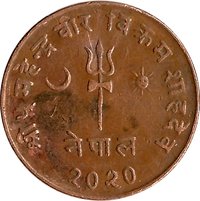
Crescent, star, trident.
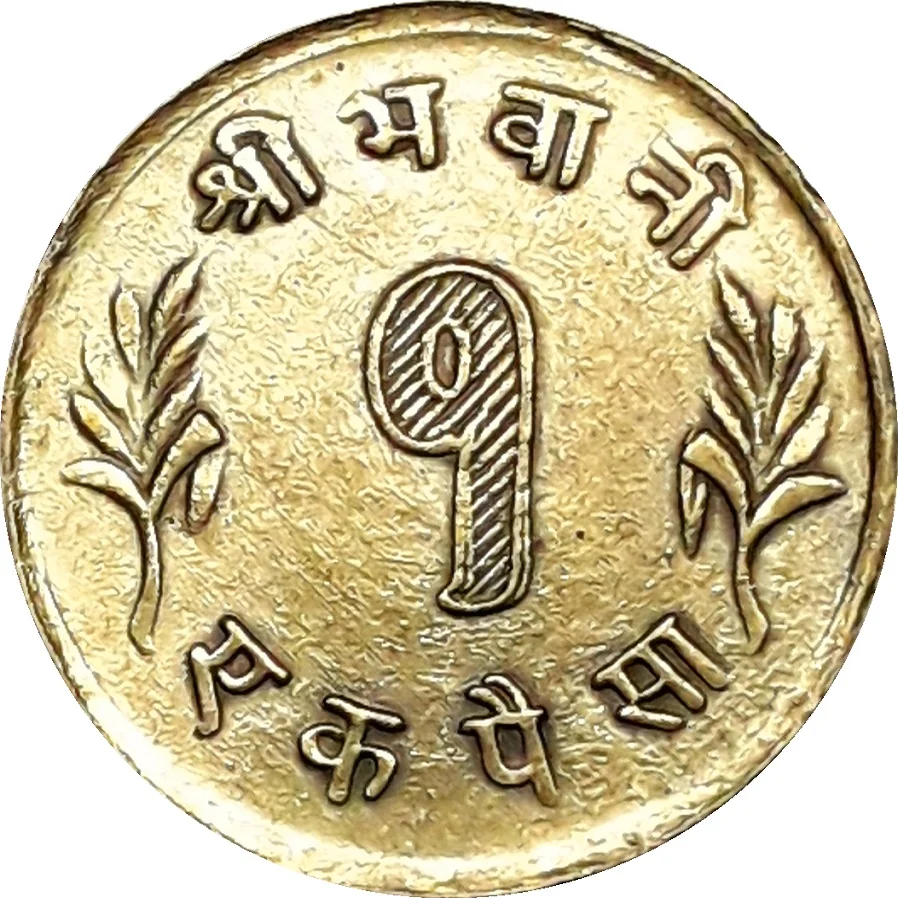
Reverse
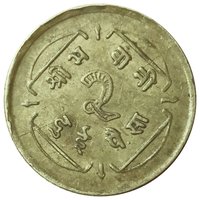
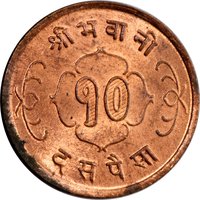
Description:
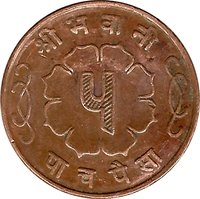
Shaded numerals
Edge
Plain
Mintings
| Year | Mint Mark | Mintage | Quality | Collection |
|---|---|---|---|---|
| 1957 | — | — | ||
| 1958 | — | — | ||
| 1961 | — | — | ||
| 1962 | — | — | ||
| 1963 | — | — |
Historical background
In 1957, Nepal's currency situation was characterized by a significant transition from a dual-currency system to a unified national monetary authority. Prior to this, the Nepalese rupee circulated alongside the Indian rupee, with the latter being dominant for larger transactions and external trade due to the fixed peg (1.6 Nepalese rupees = 1 Indian rupee) established in the 1950s. This linkage provided stability but also tied Nepal's economy closely to India's, limiting independent monetary policy. Furthermore, the issuance of notes was managed by two separate entities: the government (through the Nepal Rastra Bank's precursor, the Treasury) and the private Nepal Bank Limited, leading to a lack of centralized control.
The pivotal development of the year was the operationalization of the Nepal Rastra Bank (NRB) as the central bank in April 1956, with its policies and authority fully taking effect in 1957. The NRB Act of 1955 granted it the sole right to issue banknotes, a critical step toward monetary sovereignty. Consequently, 1957 was a year of consolidation, as the NRB began the process of withdrawing older government and Nepal Bank Limited notes from circulation and replacing them with its own unified currency. This move aimed to curb inflation, regulate credit, and manage foreign exchange reserves more effectively.
Despite this institutional progress, the underlying economic reality in 1957 remained challenging. The currency was still non-convertible internationally, and the fixed peg to the Indian rupee continued, meaning India's monetary decisions directly impacted Nepal. The economy was predominantly agrarian with limited industrialization, and the use of formal currency was still not widespread in rural areas, where barter persisted. Thus, while 1957 marked a foundational year for establishing a modern, centralized monetary framework, the full benefits of this reform and true monetary independence were goals for the future, constrained by economic structure and the enduring financial linkage with its southern neighbor.
The pivotal development of the year was the operationalization of the Nepal Rastra Bank (NRB) as the central bank in April 1956, with its policies and authority fully taking effect in 1957. The NRB Act of 1955 granted it the sole right to issue banknotes, a critical step toward monetary sovereignty. Consequently, 1957 was a year of consolidation, as the NRB began the process of withdrawing older government and Nepal Bank Limited notes from circulation and replacing them with its own unified currency. This move aimed to curb inflation, regulate credit, and manage foreign exchange reserves more effectively.
Despite this institutional progress, the underlying economic reality in 1957 remained challenging. The currency was still non-convertible internationally, and the fixed peg to the Indian rupee continued, meaning India's monetary decisions directly impacted Nepal. The economy was predominantly agrarian with limited industrialization, and the use of formal currency was still not widespread in rural areas, where barter persisted. Thus, while 1957 marked a foundational year for establishing a modern, centralized monetary framework, the full benefits of this reform and true monetary independence were goals for the future, constrained by economic structure and the enduring financial linkage with its southern neighbor.
Series: 1957 Nepal circulation coins
🌱 Common