

5 francs – Comoro Islands
Add to wishlist
Circulating commemorative coins
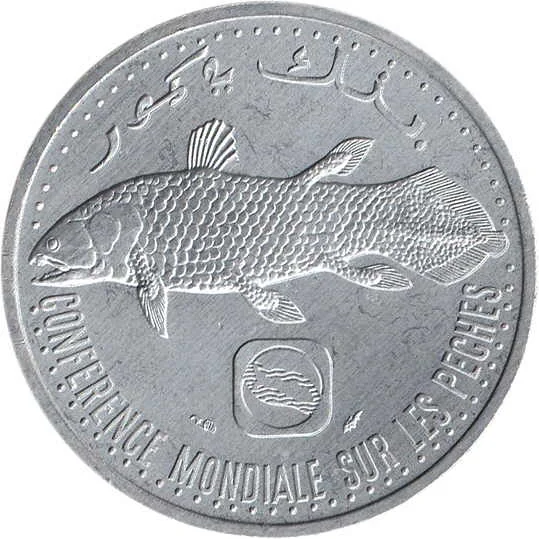
Commemoration: FAO - World Fisheries Conference
Context
Years: 1984–1992
Issuer: Comoro Islands
Issuing organization: Central Bank of the Comoros
Period:
(1975—2001)
Currency:
(since 1976)
Total mintage: 1,510,000
Material
References
KM: #
Numista: #6042
Value
Exchange value: 5 KMF
Obverse
Description:
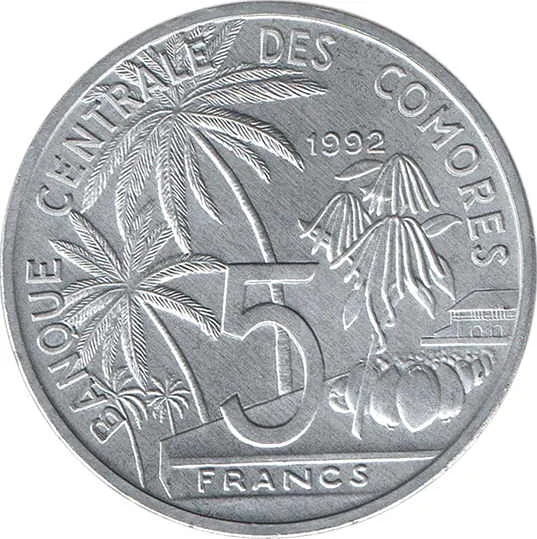
Coconuts and palm trees encircle the denomination, date at top right.
Inscription:
BANQUE CENTRALE DES COMORES
5 FRANCS
5 FRANCS
Translation:
Central Bank of the Comoros
5 Francs
5 Francs
Script: Latin
Language: French
Engraver: Lucien Georges Bazor
Reverse
Edge
Plain
Mints
| Name | Mark |
|---|---|
| Monnaie de Paris | — |
Mintings
| Year | Mint Mark | Mintage | Quality | Collection |
|---|---|---|---|---|
| 1984 | — | 1,010,000 | ||
| 1992 | — | 500,000 |
Historical background
In 1984, the currency situation in the Comoro Islands was defined by its entrenched dependency on France and the French Franc (FRF). Since independence in 1975, the archipelago had remained within the "Franc Zone" (Zone Franc), using the Comorian Franc (KMF) which was—and remains—pegged to the French Franc at a fixed and guaranteed exchange rate (KMF 50 = FRF 1). This arrangement, managed by the French Treasury, provided monetary stability and guaranteed convertibility, but it also meant Comoros ceded control over its monetary policy to France. The system was governed by the Institut d'Émission des Comores, a precursor to the Central Bank, which operated under strict rules requiring foreign exchange reserves to be held in France.
Economically, this period was one of significant strain. The early 1980s saw a sharp decline in the global prices of the country's key exports—vanilla, cloves, and ylang-ylang—leading to chronic trade deficits and mounting public debt. While the fixed peg prevented currency devaluation and imported inflation, it also made Comorian exports less competitive and limited the government's tools to respond to the crisis. The economy was heavily reliant on French budgetary aid and remittances from Comorians living abroad, highlighting the fragility masked by the stable currency.
Consequently, the currency situation in 1984 was a paradox of formal stability amidst underlying economic vulnerability. The fixed link to the French Franc provided a crucial anchor, preventing monetary collapse, but it did not address the structural weaknesses of a narrow, agrarian economy. This period underscored the complex trade-offs of the post-colonial monetary union, where financial security was balanced against a lack of economic sovereignty and limited flexibility to stimulate growth or adjust to external shocks.
Economically, this period was one of significant strain. The early 1980s saw a sharp decline in the global prices of the country's key exports—vanilla, cloves, and ylang-ylang—leading to chronic trade deficits and mounting public debt. While the fixed peg prevented currency devaluation and imported inflation, it also made Comorian exports less competitive and limited the government's tools to respond to the crisis. The economy was heavily reliant on French budgetary aid and remittances from Comorians living abroad, highlighting the fragility masked by the stable currency.
Consequently, the currency situation in 1984 was a paradox of formal stability amidst underlying economic vulnerability. The fixed link to the French Franc provided a crucial anchor, preventing monetary collapse, but it did not address the structural weaknesses of a narrow, agrarian economy. This period underscored the complex trade-offs of the post-colonial monetary union, where financial security was balanced against a lack of economic sovereignty and limited flexibility to stimulate growth or adjust to external shocks.
🌱 Common