

25 Francs – Comoro Islands
Circulating commemorative coins
Commemoration: F.A.O.
Context
Years: 1981–1982
Issuer: Comoro Islands
Issuing organization: Central Bank of the Comoros
Period:
(1975—2001)
Currency:
(since 1976)
Total mintage: 3,007,000
Material
References
KM: #Click to copy to clipboard14
Numista: #8276
Value
Exchange value: 25 KMF
Obverse
Description:
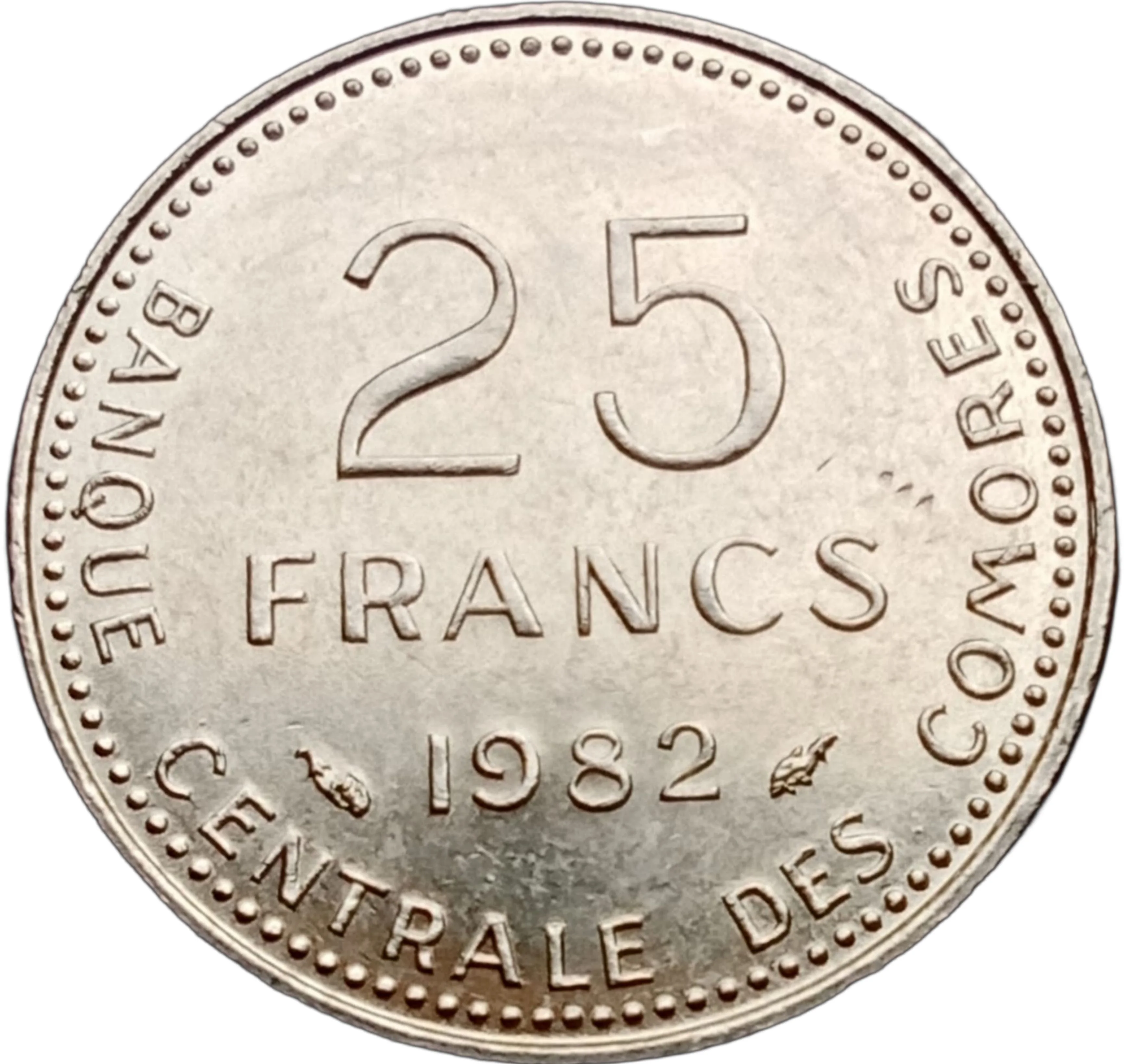
Value, date, mint
Inscription:
BANQUE CENTRALE DES COMORES
25 FRANCS
1982
25 FRANCS
1982
Translation:
Central Bank of the Comoros
25 Francs
1982
25 Francs
1982
Language: French
Reverse
Description:
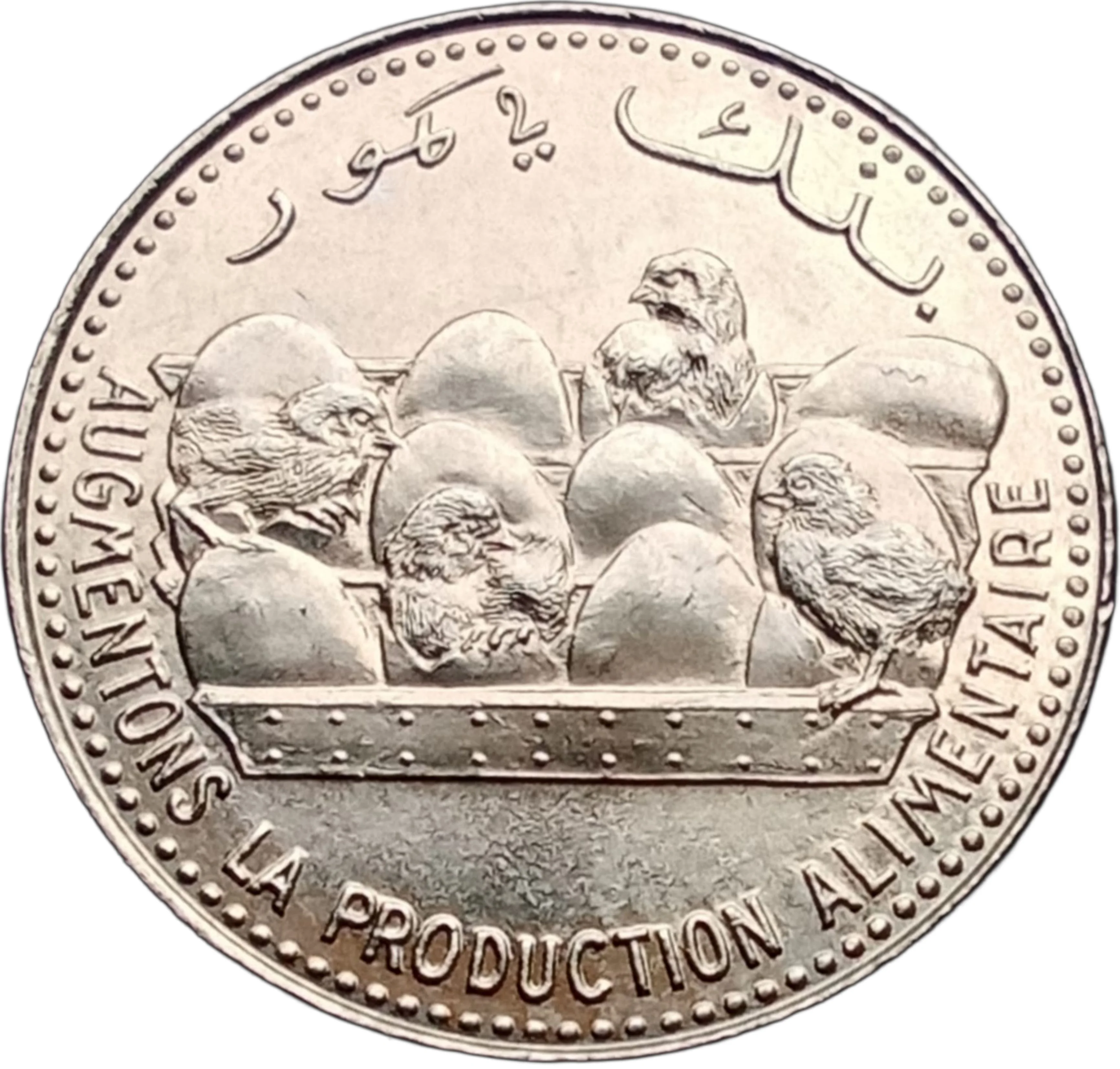
Four chicks hatching (poultry farming)
Inscription:
AUGMENTONS LA PRODUCTION ALIMENTAIRE
Translation:
Let's Increase Food Production
Language: French
Edge
Reeded
Categories
| Organization> FAO |
Mints
| Name | Mark |
|---|---|
| Monnaie de Paris | — |
Mintings
| Year | Mint Mark | Mintage | Quality | Collection |
|---|---|---|---|---|
| 1981 | — | 1,000,000 | ||
| 1982 | — | 2,007,000 |
Historical background
In 1981, the currency situation in the Comoro Islands was defined by its membership in the Franc Zone (Zone Franc), a monetary arrangement guaranteeing stability through a fixed peg to the French franc. The official currency was (and remains) the Comorian franc (KMF), which was issued by the Institut d'Émission des Comores, the predecessor to the Central Bank of the Comoros. This peg provided a crucial anchor for the small, fragmented island economy, which relied heavily on agricultural exports like vanilla, cloves, and ylang-ylang, and was vulnerable to external shocks and price fluctuations.
Economically, the year was challenging. The global recession of the early 1980s depressed prices for the Comoros' key commodity exports, straining foreign exchange reserves and creating budgetary pressures. While the fixed exchange rate with the French franc provided low inflation and monetary credibility, it also meant the Comoros had little independent monetary policy to stimulate its struggling economy. The country's financial stability was fundamentally underpinned by the French Treasury guarantee, which allowed for unlimited convertibility between the KMF and the French franc, ensuring access to essential imports.
Politically, the currency arrangement reflected the nation's deep post-colonial ties to France. Since independence in 1975, the Comoros had experienced significant instability, including a secession attempt by Anjouan and multiple coups. In this context, the fixed peg to the French franc was a source of financial order and a symbol of ongoing dependence. The system provided essential economic security but also highlighted the limitations on national financial sovereignty, as major monetary decisions were effectively made in Paris rather than Moroni.
Economically, the year was challenging. The global recession of the early 1980s depressed prices for the Comoros' key commodity exports, straining foreign exchange reserves and creating budgetary pressures. While the fixed exchange rate with the French franc provided low inflation and monetary credibility, it also meant the Comoros had little independent monetary policy to stimulate its struggling economy. The country's financial stability was fundamentally underpinned by the French Treasury guarantee, which allowed for unlimited convertibility between the KMF and the French franc, ensuring access to essential imports.
Politically, the currency arrangement reflected the nation's deep post-colonial ties to France. Since independence in 1975, the Comoros had experienced significant instability, including a secession attempt by Anjouan and multiple coups. In this context, the fixed peg to the French franc was a source of financial order and a symbol of ongoing dependence. The system provided essential economic security but also highlighted the limitations on national financial sovereignty, as major monetary decisions were effectively made in Paris rather than Moroni.
🌱 Common