

1 Sen – Brunei
Brunei
Context
Year: 1967
Issuer: Brunei 
Ruler: Omar Ali Saifuddien III
Currency:
(since 1967)
Total mintage: 1,000,000
Material
References
KM: #Click to copy to clipboard4
Numista: #6029
Value
Exchange value: 0.01 BND
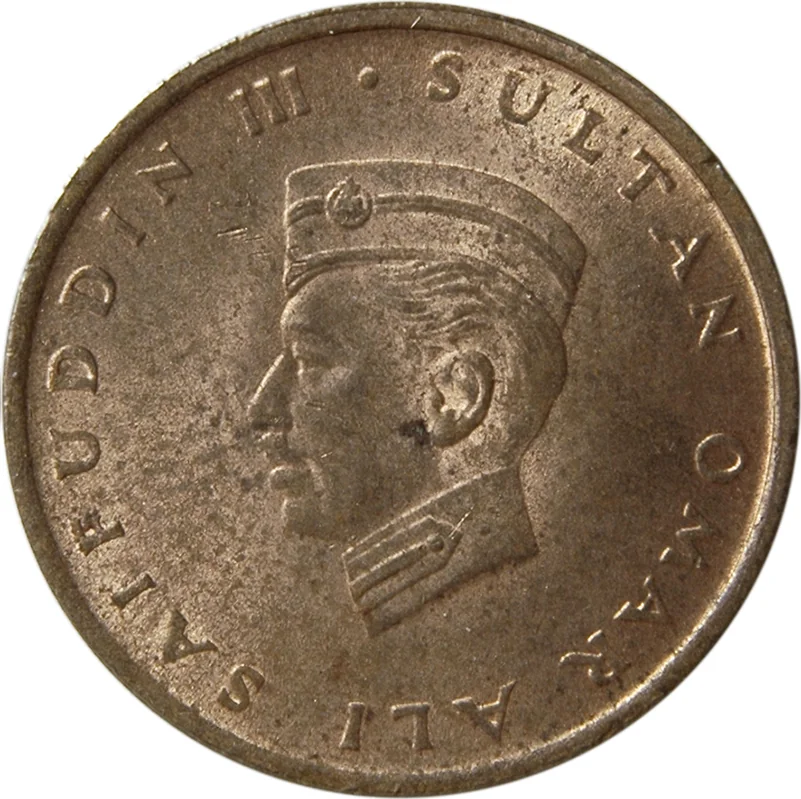
Obverse
Description:
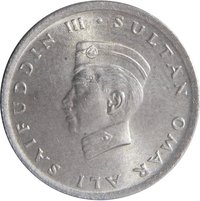
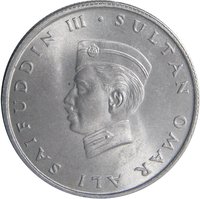
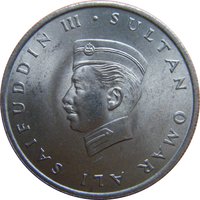
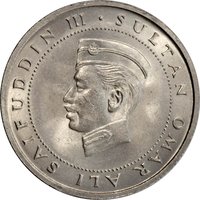
Bust of Sultan Omar Ali Saifuddin III, facing left.
Inscription:
SULTAN OMAR ALI SAIFUDDIN III
Script: Latin
Designer: Christopher Ironside
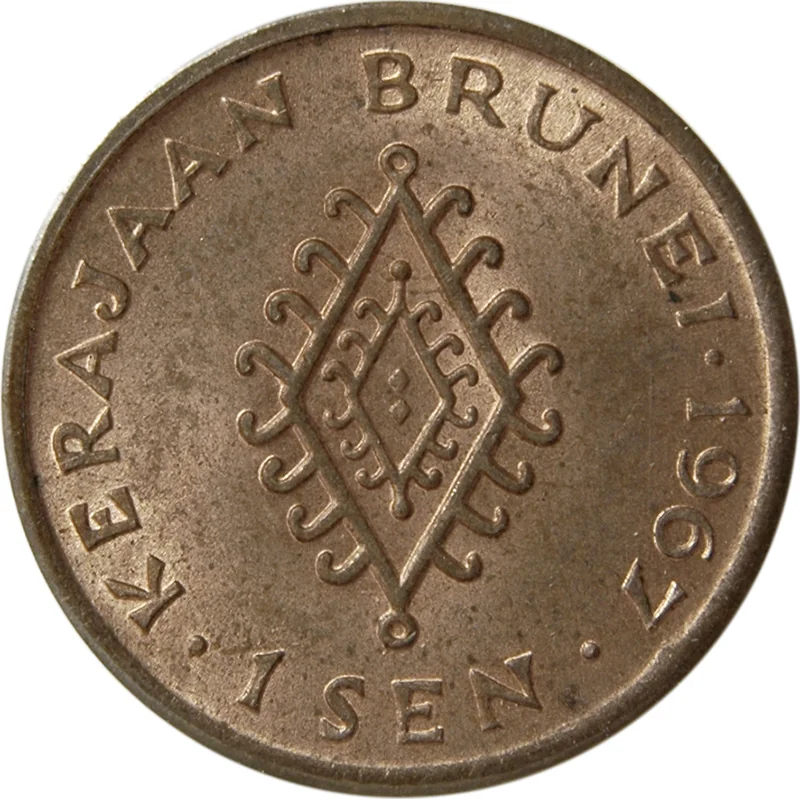
Reverse
Description:
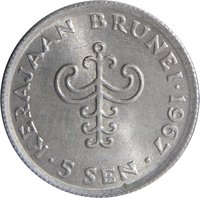
Ornamental plants
Inscription:
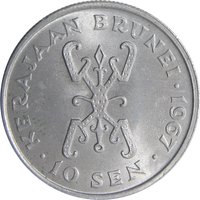
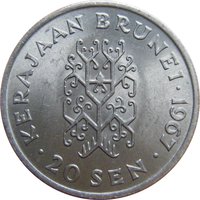
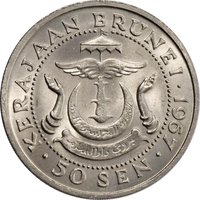
KERAJAAN BRUNEI 1967
1 SEN
1 SEN
Translation:
Kingdom of Brunei 1967
1 Sen
1 Sen
Script: Latin
Language: Malay
Engraver: Christopher Ironside
Edge
Plain
Mints
| Name | Mark |
|---|---|
| Royal Mint (Tower Hill) | — |
Mintings
| Year | Mint Mark | Mintage | Quality | Collection |
|---|---|---|---|---|
| 1967 | — | 1,000,000 |
Historical background
In 1967, Brunei faced a significant monetary transition as the longstanding currency union with Malaya and Singapore came to an end. Since 1906, Brunei had used the Straits Dollar and later the Malaya and British Borneo Dollar, which was managed by the Board of Commissioners of Currency, Malaya and British Borneo. This system provided regional stability, but the political landscape shifted dramatically with the formation of Malaysia in 1963 (which Brunei declined to join) and Singapore's independence in 1965. These events led Singapore and Malaysia to establish their own national currencies, dissolving the common currency board and compelling Brunei to issue its own sovereign currency.
The response was the establishment of the Brunei Currency Board on February 12, 1967, and the issuance of the first Brunei Dollar on June 12, 1967. Crucially, Brunei negotiated a vital agreement with Singapore to maintain interchangeability at par between their two new currencies. This arrangement, formalized in the Currency Interchangeability Agreement, was a masterstroke of financial diplomacy, ensuring immediate stability by pegging the Brunei Dollar to a trusted and familiar monetary system. It allowed the currencies to be used interchangeably in both countries, preventing economic disruption and bolstering confidence in the new currency.
Thus, the 1967 currency situation was not one of crisis but of carefully managed sovereignty. Brunei successfully navigated the collapse of a regional monetary union by launching its own national currency while instantly anchoring it to Singapore's strong financial system. This move preserved economic stability for its citizens and businesses, established a key pillar of Brunei's modern financial independence, and laid the foundation for its enduring and special monetary relationship with Singapore, which continues to this day.
The response was the establishment of the Brunei Currency Board on February 12, 1967, and the issuance of the first Brunei Dollar on June 12, 1967. Crucially, Brunei negotiated a vital agreement with Singapore to maintain interchangeability at par between their two new currencies. This arrangement, formalized in the Currency Interchangeability Agreement, was a masterstroke of financial diplomacy, ensuring immediate stability by pegging the Brunei Dollar to a trusted and familiar monetary system. It allowed the currencies to be used interchangeably in both countries, preventing economic disruption and bolstering confidence in the new currency.
Thus, the 1967 currency situation was not one of crisis but of carefully managed sovereignty. Brunei successfully navigated the collapse of a regional monetary union by launching its own national currency while instantly anchoring it to Singapore's strong financial system. This move preserved economic stability for its citizens and businesses, established a key pillar of Brunei's modern financial independence, and laid the foundation for its enduring and special monetary relationship with Singapore, which continues to this day.
🌱 Common