

20 drachmai – Greece
Add to wishlist
Greece
Obverse
Description:
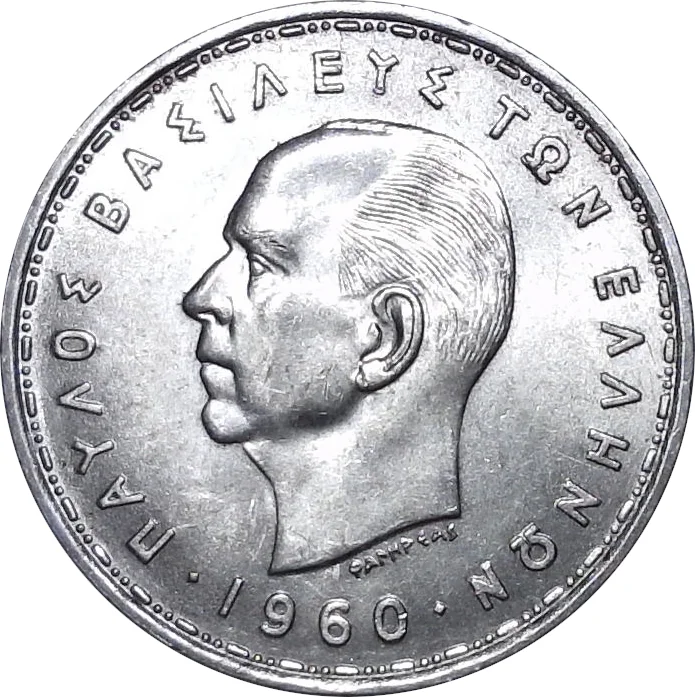
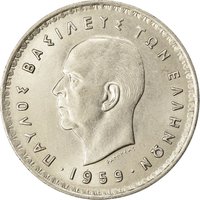
Paul I bust left, date below.
Inscription:
ΠΑΥΛΟΣ ΒΑΣΙΛΕΥΣ ΤΩΝ ΕΛΛΗΝΩΝ
1960
1960
Translation:
PAUL KING OF THE HELLENES
1960
1960
Script: Greek
Language: Greek
Engraver: Vasos Falireas
Reverse
Description:
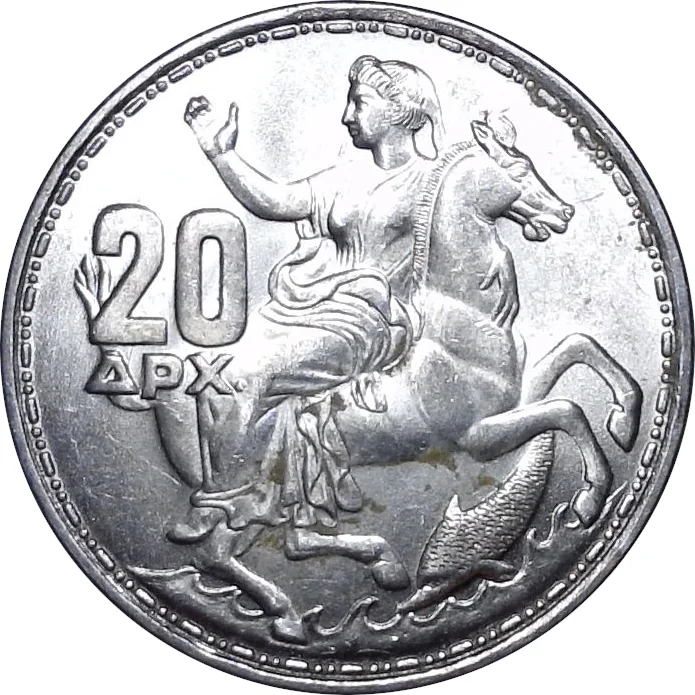
Moon goddess Selene on horseback, denomination left.
Inscription:
20
ΔΡΧ
ΔΡΧ
Translation:
Twenty drachmas
Script: Greek
Language: Greek
Engraver: Vasos Falireas
Edge
Inscripted with raised lettering and the date
Legend:
ΒΑΣΙΛΕΙΟΝ ΤΗΣ ΕΛΛΑΔΟΣ 1960
Translation:
KINGDOM OF GREECE 1960
Language: Greek
Mints
| Name | Mark |
|---|---|
| Royal Mint (Tower Hill) | — |
Mintings
| Year | Mint Mark | Mintage | Quality | Collection |
|---|---|---|---|---|
| 1960 | — | 20,000,000 | ||
| 1960 | — | — | Proof | |
| 1965 | — | — | ||
| 1965 | — | 4,987 | Proof |
Historical background
In 1960, Greece's currency situation was defined by its membership in the Bretton Woods system, with the drachma (GRD) pegged to the US dollar at a fixed rate of 30 drachmae to one dollar. This stability was underpinned by Greece's participation in the European Payments Union and its broader alignment with Western economic structures, following the recovery from the civil war. The period was one of relative monetary stability and economic growth, known as the "Greek economic miracle," driven by industrialization, tourism, and remittances from Greeks abroad, which bolstered the country's foreign exchange reserves.
However, this fixed parity masked underlying economic pressures. The drachma was widely considered overvalued, which hurt the competitiveness of Greek exports and contributed to a persistent trade deficit. The economy relied heavily on invisible earnings—shipping, tourism, and emigrant remittances—to balance its current account. Furthermore, the political landscape was tense, with significant social inequalities and a fragile government, setting the stage for future monetary challenges.
The stability of 1960 proved to be a calm before the storm. Within a few years, pressures would mount, leading to a significant devaluation in 1953 (a key pre-1960 adjustment) and again in 1967. The fixed exchange rate regime ultimately limited Greece's ability to independently manage monetary policy to address domestic inflation and growth, a tension that would characterize its economic trajectory long after the Bretton Woods system collapsed in the early 1970s.
However, this fixed parity masked underlying economic pressures. The drachma was widely considered overvalued, which hurt the competitiveness of Greek exports and contributed to a persistent trade deficit. The economy relied heavily on invisible earnings—shipping, tourism, and emigrant remittances—to balance its current account. Furthermore, the political landscape was tense, with significant social inequalities and a fragile government, setting the stage for future monetary challenges.
The stability of 1960 proved to be a calm before the storm. Within a few years, pressures would mount, leading to a significant devaluation in 1953 (a key pre-1960 adjustment) and again in 1967. The fixed exchange rate regime ultimately limited Greece's ability to independently manage monetary policy to address domestic inflation and growth, a tension that would characterize its economic trajectory long after the Bretton Woods system collapsed in the early 1970s.
🌱 Very Common