

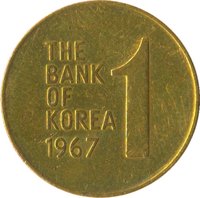
1 Won – South Korea
South Korea
Context
Years: 1966–1967
Issuer: South Korea 
Issuing organization: Bank of Korea
Period:
(since 1948)
Currency:
(since 1962)
Total mintage: 55,500,000
Material
References
KM: #Click to copy to clipboard4
Numista: #5993
Value
Exchange value: 1 KRW = $0.00
Inflation-adjusted value: 44.37 KRW
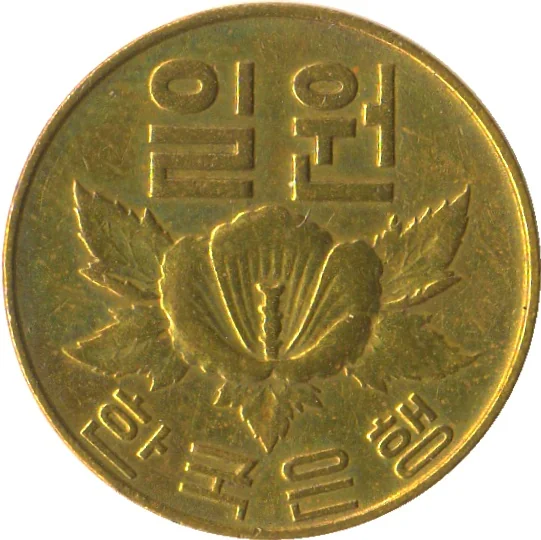
Obverse
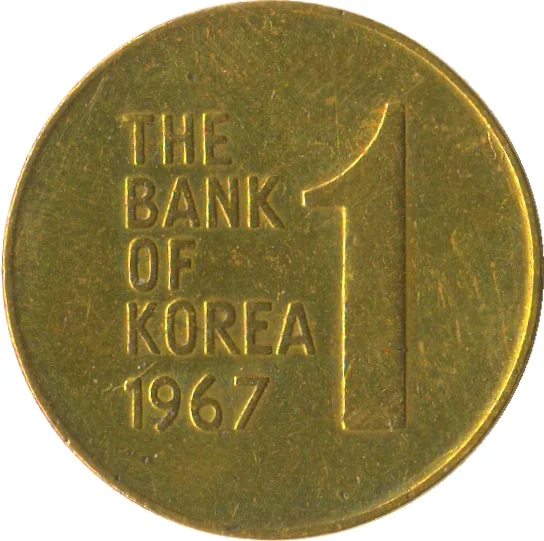
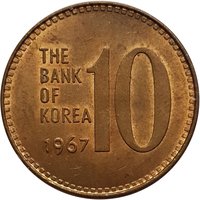
Reverse
Edge
Plain
Mintings
| Year | Mint Mark | Mintage | Quality | Collection |
|---|---|---|---|---|
| 1966 | — | 7,000,000 | ||
| 1967 | — | 48,500,000 |
Historical background
In 1966, South Korea's currency situation was characterized by a tightly controlled and overvalued official exchange rate for the South Korean won, managed under a fixed exchange rate system. The government, led by President Park Chung-hee, maintained an official rate of approximately 255 won to the US dollar. This overvaluation was a tool of the state-led industrialization drive, intended to make imports of crucial capital goods and raw materials cheaper for the burgeoning chaebol (industrial conglomerates) focused on export-oriented growth. However, this policy created a significant disparity with market realities, suppressing the won's true value and leading to persistent balance of payments pressures.
Beneath this official facade, a thriving and substantial black market for foreign exchange existed, where the US dollar traded at a much higher rate, often exceeding 300 won. This black market was fueled by the scarcity of hard currency, the demands of businesses operating outside official channels, and remittances from Koreans working abroad. The government tacitly acknowledged this parallel economy but actively sought to curb it through strict foreign exchange controls and the mandatory surrender of foreign currency earnings by exporters, aiming to centralize all hard currency for strategic state allocation.
The currency regime of 1966 was thus a critical, albeit strained, component of South Korea's Third Five-Year Economic Development Plan (1972-1976). The overvalued won acted as a hidden subsidy for industrial imports, but its unsustainability was becoming apparent. It would lead to a major devaluation in 1971 (to 373 won per dollar) and eventually to a series of liberalization measures in the following decades, marking the beginning of a long transition from a controlled financial system to a more market-oriented one.
Beneath this official facade, a thriving and substantial black market for foreign exchange existed, where the US dollar traded at a much higher rate, often exceeding 300 won. This black market was fueled by the scarcity of hard currency, the demands of businesses operating outside official channels, and remittances from Koreans working abroad. The government tacitly acknowledged this parallel economy but actively sought to curb it through strict foreign exchange controls and the mandatory surrender of foreign currency earnings by exporters, aiming to centralize all hard currency for strategic state allocation.
The currency regime of 1966 was thus a critical, albeit strained, component of South Korea's Third Five-Year Economic Development Plan (1972-1976). The overvalued won acted as a hidden subsidy for industrial imports, but its unsustainability was becoming apparent. It would lead to a major devaluation in 1971 (to 373 won per dollar) and eventually to a series of liberalization measures in the following decades, marking the beginning of a long transition from a controlled financial system to a more market-oriented one.
🌱 Very Common