

100 hwan – South Korea
Add to wishlist
South Korea
Context
Year: 1959
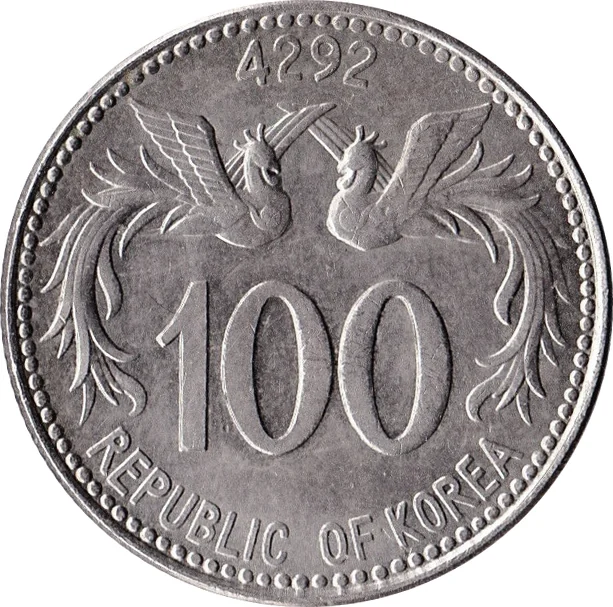
Korean - Dangun Year:: 4292
Issuer: South Korea
Issuing organization: Bank of Korea
Period:
(since 1948)
Currency:
(1953—1962)
Demonetization: 10 June 1962
Total mintage: 50,000,000
Material
References
KM: #
Numista: #9658
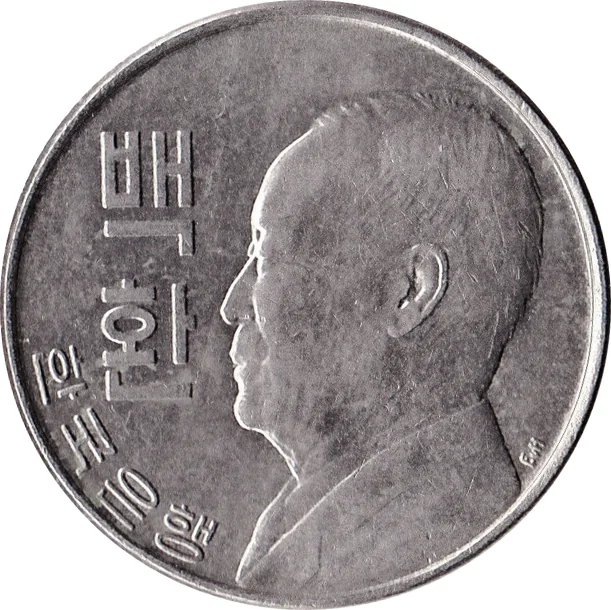
Obverse
Reverse
Edge
Reeded
Categories
| Animal> Bird |
| Mythology> Fantastic animal |
| Person> Politician |
Mints
| Name | Mark |
|---|---|
| United States Mint of Philadelphia | — |
Mintings
| Year | Mint Mark | Mintage | Quality | Collection |
|---|---|---|---|---|
| 1959 | — | 50,000,000 |
Historical background
In 1959, South Korea's currency situation was characterized by the aftermath of the Korean War and the early stages of economic reconstruction under President Syngman Rhee. The official currency was the hwan, which had been introduced in 1953 to replace the old won at a rate of 1 hwan to 100 won, in an attempt to curb the hyperinflation caused by war financing. However, this reform was largely unsuccessful; the economy remained weak, reliant on significant U.S. aid, and plagued by persistent inflation. The government maintained a complex system of multiple exchange rates, with an overvalued official rate for essential imports and a much higher "free market" rate, which encouraged corruption and a thriving black market for foreign currency.
Economically, the country was still predominantly agrarian with limited industrialization. The Rhee administration's focus on political survival over sound fiscal policy led to excessive money printing to finance deficits, further devaluing the hwan. By the end of the decade, the currency was visibly unstable, and public confidence was low. The multiple exchange rate system distorted trade and hampered efficient allocation of resources, creating a major bottleneck for sustainable growth.
This precarious monetary environment set the stage for the profound reforms that would follow the April 1960 student revolution, which overthrew Rhee's government. The subsequent military coup of 1961, led by Park Chung-hee, identified currency and financial stabilization as a top priority. This directly led to the 1962 currency reform, which replaced the depreciated hwan with a new won (at a rate of 10 hwan = 1 won) and implemented a unified, realistic exchange rate system. Thus, 1959 represents the final year of an unstable monetary regime, immediately preceding the drastic measures that would underpin South Korea's period of rapid industrialization and export-led growth.
Economically, the country was still predominantly agrarian with limited industrialization. The Rhee administration's focus on political survival over sound fiscal policy led to excessive money printing to finance deficits, further devaluing the hwan. By the end of the decade, the currency was visibly unstable, and public confidence was low. The multiple exchange rate system distorted trade and hampered efficient allocation of resources, creating a major bottleneck for sustainable growth.
This precarious monetary environment set the stage for the profound reforms that would follow the April 1960 student revolution, which overthrew Rhee's government. The subsequent military coup of 1961, led by Park Chung-hee, identified currency and financial stabilization as a top priority. This directly led to the 1962 currency reform, which replaced the depreciated hwan with a new won (at a rate of 10 hwan = 1 won) and implemented a unified, realistic exchange rate system. Thus, 1959 represents the final year of an unstable monetary regime, immediately preceding the drastic measures that would underpin South Korea's period of rapid industrialization and export-led growth.
🌱 Common