

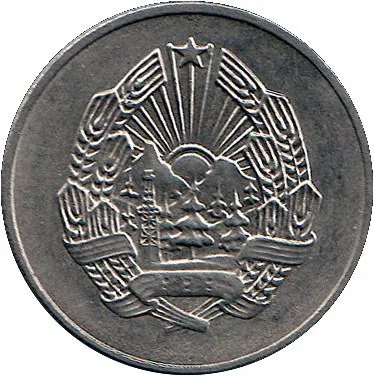
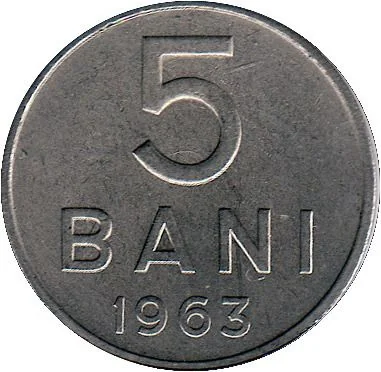


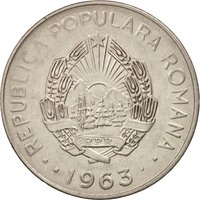
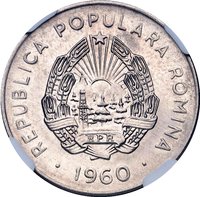
Obverse
Description:
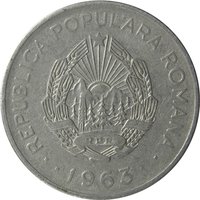
National emblem with RPR ribbon.
Inscription:
RPR
Script: Latin
Engraver: Haralambie Ionescu
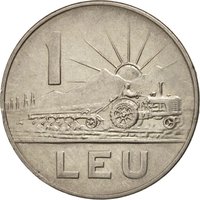
Reverse
Edge
Plain
Categories
| Symbols> Coat of Arms |
Mints
| Name | Mark |
|---|---|
| State Mint | — |
Mintings
| Year | Mint Mark | Mintage | Quality | Collection |
|---|---|---|---|---|
| 1963 | — | 95,700,000 |
Historical background
In 1963, Romania’s currency situation was defined by its centrally planned economy and its political alignment within the Soviet bloc. The national currency, the leu, was a non-convertible "soft currency," meaning it could not be freely exchanged for Western hard currencies or gold. Its value and use were strictly controlled by the state, with an official exchange rate set by the government that bore little relation to its actual purchasing power on the international market. Internally, this system facilitated the state’s economic planning, but it also created a rigid and inefficient monetary environment isolated from global financial flows.
The year fell within a period of relative economic stability for Romania, following the completion of a major monetary reform in 1952, which had revalued the leu and replaced the old currency at steep rates to confiscate savings and curb inflation. By 1963, the country was pursuing a policy of increased industrial independence from the Soviet Union, seeking to develop its own heavy industry. This autarkic drive required strict control over foreign exchange to prioritize imports of machinery and technology, further cementing the leu's isolation. Access to hard currency was a state monopoly, reserved almost exclusively for approved foreign trade transactions.
For ordinary Romanians, the non-convertible leu meant severely restricted travel abroad and no legal access to foreign goods outside of limited state-run shops. However, a black market for hard currencies like the US dollar and the Deutsche Mark persisted, operating at exchange rates far more favorable than the official state rate. This parallel market reflected the disconnect between the government's fixed valuation of the leu and the population's actual trust in its worth, a hidden pressure point within the otherwise stable façade of the planned economy.
The year fell within a period of relative economic stability for Romania, following the completion of a major monetary reform in 1952, which had revalued the leu and replaced the old currency at steep rates to confiscate savings and curb inflation. By 1963, the country was pursuing a policy of increased industrial independence from the Soviet Union, seeking to develop its own heavy industry. This autarkic drive required strict control over foreign exchange to prioritize imports of machinery and technology, further cementing the leu's isolation. Access to hard currency was a state monopoly, reserved almost exclusively for approved foreign trade transactions.
For ordinary Romanians, the non-convertible leu meant severely restricted travel abroad and no legal access to foreign goods outside of limited state-run shops. However, a black market for hard currencies like the US dollar and the Deutsche Mark persisted, operating at exchange rates far more favorable than the official state rate. This parallel market reflected the disconnect between the government's fixed valuation of the leu and the population's actual trust in its worth, a hidden pressure point within the otherwise stable façade of the planned economy.

🌱 Very Common