

5 centimes – Belgium
Add to wishlist
Belgium
Context
Material
Diameter: 19 mm
Weight: 2.5 g
Thickness: 1.36 mm
Shape: Round with a round hole
Magnetic: No
Technique: Milled
Alignment: Coin alignment
flip
References
KM: #
Numista: #5957
Value
Exchange value: 0.05 BEF
Obverse
Description:
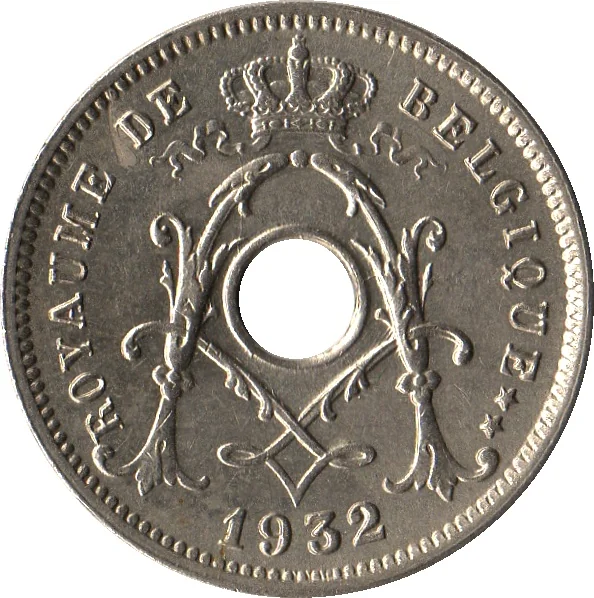
King Albert I's monogram, French legend, date below.
Inscription:
ROYAUME DE BELGIQUE ★★
1932
1932
Translation:
Kingdom of Belgium ★★
1932
1932
Script: Latin
Language: French
Engraver: Alphonse Michaux
Reverse
Description:
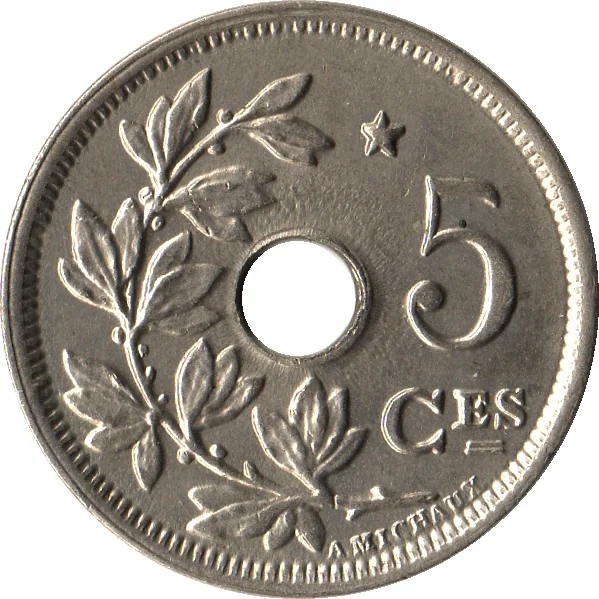
Center hole flanked by olive sprig and value, 5-pointed star above.
Inscription:
★
5
CES
A. MICHAUX
5
CES
A. MICHAUX
Script: Latin
Engraver: Alphonse Michaux
Edge
Plain
Mints
| Name | Mark |
|---|---|
| Royal Mint of Belgium | — |
Mintings
| Year | Mint Mark | Mintage | Quality | Collection |
|---|---|---|---|---|
| 1932 | — | — |
Historical background
In 1932, Belgium, like much of the world, was mired in the Great Depression. The country had initially attempted to weather the storm by adhering to the gold standard, a policy championed by the National Bank of Belgium under Governor Georges Janssen. This orthodox approach aimed to maintain confidence in the Belgian franc and international credibility, but it came at a severe domestic cost. Deflationary policies, including cuts to public salaries and social spending, led to plummeting prices, widespread business failures, and soaring unemployment, creating significant social and political unrest.
The situation was exacerbated by the devaluation of the British pound in 1931 and growing pressure on gold-backed currencies. Belgium found its exports becoming increasingly uncompetitive, while speculative attacks drained its gold reserves. A crucial turning point came in March 1932 with the devaluation of the Dutch guilder. As Belgium's most important trading neighbor and economic rival, the Netherlands' move placed immense and immediate pressure on the Belgian government. It created a stark choice: either follow suit to protect its export industries or hold firm and risk a deeper economic collapse.
Consequently, 1932 was a year of intense debate and crisis management, setting the stage for Belgium's eventual break from gold. While the actual devaluation of the Belgian franc would not occur until March 1935, the events of 1932—particularly the Dutch devaluation—shattered the consensus around the existing monetary policy. The year was defined by a losing battle to defend an overvalued currency, which deepened the economic crisis and made the politically difficult decision to devalue increasingly inevitable.
The situation was exacerbated by the devaluation of the British pound in 1931 and growing pressure on gold-backed currencies. Belgium found its exports becoming increasingly uncompetitive, while speculative attacks drained its gold reserves. A crucial turning point came in March 1932 with the devaluation of the Dutch guilder. As Belgium's most important trading neighbor and economic rival, the Netherlands' move placed immense and immediate pressure on the Belgian government. It created a stark choice: either follow suit to protect its export industries or hold firm and risk a deeper economic collapse.
Consequently, 1932 was a year of intense debate and crisis management, setting the stage for Belgium's eventual break from gold. While the actual devaluation of the Belgian franc would not occur until March 1935, the events of 1932—particularly the Dutch devaluation—shattered the consensus around the existing monetary policy. The year was defined by a losing battle to defend an overvalued currency, which deepened the economic crisis and made the politically difficult decision to devalue increasingly inevitable.
🌱 Common