

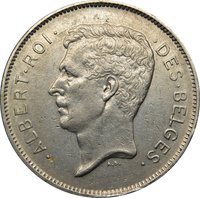
Obverse
Description:
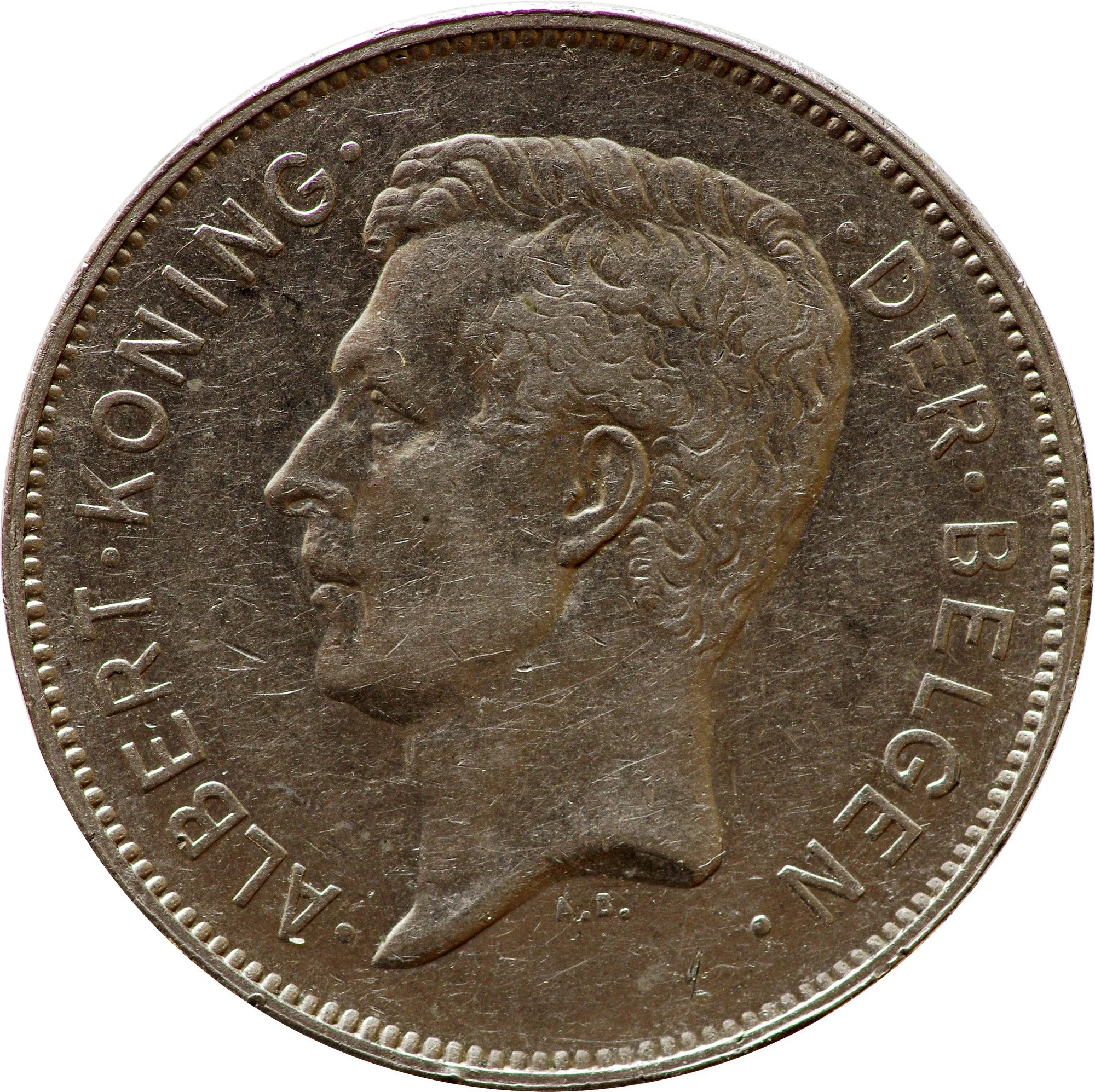
King Albert I facing left, surrounded by Dutch text. Designer initials below.
Inscription:
·ALBERT·KONING· ·DER·BELGEN·
A.B.
A.B.
Translation:
Albert King of the Belgians
A.B.
A.B.
Script: Latin
Language: Dutch
Engraver: Armand Bonnetain
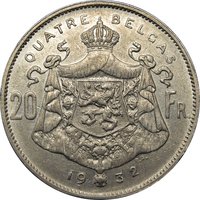
Reverse
Description:
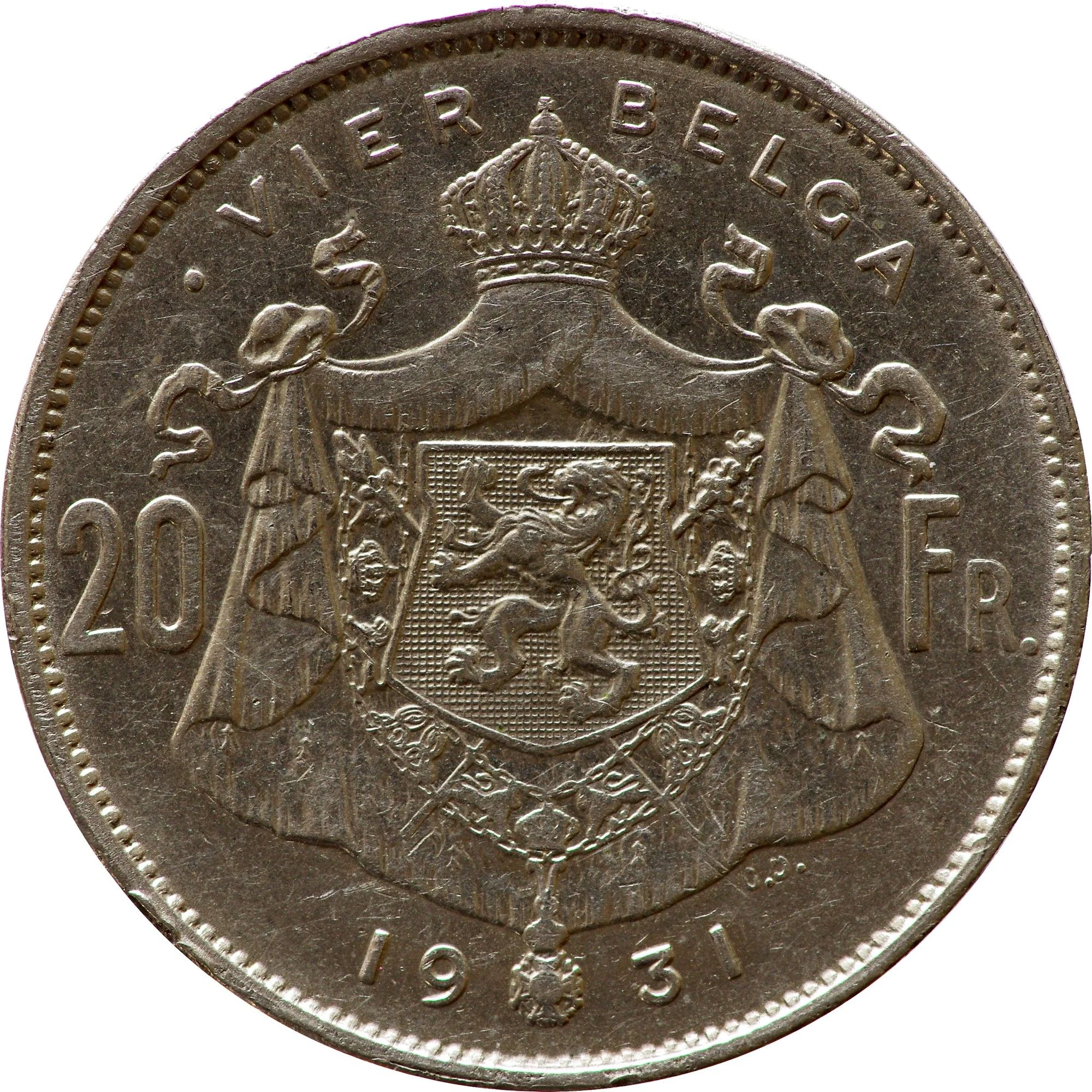
Belgium's coat of arms encircled by the face value in two currencies.
Inscription:
VIER BELGA
20 FR.
1932
G.D.
20 FR.
1932
G.D.
Translation:
Twenty Belgian Francs
1932
G.D.
1932
G.D.
Script: Latin
Engraver: Godefroid Devreese
Categories
| Symbols> Coat of Arms |
| Symbol> Crown |
Mints
| Name | Mark |
|---|---|
| Royal Mint of Belgium | — |
Mintings
| Year | Mint Mark | Mintage | Quality | Collection |
|---|---|---|---|---|
| 1931 | — | 2,600,000 | ||
| 1932 | — | 6,950,000 |
Historical background
In 1931, Belgium, like much of the world, was engulfed in the Great Depression and a severe international financial crisis. The country operated on the gold standard, pegging the Belgian franc to a fixed quantity of gold, which tied its monetary policy to that of other gold-standard nations. This system came under immense strain following the collapse of the major Austrian bank Creditanstalt in May 1931, which triggered a cascade of bank failures and a continent-wide flight from currencies into gold. As capital fled, Belgium's gold reserves came under pressure, threatening its ability to maintain the franc's parity.
The pivotal moment arrived in September 1931 when Great Britain, a major trading partner and financial centre, dramatically abandoned the gold standard, allowing the pound sterling to devalue. This placed Belgium and other remaining "gold bloc" nations (including France, the Netherlands, and Switzerland) at a severe competitive disadvantage. Their overvalued currencies made exports prohibitively expensive, crippling Belgian industry—particularly the critical textile and coal sectors in Flanders and Wallonia—and deepening deflation and unemployment. The Belgian government, led by Prime Minister Jules Renkin and supported by the powerful National Bank of Belgium, initially chose a path of strict deflationary austerity, cutting wages and public spending in a painful effort to defend the franc's gold parity.
This orthodox defence proved economically and socially devastating throughout the early 1930s. While Belgium managed to cling to the gold standard longer than many, the policy exacerbated the domestic depression, leading to widespread social unrest and political instability. The relentless pressure ultimately forced Belgium to devalue the franc and effectively abandon the gold standard in March 1935, following a new devaluation by its key ally France. This belated move, part of the "New Deal"-style reforms of Prime Minister Paul van Zeeland, finally allowed for a recovery programme and a managed, more competitive currency.
The pivotal moment arrived in September 1931 when Great Britain, a major trading partner and financial centre, dramatically abandoned the gold standard, allowing the pound sterling to devalue. This placed Belgium and other remaining "gold bloc" nations (including France, the Netherlands, and Switzerland) at a severe competitive disadvantage. Their overvalued currencies made exports prohibitively expensive, crippling Belgian industry—particularly the critical textile and coal sectors in Flanders and Wallonia—and deepening deflation and unemployment. The Belgian government, led by Prime Minister Jules Renkin and supported by the powerful National Bank of Belgium, initially chose a path of strict deflationary austerity, cutting wages and public spending in a painful effort to defend the franc's gold parity.
This orthodox defence proved economically and socially devastating throughout the early 1930s. While Belgium managed to cling to the gold standard longer than many, the policy exacerbated the domestic depression, leading to widespread social unrest and political instability. The relentless pressure ultimately forced Belgium to devalue the franc and effectively abandon the gold standard in March 1935, following a new devaluation by its key ally France. This belated move, part of the "New Deal"-style reforms of Prime Minister Paul van Zeeland, finally allowed for a recovery programme and a managed, more competitive currency.
🌱 Fairly Common