

1 Franc – Rwanda
Rwanda
Context
Year: 2003
Issuer: Rwanda 
Issuing organization: National Bank of Rwanda
Period:
(since 1962)
Currency:
(since 1964)
Total mintage: 2,500,000
Material
References
KM: #Click to copy to clipboard22
Numista: #5915
Value
Exchange value: 1 RWF
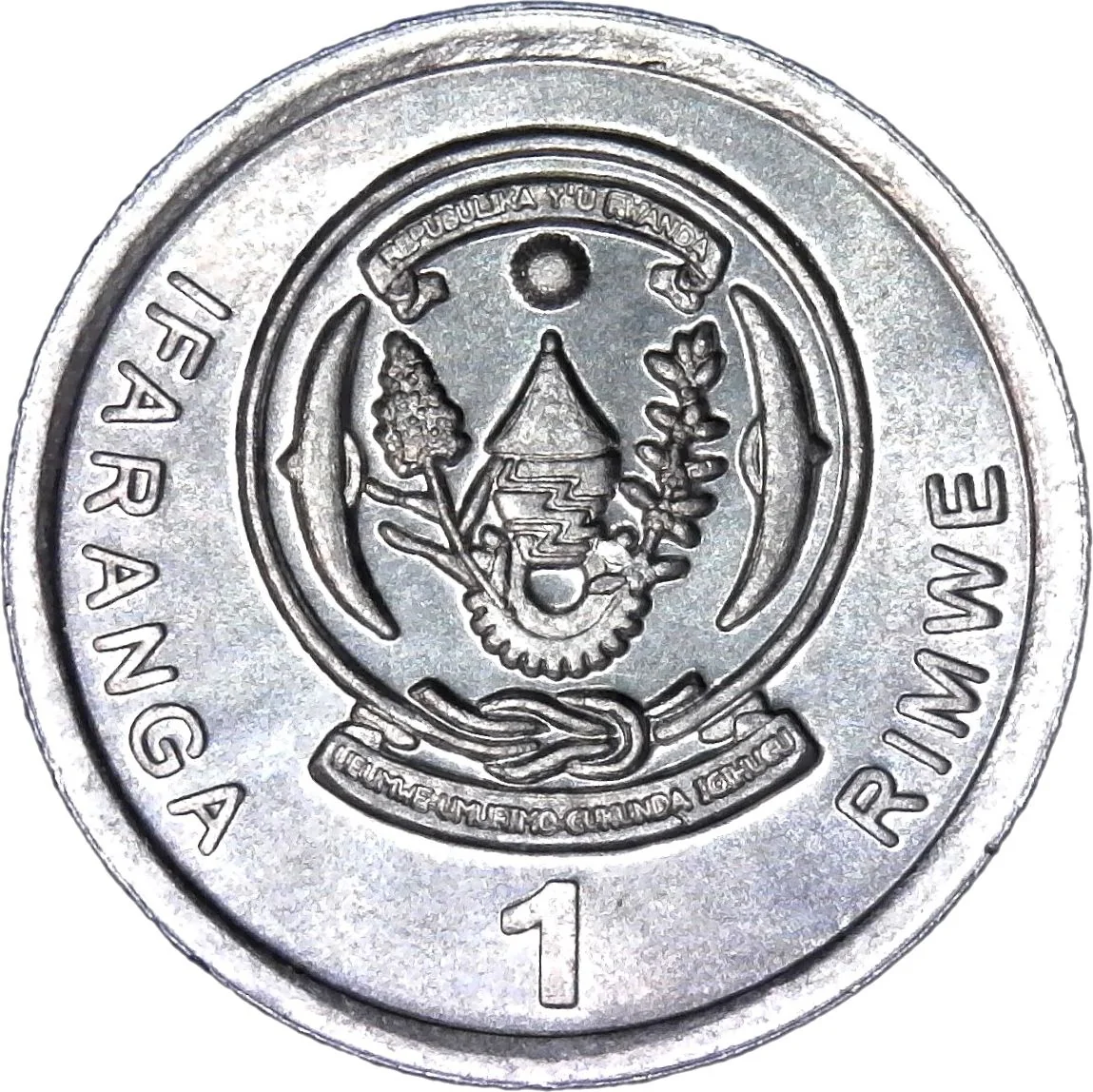
Obverse
Description:
Rwanda's national emblem.
Inscription:
REPUBLIKA Y'U RWANDA
UBUMWI UMURIMO GUKUNDA IGIHUGU
IFARANGA 1 RIMWE
UBUMWI UMURIMO GUKUNDA IGIHUGU
IFARANGA 1 RIMWE
Translation:
REPUBLIC OF RWANDA
LIBERTY WORK PATRIOTISM
1 FRANC ONE
LIBERTY WORK PATRIOTISM
1 FRANC ONE
Script: Latin
Language: Kinyarwanda
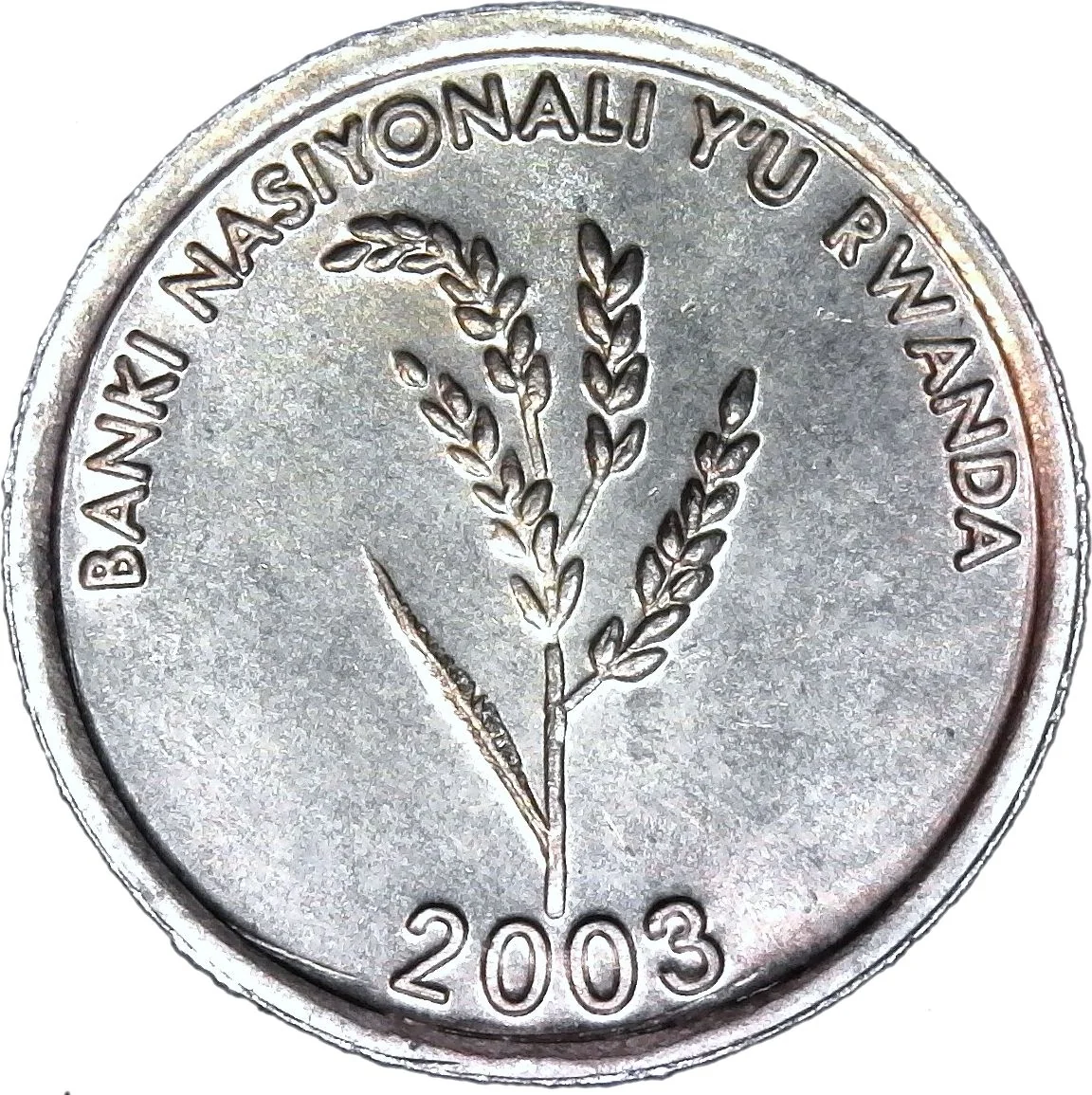
Reverse
Description:
Rice plant encircled by text and date.
Inscription:
BANK NASIYONALI Y'U RWANDA
2003
2003
Translation:
National Bank of Rwanda
2003
2003
Script: Latin
Languages: French, Kinyarwanda
Edge
Plain
Categories
| Agriculture |
| Symbols> Coat of Arms |
Mintings
| Year | Mint Mark | Mintage | Quality | Collection |
|---|---|---|---|---|
| 2003 | — | 2,500,000 |
Historical background
In 2003, Rwanda’s currency situation was characterized by relative stability and prudent management under the National Bank of Rwanda (BNR), a significant achievement given the country's recent history. The Rwandan franc (RWF) operated under a managed float, with its value influenced by market forces but actively stabilized by the central bank through strategic interventions. This period followed a major demonetization in 1995, which had successfully removed large amounts of old currency circulated during the genocide from the economy, helping to restore monetary control and confidence. By 2003, inflation was largely under control, averaging in the low single digits, which reflected disciplined fiscal and monetary policies supported by Rwanda's commitments under Heavily Indebted Poor Countries (HIPC) Initiative agreements.
The broader economic context was one of ambitious post-conflict reconstruction and poverty reduction, guided by the government's "Vision 2020" framework. A key focus was deepening financial inclusion and moving away from a cash-dominated society, though in 2003, currency in circulation remained essential for most transactions, particularly in rural areas. The stability of the franc was crucial for encouraging investment and implementing national development programs. The exchange rate regime effectively balanced the need for stability to foster growth with the flexibility to absorb external shocks, with the franc showing moderate and managed depreciation against major currencies like the US dollar to maintain export competitiveness.
Furthermore, Rwanda's currency stability in 2003 was underpinned by substantial donor support and debt relief, which bolstered foreign exchange reserves. This external assistance provided a buffer for the BNR to manage liquidity and exchange rate pressures. While the financial system was still developing, with limited foreign exchange market depth, the central bank's policies successfully provided a stable monetary environment. This stability formed a critical foundation for the rapid economic growth and financial sector modernization that would accelerate in the subsequent years.
The broader economic context was one of ambitious post-conflict reconstruction and poverty reduction, guided by the government's "Vision 2020" framework. A key focus was deepening financial inclusion and moving away from a cash-dominated society, though in 2003, currency in circulation remained essential for most transactions, particularly in rural areas. The stability of the franc was crucial for encouraging investment and implementing national development programs. The exchange rate regime effectively balanced the need for stability to foster growth with the flexibility to absorb external shocks, with the franc showing moderate and managed depreciation against major currencies like the US dollar to maintain export competitiveness.
Furthermore, Rwanda's currency stability in 2003 was underpinned by substantial donor support and debt relief, which bolstered foreign exchange reserves. This external assistance provided a buffer for the BNR to manage liquidity and exchange rate pressures. While the financial system was still developing, with limited foreign exchange market depth, the central bank's policies successfully provided a stable monetary environment. This stability formed a critical foundation for the rapid economic growth and financial sector modernization that would accelerate in the subsequent years.






🌱 Common