

10 francs – Rwanda
Add to wishlist
Rwanda
Context
Year: 1985
Issuer: Rwanda
Issuing organization: National Bank of Rwanda
Period:
(since 1962)
Currency:
(since 1964)
Demonetized: Yes
Total mintage: 8,000,000
Material
Diameter: 26.5 mm
Weight: 7 g
Shape: Round
Composition: Copper-nickel
Technique: Milled
Alignment: Coin alignment
flip
References
KM: #
Numista: #13113
Value
Exchange value: 10 RWF
Obverse
Description:
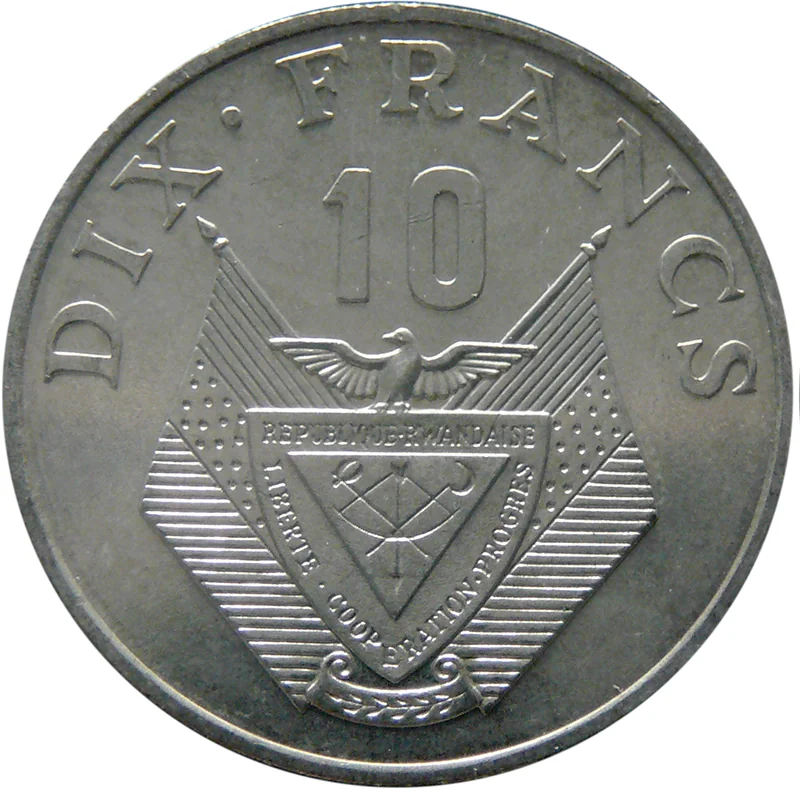
Rwanda's coat of arms bears the national motto.
Inscription:
DIX · FRANCS
10
RÉPUBLIQUE RWANDAISE
LIBERTÉ-COOPÉRATION-PROGRÈS
10
RÉPUBLIQUE RWANDAISE
LIBERTÉ-COOPÉRATION-PROGRÈS
Translation:
TEN FRANCS
10
RWANDAN REPUBLIC
LIBERTY-COOPERATION-PROGRESS
10
RWANDAN REPUBLIC
LIBERTY-COOPERATION-PROGRESS
Script: Latin
Language: French
Engraver: Leslie Durbin
Reverse
Description:
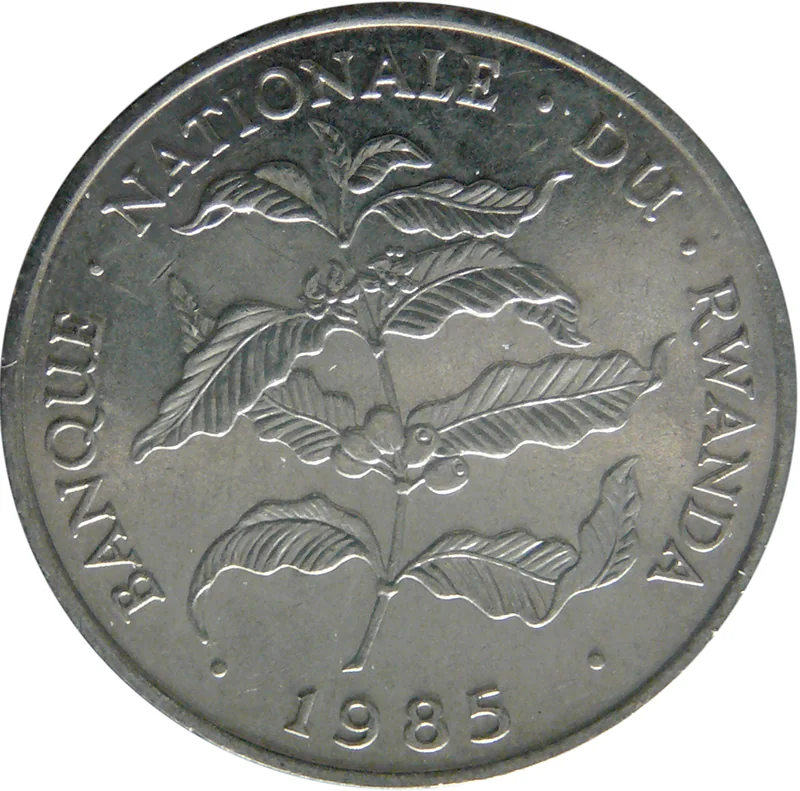
Coffee branch.
Inscription:
BANQUE · NATIONALE · DU · RWANDA
· 1985 ·
· 1985 ·
Translation:
NATIONAL BANK OF RWANDA
· 1985 ·
· 1985 ·
Script: Latin
Language: French
Engraver: Leslie Durbin
Edge
Plain
Categories
| Symbols> Coat of Arms |
Mints
| Name | Mark |
|---|---|
| Royal Mint | — |
Mintings
| Year | Mint Mark | Mintage | Quality | Collection |
|---|---|---|---|---|
| 1985 | — | 8,000,000 |
Historical background
In 1985, Rwanda's currency situation was characterized by relative stability but underlying fragility, heavily influenced by its colonial legacy and regional dynamics. The official currency remained the Rwandan franc (RWF), which had been introduced in 1964 to replace the Rwanda-Burundi franc following the dissolution of the monetary union with Burundi. The franc was pegged to a basket of currencies, with a strong historical linkage to the Belgian franc, reflecting Rwanda's close economic ties with Belgium. This peg provided a measure of stability against foreign exchange fluctuations, but the economy was fundamentally weak, relying heavily on exports of coffee and tea, which made it vulnerable to volatile global commodity prices.
The administration of President Juvénal Habyarimana, in power since 1973, maintained strict control over monetary policy and foreign exchange through the National Bank of Rwanda. Access to foreign currency was tightly regulated, and the official exchange rate was fixed by the central bank. However, this control masked economic strains. While inflation was moderate by regional standards, persistent trade deficits, declining terms of trade, and rising external debt were mounting pressures on the franc's stability. The economy was also hampered by land scarcity, rapid population growth, and inefficient state interventions.
Regionally, Rwanda was a member of the Economic Community of the Great Lakes Countries (CEPGL) along with Burundi and Zaire (now DR Congo), which envisioned monetary cooperation but had achieved little practical integration by 1985. Informally, the Kenyan shilling and Tanzanian shilling circulated in border areas due to trade, but the Rwandan franc remained dominant. The currency's apparent calm in 1985 was, in hindsight, a precarious plateau. Within less than a decade, the devastating genocide and civil war would shatter the economy, leading to hyperinflation and a complete monetary collapse, making the mid-1980s a final period of superficial stability before profound crisis.
The administration of President Juvénal Habyarimana, in power since 1973, maintained strict control over monetary policy and foreign exchange through the National Bank of Rwanda. Access to foreign currency was tightly regulated, and the official exchange rate was fixed by the central bank. However, this control masked economic strains. While inflation was moderate by regional standards, persistent trade deficits, declining terms of trade, and rising external debt were mounting pressures on the franc's stability. The economy was also hampered by land scarcity, rapid population growth, and inefficient state interventions.
Regionally, Rwanda was a member of the Economic Community of the Great Lakes Countries (CEPGL) along with Burundi and Zaire (now DR Congo), which envisioned monetary cooperation but had achieved little practical integration by 1985. Informally, the Kenyan shilling and Tanzanian shilling circulated in border areas due to trade, but the Rwandan franc remained dominant. The currency's apparent calm in 1985 was, in hindsight, a precarious plateau. Within less than a decade, the devastating genocide and civil war would shatter the economy, leading to hyperinflation and a complete monetary collapse, making the mid-1980s a final period of superficial stability before profound crisis.
🌱 Common