

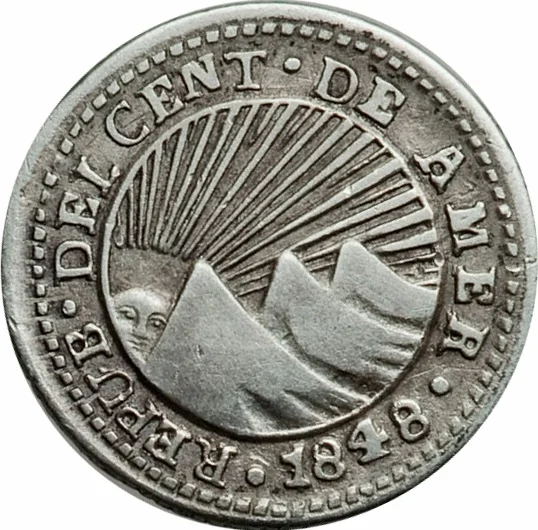
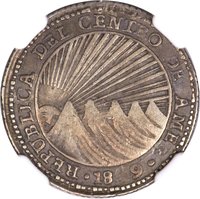
Obverse
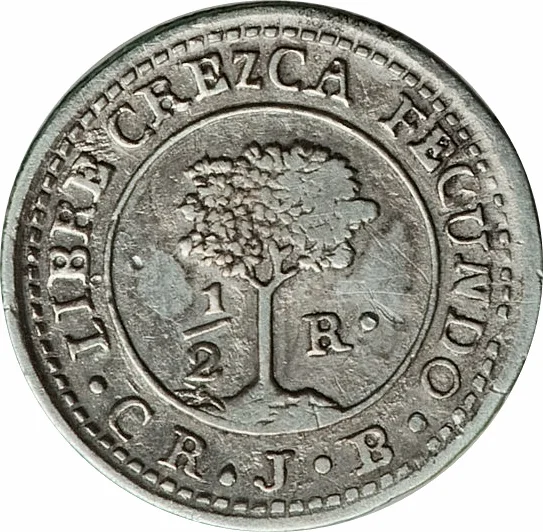
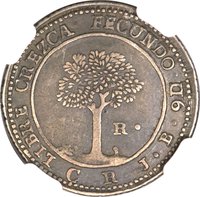
Reverse
Edge
Mints
| Name | Mark |
|---|---|
| Casa Nacional de Moneda de Costa Rica | CR |
Historical background
The currency situation in the Federal Republic of Central America in 1846 was one of profound disorder, reflecting the political disintegration of the union itself. The Federation had formally dissolved in 1841, leaving the five successor states—Guatemala, El Salvador, Honduras, Nicaragua, and Costa Rica—as independent nations. However, they inherited a chaotic monetary landscape characterized by a severe shortage of official coinage. The primary circulating medium remained the silver Spanish colonial real, but its supply was insufficient for economic needs, leading to a reliance on a confusing mix of foreign coins, including those from Peru, Bolivia, Mexico, and even the United States and Great Britain.
This scarcity and variety created significant commercial problems. Without a central authority to standardize value, the exchange rates between these heterogeneous coins fluctuated wildly from town to town, and their intrinsic silver content was often suspect due to wear and clipping. To facilitate trade, the individual states began authorizing the use of specific foreign coins by decree, effectively creating separate monetary zones. For example, Guatemala favored the Peruvian peso, while Costa Rica circulated Colombian and Chilean coinage. This patchwork system severely hampered inter-regional trade, one of the original goals of the Federation, and fostered counterfeiting and financial speculation.
Consequently, by 1846, each state was actively pursuing its own sovereign monetary solution. The most advanced was Costa Rica, which had already established its own mint in 1836 and was producing distinctive national coinage. The other states were in various stages of planning or implementing their own minting projects to replace the anachronistic colonial and foreign pieces. Thus, the currency situation in 1846 was a transitional period of competing monetary anarchy, marking the definitive end of any lingering financial unity and accelerating the separate economic destinies of the Central American nations.
This scarcity and variety created significant commercial problems. Without a central authority to standardize value, the exchange rates between these heterogeneous coins fluctuated wildly from town to town, and their intrinsic silver content was often suspect due to wear and clipping. To facilitate trade, the individual states began authorizing the use of specific foreign coins by decree, effectively creating separate monetary zones. For example, Guatemala favored the Peruvian peso, while Costa Rica circulated Colombian and Chilean coinage. This patchwork system severely hampered inter-regional trade, one of the original goals of the Federation, and fostered counterfeiting and financial speculation.
Consequently, by 1846, each state was actively pursuing its own sovereign monetary solution. The most advanced was Costa Rica, which had already established its own mint in 1836 and was producing distinctive national coinage. The other states were in various stages of planning or implementing their own minting projects to replace the anachronistic colonial and foreign pieces. Thus, the currency situation in 1846 was a transitional period of competing monetary anarchy, marking the definitive end of any lingering financial unity and accelerating the separate economic destinies of the Central American nations.
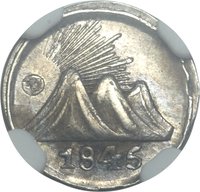
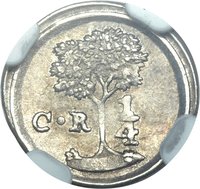
💎 Extremely Rare