

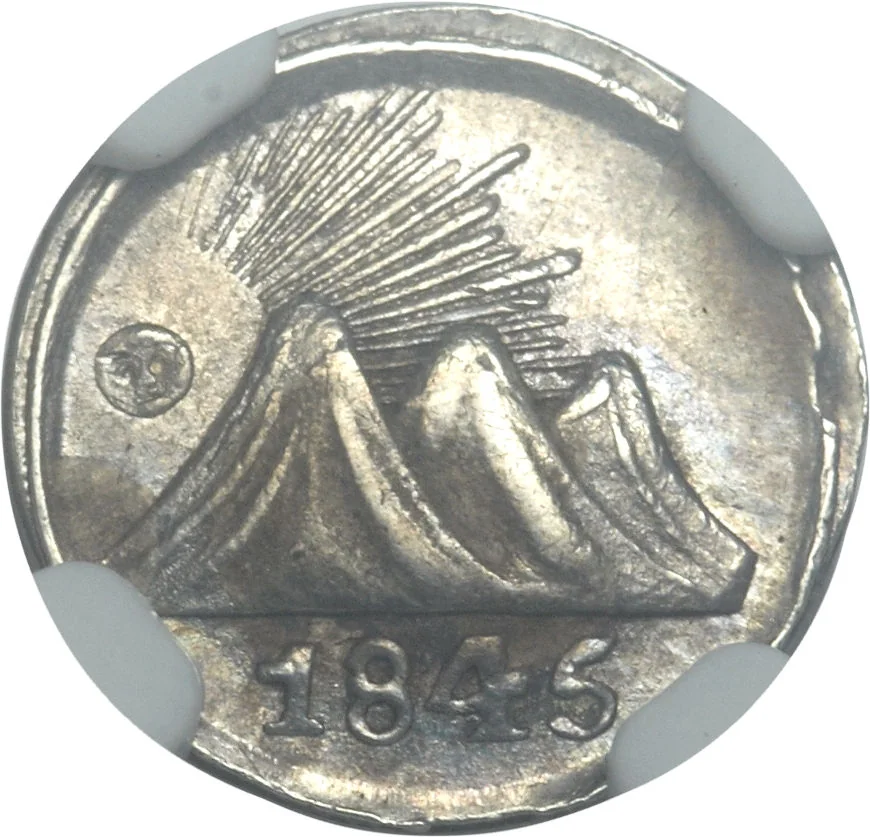
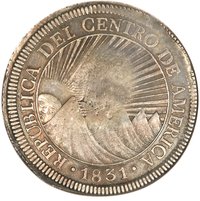
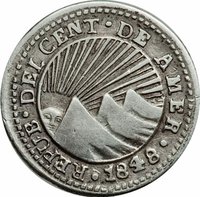
Obverse
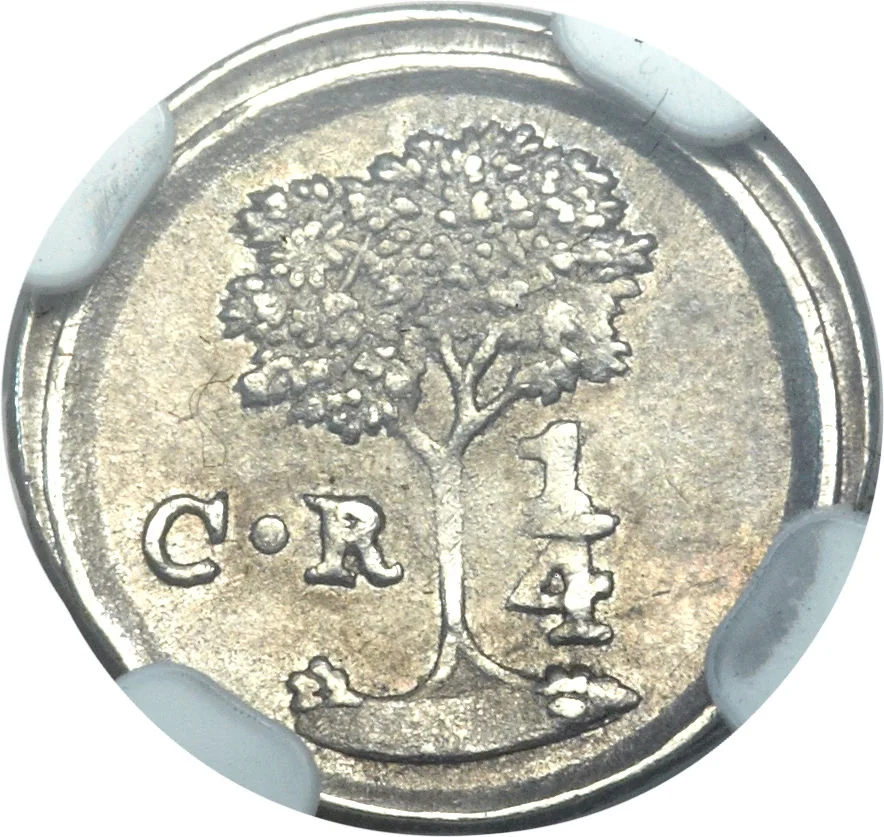
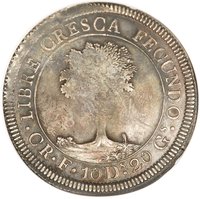
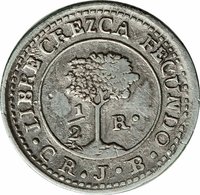
Reverse
Edge
Mints
| Name | Mark |
|---|---|
| Casa Nacional de Moneda de Costa Rica | CR |
Mintings
| Year | Mint Mark | Mintage | Quality | Collection |
|---|---|---|---|---|
| 1845 | CR | — |
Historical background
By 1845, the currency situation within the disintegrating Federal Republic of Central America was one of profound disorder and regional fragmentation. The federal government, which had collapsed in practical terms by 1839, no longer exercised any monetary authority, leaving the five successor states—Guatemala, El Salvador, Honduras, Nicaragua, and Costa Rica—to issue their own coinage and paper money. This led to a chaotic patchwork of currencies of varying weights, metallic content, and credibility, all circulating uneasily alongside a multitude of foreign coins, primarily Spanish colonial reales, British sovereigns, and French francs.
The primary circulating medium remained silver, specifically the old Spanish colonial real, but its value and acceptance were highly localized. Each state minted its own silver coins, often stamped with federal symbols but valued differently across borders. To finance deficits and wars, several states, notably El Salvador and Guatemala, also began issuing paper money, which was not backed by specie and quickly depreciated. This fiat money fueled inflation and was deeply distrusted by the public, leading to widespread preference for hard currency and further complicating interstate trade, which was already hampered by internal conflicts and tariffs.
Consequently, the region suffered from a severe lack of a uniform, trusted monetary standard. Exchange rates between the different state currencies were fluctuating and arbitrary, creating a significant barrier to economic recovery and integration. The situation in 1845 was, therefore, a direct reflection of the political fragmentation: monetary anarchy mirrored the civil strife, with no central bank, no coordinated policy, and no prospect for a common currency, deeply entrenching economic instability as a defining feature of the post-federal period.
The primary circulating medium remained silver, specifically the old Spanish colonial real, but its value and acceptance were highly localized. Each state minted its own silver coins, often stamped with federal symbols but valued differently across borders. To finance deficits and wars, several states, notably El Salvador and Guatemala, also began issuing paper money, which was not backed by specie and quickly depreciated. This fiat money fueled inflation and was deeply distrusted by the public, leading to widespread preference for hard currency and further complicating interstate trade, which was already hampered by internal conflicts and tariffs.
Consequently, the region suffered from a severe lack of a uniform, trusted monetary standard. Exchange rates between the different state currencies were fluctuating and arbitrary, creating a significant barrier to economic recovery and integration. The situation in 1845 was, therefore, a direct reflection of the political fragmentation: monetary anarchy mirrored the civil strife, with no central bank, no coordinated policy, and no prospect for a common currency, deeply entrenching economic instability as a defining feature of the post-federal period.
✨ Legendary