

100 Euro – Austria
Austria

Obverse
Description:
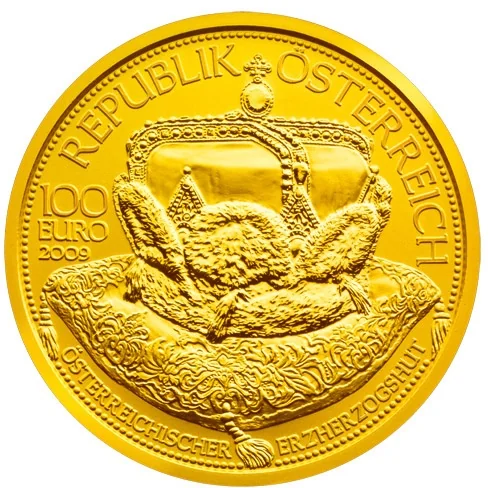
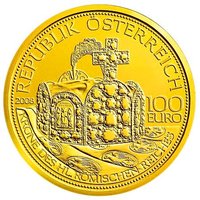
The Archducal Crown, nicknamed the ‘Archduke’s Hat’ for its red velvet lining, was a ceremonial symbol never used in coronations. This exquisitely beautiful relic is featured as the second coin in our Crowns of the House of Habsburg series.
Inscription:
REPUPLIK ÖSTERREICH
100
EURO
2009
ÖSTERREICHISCHER ERZHERZOGSHUT
100
EURO
2009
ÖSTERREICHISCHER ERZHERZOGSHUT
Translation:
REPUBLIC OF AUSTRIA
100
EURO
2009
AUSTRIAN ARCHDUKE'S HAT
100
EURO
2009
AUSTRIAN ARCHDUKE'S HAT
Script: Latin
Language: German
Designer: Helmut Andexlinger
Reverse
Inscription:
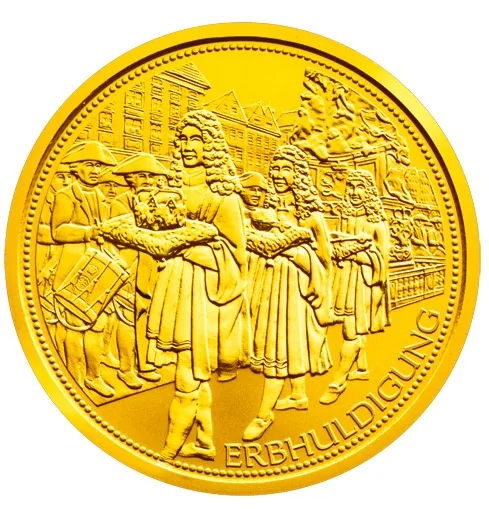
ERBHULDIGUNG
Script: Latin
Edge
Mints
| Name | Mark |
|---|---|
| Münze Österreich | — |
Mintings
| Year | Mint Mark | Mintage | Quality | Collection |
|---|---|---|---|---|
| 2009 | — | 30,000 | Proof |
Historical background
In 2009, Austria, as a member of the Eurozone, used the euro (€) as its official currency, having fully adopted it in 2002 and phased out the Austrian schilling. The global financial crisis, which began in 2008, was the dominant economic backdrop, leading to a severe recession across the continent. For Austria, this meant a significant contraction in GDP, a sharp rise in unemployment, and substantial stress on its banking sector, which had heavy exposure to Central and Eastern European markets. The euro's status as a shared currency meant Austria's monetary policy was set by the European Central Bank (ECB), which responded to the crisis with interest rate cuts and measures to ensure liquidity in the financial system.
The currency situation was marked by stability in the euro's exchange rate against major currencies like the US dollar, but underlying vulnerabilities were exposed. Austria's specific challenge was the crisis within its large banking institutions, particularly Hypo Alpe-Adria, which required a costly nationalization in December 2009 to prevent its collapse. This event underscored how national financial stability within the Eurozone was interconnected, as the banks' troubles stemmed from cross-border lending. There was no discussion of leaving the euro, but the crisis intensified debates about the need for stricter EU-wide financial regulation and banking supervision.
Overall, 2009 was a year where Austria managed the consequences of the financial crisis within the framework of the common European currency. The euro provided exchange rate stability and eliminated currency risk within the Eurozone, but it also meant Austria had no independent monetary policy tools to devalue its currency or set bespoke interest rates to combat the recession. The focus was instead on national fiscal stimulus and bank bailouts, while looking to the ECB for broader monetary support, setting the stage for the subsequent European sovereign debt crisis that would fully erupt in 2010.
The currency situation was marked by stability in the euro's exchange rate against major currencies like the US dollar, but underlying vulnerabilities were exposed. Austria's specific challenge was the crisis within its large banking institutions, particularly Hypo Alpe-Adria, which required a costly nationalization in December 2009 to prevent its collapse. This event underscored how national financial stability within the Eurozone was interconnected, as the banks' troubles stemmed from cross-border lending. There was no discussion of leaving the euro, but the crisis intensified debates about the need for stricter EU-wide financial regulation and banking supervision.
Overall, 2009 was a year where Austria managed the consequences of the financial crisis within the framework of the common European currency. The euro provided exchange rate stability and eliminated currency risk within the Eurozone, but it also meant Austria had no independent monetary policy tools to devalue its currency or set bespoke interest rates to combat the recession. The focus was instead on national fiscal stimulus and bank bailouts, while looking to the ECB for broader monetary support, setting the stage for the subsequent European sovereign debt crisis that would fully erupt in 2010.
Series: Crown of the Habsburgs
💎 Extremely Rare