

Obverse
Description:
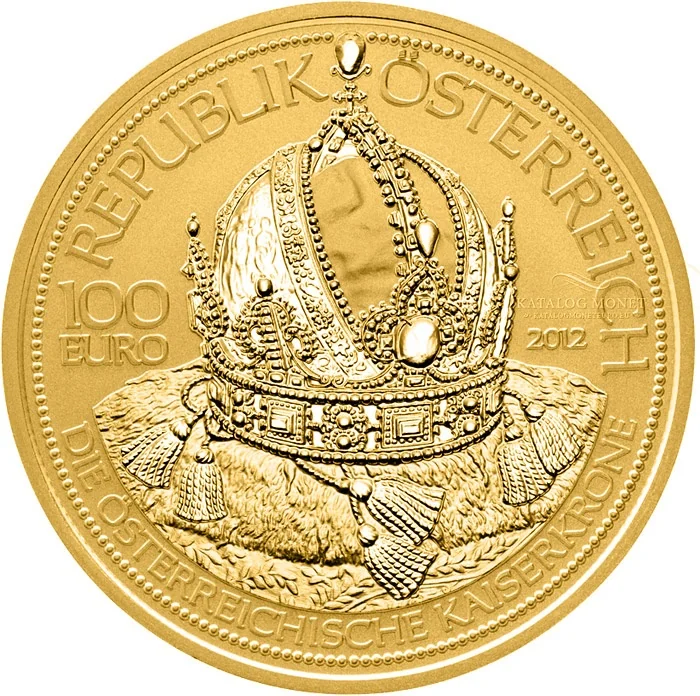
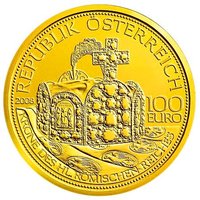
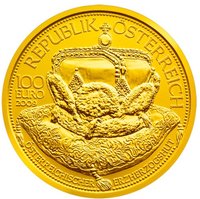
The obverse intricately depicts the Austrian Imperial Crown. Its three parts—a jeweled base circle with eight lilies, a high arch set with diamonds and a top emerald, and a mitre with enameled bands and engraved scenes from Rudolf II's life—mirror the Crown of the Holy Roman Empire. Also featured are the issuing country "Republik Oesterreich," face value, year, and the crown's name, all within a pearl border. This side was engraved by Thomas Pesendorfer, who spent over 40 hours carving the plaster model.
Inscription:
REPUBLIK ÖSTERREICH
100 EURO
2012
DIE ÖSTERREICHISCHE KAISERKRONE
100 EURO
2012
DIE ÖSTERREICHISCHE KAISERKRONE
Translation:
REPUBLIC OF AUSTRIA
100 EURO
2012
THE AUSTRIAN IMPERIAL CROWN
100 EURO
2012
THE AUSTRIAN IMPERIAL CROWN
Script: Latin
Language: German
Engraver: Thomas Pesendorfer
Reverse
Description:
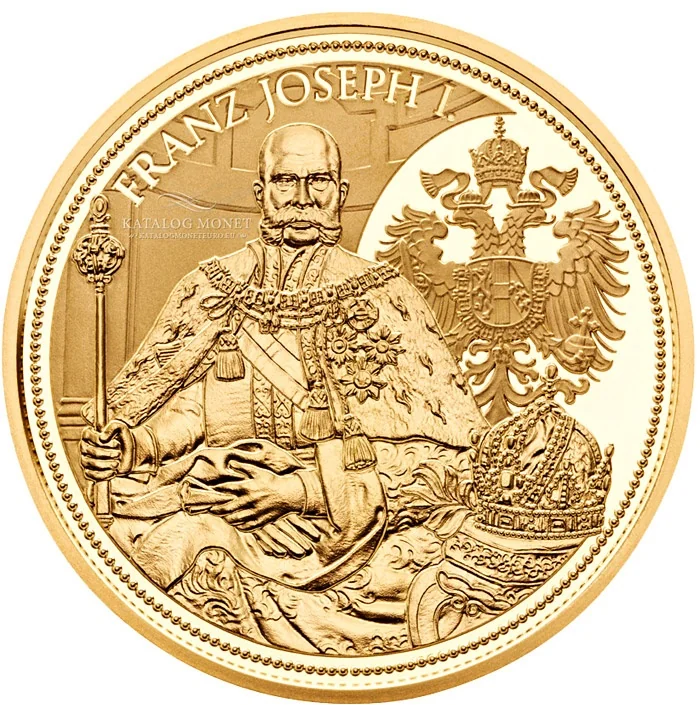
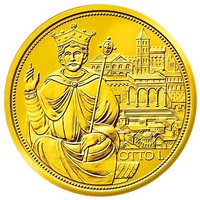
The reverse depicts Emperor Francis Joseph I in Austrian imperial robes, based on a Julius Viktor Berger painting. The detailed portrait shows him in an embroidered robe and mantle, adorned with Habsburg orders and the Order of the Golden Fleece. He holds the jeweled Imperial sceptre, while the Imperial Crown rests on a cushion beside the double-headed eagle. Engraver Helmut Andexlinger adapted the portrait to appear more friendly and described the meticulous work on the small coin as “very challenging.”
The Habsburg dynasty, lasting over 800 years, used the crown and robes for investiture ceremonies rather than coronations. The Imperial Crown, crafted in 1602 for Rudolf II by Jan Vermeyen, remains a masterpiece of goldsmithing and is kept in Vienna’s Imperial Treasury. The Order of the Golden Fleece, founded in 1430, is among Europe's most prestigious orders. Restricted to a limited number of knights, its sovereign consulted the order on major state decisions, including war.
The Habsburg dynasty, lasting over 800 years, used the crown and robes for investiture ceremonies rather than coronations. The Imperial Crown, crafted in 1602 for Rudolf II by Jan Vermeyen, remains a masterpiece of goldsmithing and is kept in Vienna’s Imperial Treasury. The Order of the Golden Fleece, founded in 1430, is among Europe's most prestigious orders. Restricted to a limited number of knights, its sovereign consulted the order on major state decisions, including war.
Inscription:
FRANZ JOSEPH I.
Script: Latin
Engraver: Helmut Andexlinger
Edge
Plain
Mints
| Name | Mark |
|---|---|
| Münze Österreich | — |
Mintings
| Year | Mint Mark | Mintage | Quality | Collection |
|---|---|---|---|---|
| 2012 | — | 30,000 | Proof |
Historical background
In 2012, Austria was a stable and integral member of the Eurozone, having adopted the euro as its physical currency in 2002. The country's financial system was considered robust, with a conservative banking sector that had weathered the initial 2008 global financial crisis relatively well. However, the overarching currency situation was dominated not by domestic Austrian policy, but by the severe existential crisis of the euro itself. Austria, as a member of the European Union's core, was deeply invested in the stability of the single currency and was directly affected by the sovereign debt turmoil emanating from Southern Europe, particularly Greece.
The primary concern for Austrian authorities and financial institutions was their significant exposure to the economies of Central, Eastern, and Southeastern Europe (CESEE), where Austrian banks had extensive operations. While these investments were profitable, they created vulnerability as the euro crisis threatened to cause regional economic slowdowns or banking stress. Domestically, Austria maintained a strong fiscal position with a low deficit and enjoyed a AAA credit rating, which provided a buffer. Public debate centered on Austria's contributions to Eurozone bailout funds like the European Financial Stability Facility (EFSF) and the future European Stability Mechanism (ESM), with some political factions expressing concern over the costs of safeguarding the currency union.
Ultimately, Austria’s 2012 currency context was one of a stable national position within a turbulent common currency area. The government, under Chancellor Werner Faymann, was a firm supporter of the European Central Bank's efforts to preserve the euro, including the "whatever it takes" stance announced by ECB President Mario Draghi in mid-2012. The year concluded with Austria navigating the dual imperatives of supporting collective Eurozone stability measures while managing its own banking sector's external exposures, all within a framework of continued commitment to the European single currency project.
The primary concern for Austrian authorities and financial institutions was their significant exposure to the economies of Central, Eastern, and Southeastern Europe (CESEE), where Austrian banks had extensive operations. While these investments were profitable, they created vulnerability as the euro crisis threatened to cause regional economic slowdowns or banking stress. Domestically, Austria maintained a strong fiscal position with a low deficit and enjoyed a AAA credit rating, which provided a buffer. Public debate centered on Austria's contributions to Eurozone bailout funds like the European Financial Stability Facility (EFSF) and the future European Stability Mechanism (ESM), with some political factions expressing concern over the costs of safeguarding the currency union.
Ultimately, Austria’s 2012 currency context was one of a stable national position within a turbulent common currency area. The government, under Chancellor Werner Faymann, was a firm supporter of the European Central Bank's efforts to preserve the euro, including the "whatever it takes" stance announced by ECB President Mario Draghi in mid-2012. The year concluded with Austria navigating the dual imperatives of supporting collective Eurozone stability measures while managing its own banking sector's external exposures, all within a framework of continued commitment to the European single currency project.
Series: Crown of the Habsburgs
💎 Extremely Rare