

1 cent – Jamaica
Add to wishlist
Jamaica
Context
Years: 1969–1971
Issuer: Jamaica
Ruler: Elizabeth II
Currency:
(since 1969)
Demonetization: 15 February 2018
Total mintage: 45,861,000
Material
References
KM: #
Numista: #5787
Value
Exchange value: 0.01 JMD
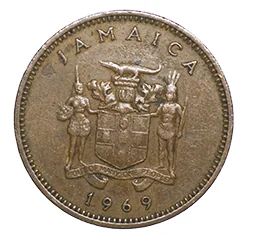
Obverse
Description:
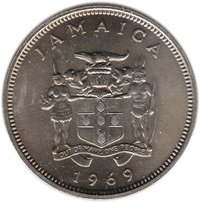
Jamaican coat of arms.
Inscription:
JAMAICA
1969
OUT OF MANY ONE PEOPLE
1969
OUT OF MANY ONE PEOPLE
Translation:
JAMAICA
1969
OUT OF MANY ONE PEOPLE
1969
OUT OF MANY ONE PEOPLE
Script: Latin
Language: English
Engraver: Christopher Ironside
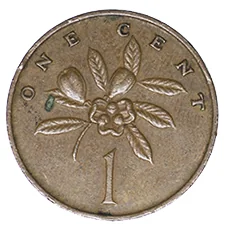
Reverse
Description:
Ackee fruit at centre, value below.
Inscription:
ONE CENT
1
1
Script: Latin
Engraver: Christopher Ironside
Edge
Plain
Categories
| Symbols> Coat of Arms |
| Plant> Fruit |
Mints
| Name | Mark |
|---|---|
| Franklin Mint | — |
| Royal Mint | — |
Mintings
| Year | Mint Mark | Mintage | Quality | Collection |
|---|---|---|---|---|
| 1969 | — | 30,200,000 | ||
| 1969 | — | 19,000 | Proof | |
| 1970 | — | 5,000 | Matte | |
| 1970 | — | 10,000,000 | ||
| 1970 | — | 12,000 | Proof | |
| 1971 | — | 5,625,000 |
Historical background
In 1969, Jamaica’s currency situation was defined by its recent transition to a decimal system and its ongoing peg to sterling within the broader context of the Bretton Woods fixed exchange rate regime. Just two years prior, in 1967, the country had introduced the Jamaican dollar (JMD), replacing the Jamaican pound and ending the centuries-old system of pounds, shillings, and pence. This new decimal currency was initially pegged at par with the British pound sterling (JMD 1 = £1 sterling), a reflection of Jamaica’s deep historical and economic ties to the United Kingdom as a recently independent nation (since 1962).
Economically, the fixed peg to sterling provided stability for trade and investment but also tied Jamaica’s monetary policy closely to that of the United Kingdom. This period was one of relative currency stability, with the Jamaican dollar maintaining its parity. However, the external environment was beginning to shift. The late 1960s saw growing pressures on the Bretton Woods system, and the British pound itself had been devalued in 1967, which automatically devalued the Jamaican dollar against the US dollar by the same margin. This underscored a vulnerability: Jamaica’s peg meant its currency was indirectly affected by economic events in Britain, not solely by domestic conditions.
Looking ahead, the stability of 1969 was precarious. The Jamaican economy remained heavily dependent on exports of bauxite/alumina, sugar, and bananas, making it susceptible to commodity price swings. Within a few years, the global monetary landscape would be upended by the collapse of Bretton Woods and the 1972 sterling float, forcing Jamaica to reconsider its peg. The subsequent decade would see significant economic challenges, leading to a shift in 1973 to a peg against the US dollar and, eventually, to a managed float. Thus, 1969 represents a calm before the storm, a final year of a seemingly stable colonial-era monetary order soon to be transformed by global and domestic pressures.
Economically, the fixed peg to sterling provided stability for trade and investment but also tied Jamaica’s monetary policy closely to that of the United Kingdom. This period was one of relative currency stability, with the Jamaican dollar maintaining its parity. However, the external environment was beginning to shift. The late 1960s saw growing pressures on the Bretton Woods system, and the British pound itself had been devalued in 1967, which automatically devalued the Jamaican dollar against the US dollar by the same margin. This underscored a vulnerability: Jamaica’s peg meant its currency was indirectly affected by economic events in Britain, not solely by domestic conditions.
Looking ahead, the stability of 1969 was precarious. The Jamaican economy remained heavily dependent on exports of bauxite/alumina, sugar, and bananas, making it susceptible to commodity price swings. Within a few years, the global monetary landscape would be upended by the collapse of Bretton Woods and the 1972 sterling float, forcing Jamaica to reconsider its peg. The subsequent decade would see significant economic challenges, leading to a shift in 1973 to a peg against the US dollar and, eventually, to a managed float. Thus, 1969 represents a calm before the storm, a final year of a seemingly stable colonial-era monetary order soon to be transformed by global and domestic pressures.
Series: 1969 series
🌱 Very Common