

10 kroner (Henrik Wergeland) – Norway
Add to wishlist
Circulating commemorative coins
Commemoration: Henrik Wergeland 200 years
Norway
Context
Material
References
KM: #
Numista: #11072
Value
Exchange value: 10 NOK
Inflation-adjusted value: 16.04 NOK
Obverse
Description:
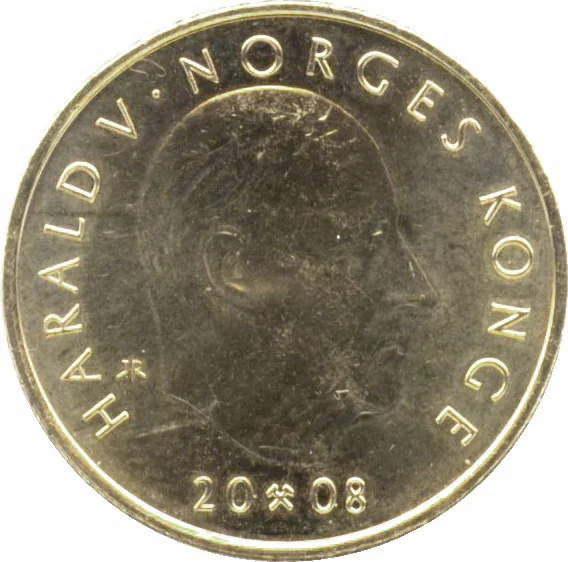
King Harald V bust facing right. Engraver's initials behind bust. Inscription surrounds. Date split by mintmark below. Solid rim ring.
Inscription:
HARALD V · NORGES KONGE
IAR
20 ⚒ 08
IAR
20 ⚒ 08
Translation:
Harald V, Norway's King
IAR
20 08
IAR
20 08
Script: Latin
Engraver: Ingrid Austlid Rise
Reverse
Description:
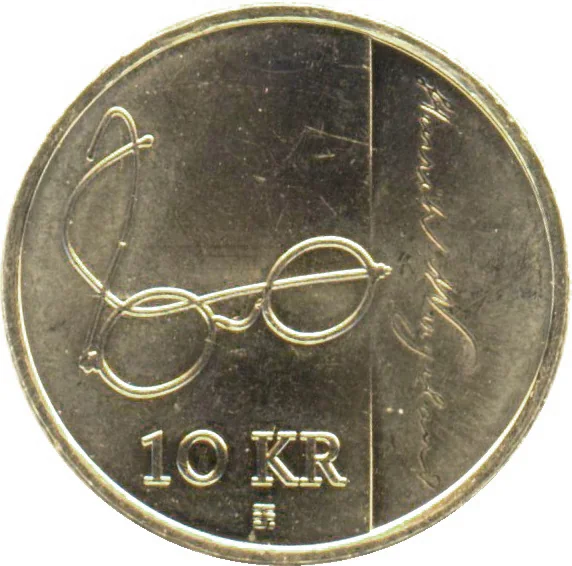
Henrik Wergeland's glasses and signature. The coin's surface is split, with one part resembling billowing paper. Value under glasses, designer's initials below, signature on right. Solid rim.
Inscription:
Henrik Wergeland
10 KR
EF.
10 KR
EF.
Scripts: Latin, Latin (cursive)
Engraver: Ingrid Austlid Rise
Designer: Enzo Finger
Edge
Segmented reeding.
Categories
| Art> Literature |
| Event> Birth anniversary |
Mints
| Name | Mark |
|---|---|
| Norwegian Mint | — |
Mintings
| Year | Mint Mark | Mintage | Quality | Collection |
|---|---|---|---|---|
| 2008 | — | 4,596,000 | ||
| 2008 | — | 2,271 | BU | |
| 2008 | — | 6,591 | Proof |
Historical background
In 2008, Norway's currency situation was defined by its stark contrast to the global financial crisis unfolding elsewhere. While many economies faced severe distress, Norway entered the period with exceptional fundamental strengths: vast sovereign wealth from oil and gas exports (the Government Pension Fund Global), large budget and current account surpluses, low public debt, and a robustly capitalized banking system. Consequently, the Norwegian krone (NOK) was traditionally seen as a stable and resilient currency, often influenced more by oil prices and domestic interest rate decisions than by global financial panic.
However, the krone experienced significant volatility as the crisis intensified in the autumn of 2008. Following the collapse of Lehman Brothers, a global rush for liquidity and safe-haven assets led to a dramatic appreciation of currencies like the US dollar and Japanese yen. The NOK, considered a riskier commodity currency, sold off sharply despite Norway's strong fundamentals. From September to October, the krone depreciated by approximately 30% against the euro, reflecting the extreme risk aversion and deleveraging in international markets that overwhelmed Norway's positive economic backdrop.
In response, Norges Bank, the country's central bank, took aggressive action to stabilize markets and the economy. It implemented a series of emergency interest rate cuts, slashing its key policy rate from 5.75% in September to a historic low of 1.25% by June 2009. Additionally, it provided extraordinary liquidity to ensure the functioning of the domestic money and foreign exchange markets. These measures, combined with a swift government fiscal stimulus and the eventual calming of global markets, helped the krone recover a substantial portion of its losses by the end of 2009, underscoring the temporary nature of the shock to Norway's otherwise solid financial position.
However, the krone experienced significant volatility as the crisis intensified in the autumn of 2008. Following the collapse of Lehman Brothers, a global rush for liquidity and safe-haven assets led to a dramatic appreciation of currencies like the US dollar and Japanese yen. The NOK, considered a riskier commodity currency, sold off sharply despite Norway's strong fundamentals. From September to October, the krone depreciated by approximately 30% against the euro, reflecting the extreme risk aversion and deleveraging in international markets that overwhelmed Norway's positive economic backdrop.
In response, Norges Bank, the country's central bank, took aggressive action to stabilize markets and the economy. It implemented a series of emergency interest rate cuts, slashing its key policy rate from 5.75% in September to a historic low of 1.25% by June 2009. Additionally, it provided extraordinary liquidity to ensure the functioning of the domestic money and foreign exchange markets. These measures, combined with a swift government fiscal stimulus and the eventual calming of global markets, helped the krone recover a substantial portion of its losses by the end of 2009, underscoring the temporary nature of the shock to Norway's otherwise solid financial position.
🌱 Common