

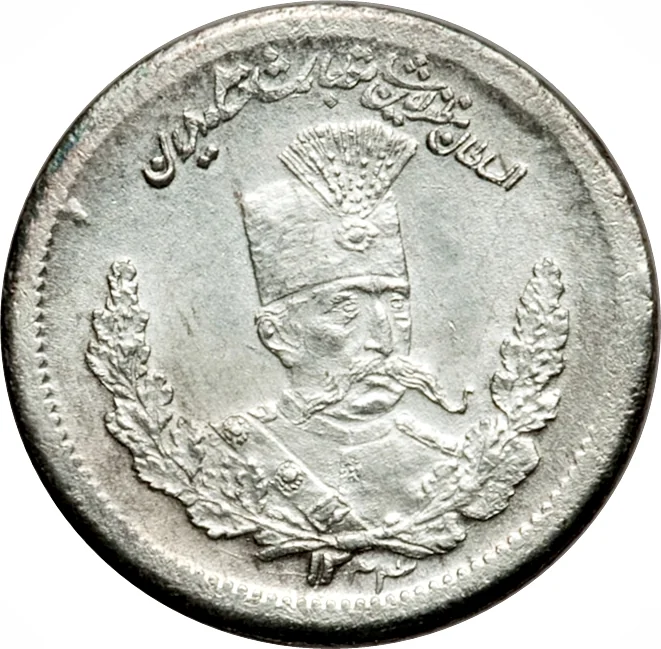
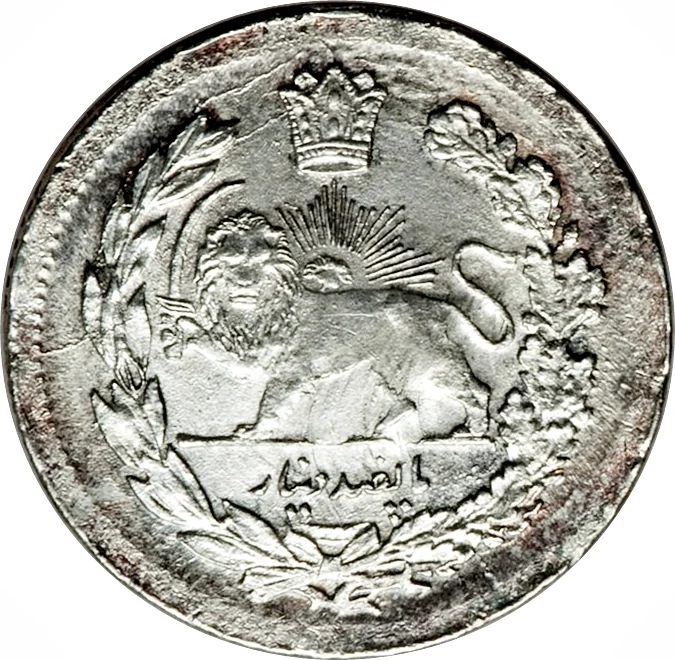
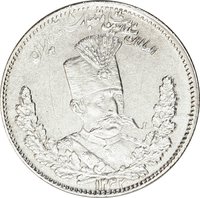
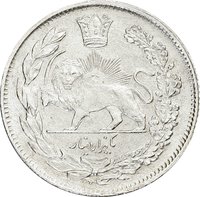
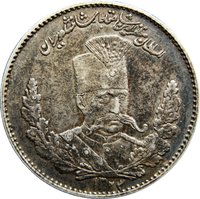
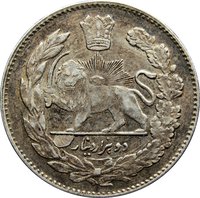
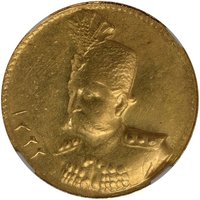
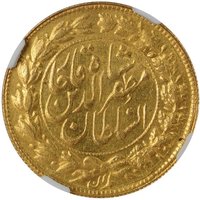
500 dinars – Iran
Add to wishlist
Iran
Context
Year: 1905
Islamic (Hijri) Year:: 1323
Issuer: Iran
Ruler: Mozaffar ad-Din Shah
Currency:
(1825—1932)
Demonetized: Yes
Material
References
KM: #
Numista: #57374
Value
Bullion value: $5.16
Mintings
| Year | Mint Mark | Mintage | Quality | Collection |
|---|---|---|---|---|
| 1905 | — | — |
Historical background
In 1905, Iran's currency system was in a state of profound disarray, a direct legacy of the Qajar dynasty's long-term economic mismanagement and foreign interference. The monetary landscape was a chaotic patchwork of domestic and foreign coins. Domestically, the primary silver coin was the kran, but its value and silver content had been severely debased over decades to fund royal extravagance and state deficits. Alongside it circulated a bewildering variety of gold tomans, copper shahis, and coins from regional mints, all with fluctuating and unreliable values. Crucially, foreign currencies, particularly the Russian ruble and British pound sterling, dominated major transactions and foreign trade, undermining national sovereignty and making the economy vulnerable to external pressures.
This monetary chaos was exacerbated by a severe shortage of silver, the metal backing the primary currency. The government lacked a central bank or unified minting authority, leading to inconsistent coin production. Consequently, counterfeiting was rampant, and exchange rates could vary dramatically between cities and even bazaars. This instability crippled domestic commerce, as merchants faced constant uncertainty, and made the state's fiscal planning nearly impossible. The inability to control its own currency was a glaring symbol of the Qajar state's weakness.
The currency crisis was not an isolated issue but a core grievance fueling the burgeoning Constitutional Revolution, which would erupt in full force in 1905-1906. The merchant class (bazaaris), whose livelihoods were directly harmed by the unpredictable monetary environment, became central figures in the opposition movement. Their demands for a "House of Justice" included calls for financial and monetary reform, seeking a stable, standardized currency as a foundation for a modern, independent nation-state. Thus, in 1905, the state of Iran's currency was both a symptom of systemic decay and a powerful catalyst for revolutionary change.
This monetary chaos was exacerbated by a severe shortage of silver, the metal backing the primary currency. The government lacked a central bank or unified minting authority, leading to inconsistent coin production. Consequently, counterfeiting was rampant, and exchange rates could vary dramatically between cities and even bazaars. This instability crippled domestic commerce, as merchants faced constant uncertainty, and made the state's fiscal planning nearly impossible. The inability to control its own currency was a glaring symbol of the Qajar state's weakness.
The currency crisis was not an isolated issue but a core grievance fueling the burgeoning Constitutional Revolution, which would erupt in full force in 1905-1906. The merchant class (bazaaris), whose livelihoods were directly harmed by the unpredictable monetary environment, became central figures in the opposition movement. Their demands for a "House of Justice" included calls for financial and monetary reform, seeking a stable, standardized currency as a foundation for a modern, independent nation-state. Thus, in 1905, the state of Iran's currency was both a symptom of systemic decay and a powerful catalyst for revolutionary change.
💎 Extremely Rare