

5 cents – Ceylon
Add to wishlist
Sri Lanka
Context
Material
Weight: 3.9 g
Thickness: 1.71 mm
Shape: Square with rounded corners
Composition: Copper-nickel
Technique: Milled
Alignment: Medal alignment
flip
References
KM: #
Numista: #5691
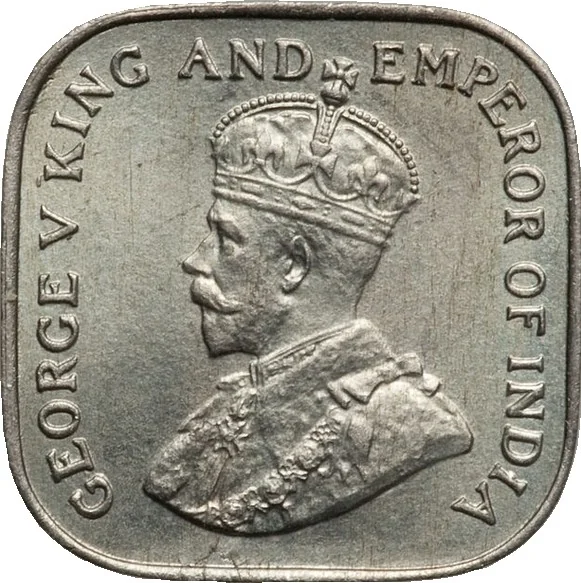
Obverse
Description:
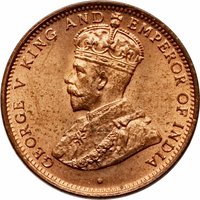
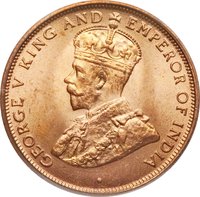
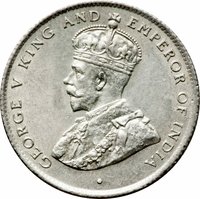
Crowned left-facing bust.
Inscription:
GEORGE V KING AND EMPEROR OF INDIA
Translation:
GEORGE V KING AND EMPEROR OF INDIA
Language: English
Engraver: Edgar Bertram MacKennal
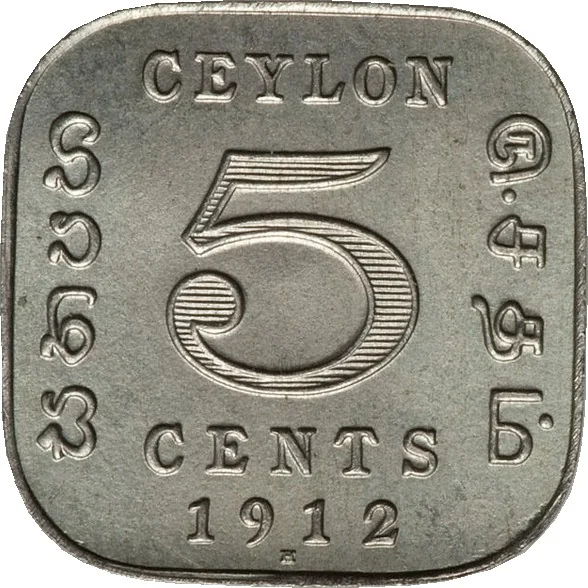
Reverse
Edge
Plain
Mintings
| Year | Mint Mark | Mintage | Quality | Collection |
|---|---|---|---|---|
| 1912 | H | 4,000,000 | ||
| 1920 | — | 6,000,000 | ||
| 1926 | — | 3,000,000 |
Historical background
In 1912, Ceylon's currency was firmly integrated into the British imperial monetary system, operating on a gold-exchange standard with the Indian rupee as its principal legal tender. The island had no central bank of its own; instead, the currency was managed by the Ceylon Currency Board, a colonial institution that ensured a fixed parity between the Ceylon rupee and the Indian rupee (at 1:1). This system was designed to facilitate trade and administrative efficiency within the Empire, particularly with India, which was Ceylon's dominant trading partner. The physical currency in circulation consisted of Indian rupee coins and notes, alongside limited issues of distinctive Ceylonese copper and silver subsidiary coinage.
This monetary arrangement, while ensuring stability, meant that Ceylon had no independent control over its money supply or interest rates, as these were effectively dictated by the policies governing the Indian rupee and the flow of sterling. The colony's currency was fully backed by sterling reserves held in London, guaranteeing convertibility. This structure tied Ceylon's economic fortunes directly to the management of the Indian economy and the broader strength of the British pound, making it vulnerable to decisions made in Calcutta and London rather than Colombo.
The year 1912 fell within a period of relative monetary stability for the colony, but the system was not without its critics. Local planters and merchants occasionally expressed concerns about exchange rate rigidity and the cost of remitting funds to London. Furthermore, the reliance on Indian rupees caused periodic shortages of small change, disrupting daily commerce. These underlying tensions would persist and eventually lead to monetary reforms in the following decades, culminating in the creation of a separate Ceylon rupee in 1938.
This monetary arrangement, while ensuring stability, meant that Ceylon had no independent control over its money supply or interest rates, as these were effectively dictated by the policies governing the Indian rupee and the flow of sterling. The colony's currency was fully backed by sterling reserves held in London, guaranteeing convertibility. This structure tied Ceylon's economic fortunes directly to the management of the Indian economy and the broader strength of the British pound, making it vulnerable to decisions made in Calcutta and London rather than Colombo.
The year 1912 fell within a period of relative monetary stability for the colony, but the system was not without its critics. Local planters and merchants occasionally expressed concerns about exchange rate rigidity and the cost of remitting funds to London. Furthermore, the reliance on Indian rupees caused periodic shortages of small change, disrupting daily commerce. These underlying tensions would persist and eventually lead to monetary reforms in the following decades, culminating in the creation of a separate Ceylon rupee in 1938.
🌱 Very Common