

50 Pfennigs – Germany
Germany
Context

Material
References
KM: #Click to copy to clipboard8
Numista: #5618
Value
Bullion value: $7.09
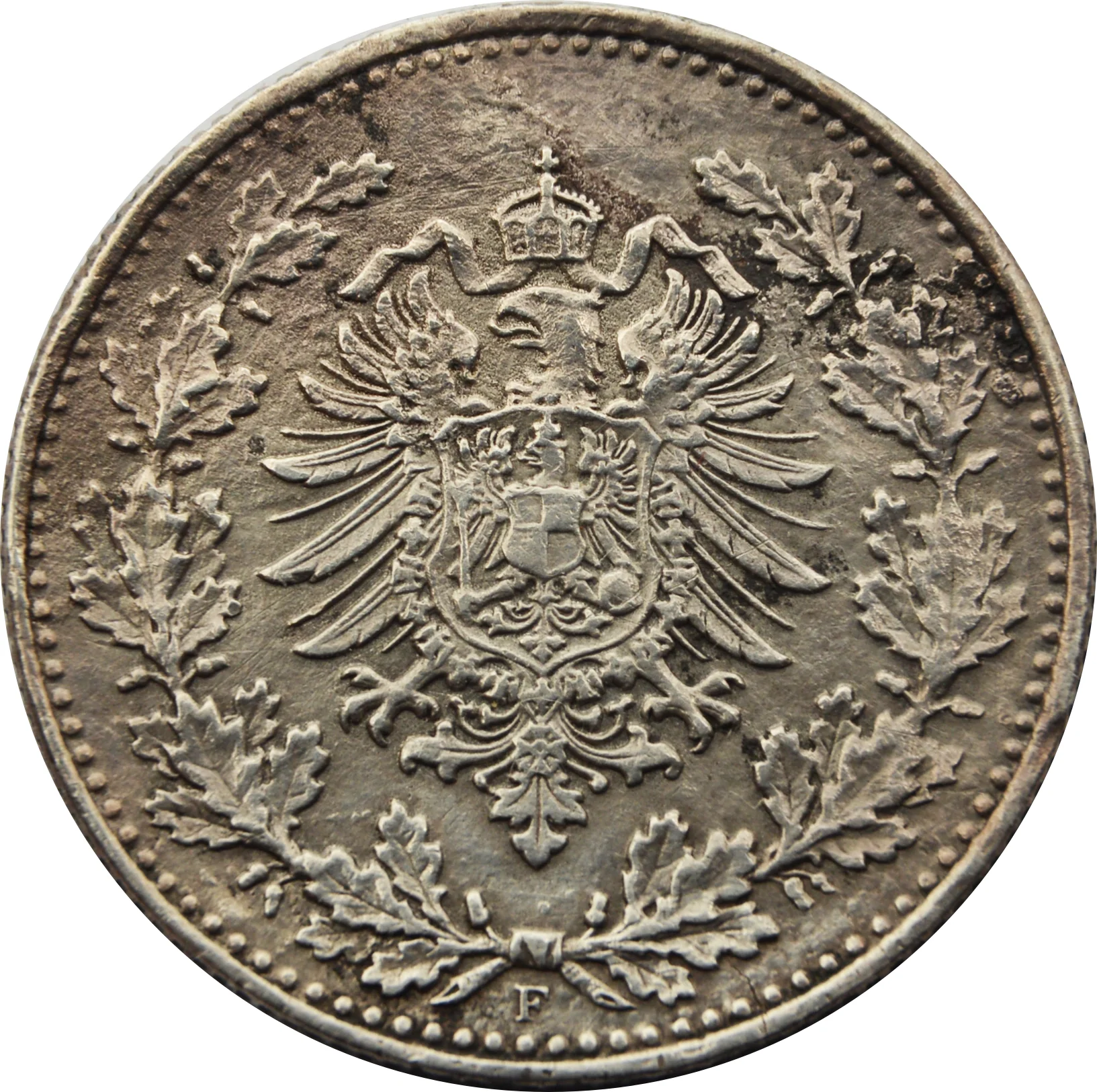
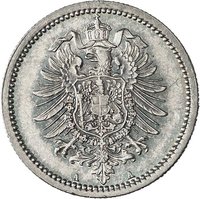
Obverse
Description:
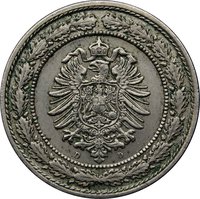
German eagle in wreath, mintmark below.
Inscription:
F
Script: Latin
Engraver: Friedrich Wilhelm Kullrich
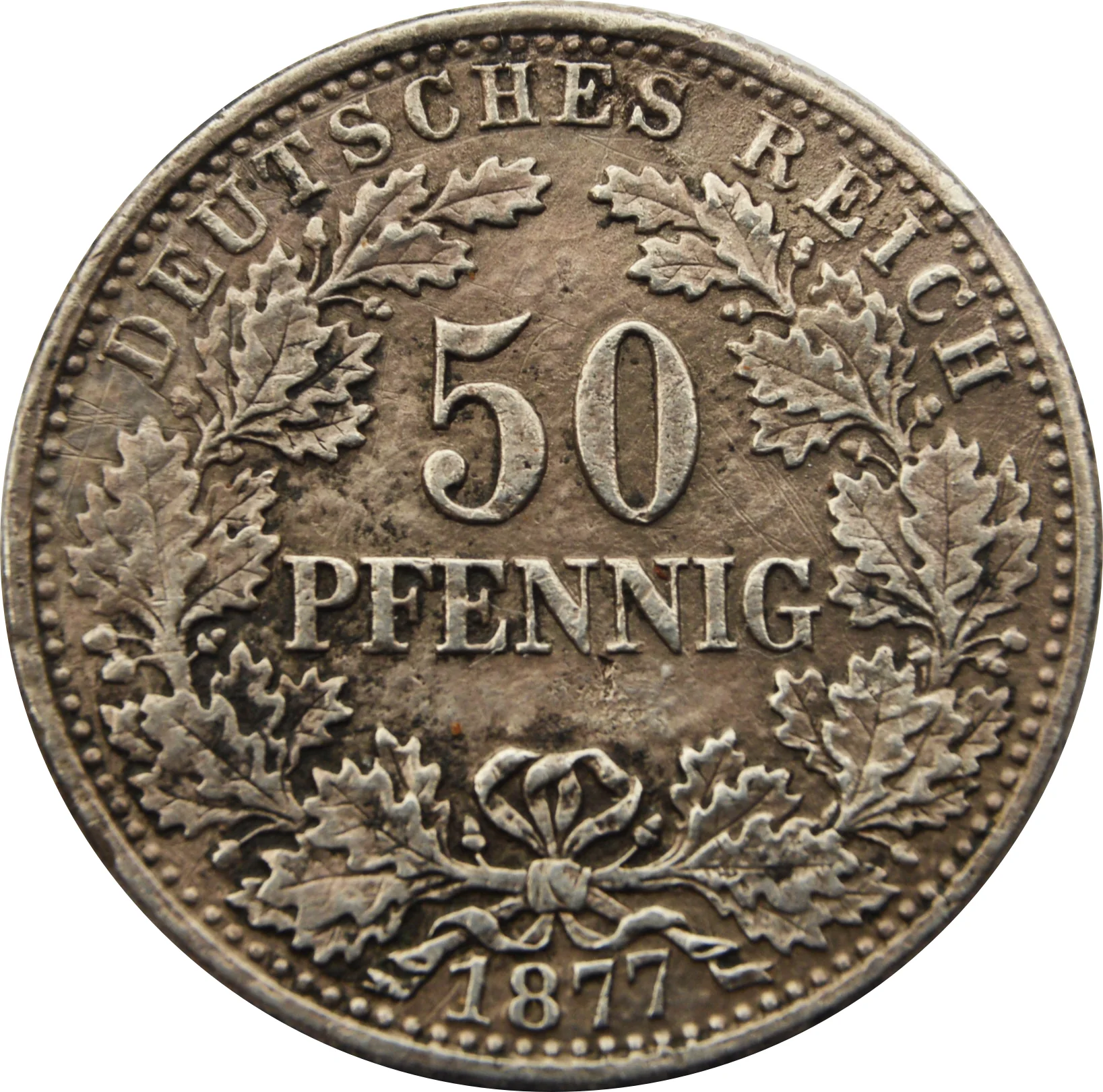
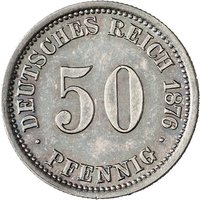
Reverse
Description:
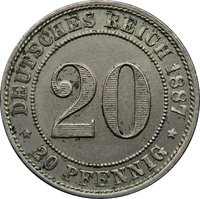
Value in wreath, date beneath.
Inscription:
DEUTSCHES REICH
50 PFENNIG
1877
50 PFENNIG
1877
Translation:
GERMAN EMPIRE
50 PFENNIG
1877
50 PFENNIG
1877
Script: Latin
Language: German
Engraver: Emil Weigand
Edge
Reeded
Mints
| Name | Mark |
|---|---|
| Berlin | A |
| Hanover | B |
| Frankfurt am Main | C |
| Munich | D |
| Dresden | E |
| Staatliche Münze Baden-Württemberg | F |
| Staatliche Münze Baden-Württemberg | G |
| Darmstadt | H |
| Hamburgische Münze | J |
Mintings
Historical background
By 1877, Germany was in the final, decisive phase of a decades-long monetary unification, navigating the complex legacy of its political fragmentation. Following unification in 1871, the new Reich inherited a chaotic system of over 100 different coin types, seven major currency zones (most using the Vereinsthaler), and a multitude of private banknotes. Chancellor Otto von Bismarck and his advisors, determined to create a symbol of national unity and facilitate industrial growth, sought to replace this patchwork with a single, modern currency. Their model was not the traditional silver standard, but the gold standard, which was increasingly dominant in international trade, particularly with Great Britain.
The legal framework for this transformation was already in place with the Coinage Act of 1873, which introduced the Goldmark as the new unit of account. However, 1877 was a critical year of practical transition. The Reichsbank was established in 1876 and began operations, becoming the central issuing authority for banknotes and gradually displacing the multitude of private and state note issues. The physical minting of new gold coins (10 and 20 Mark pieces) was underway, while the old silver Thalers, though officially demonetized, remained legal tender until 1908 to ensure a smooth changeover. The period was thus characterized by a dual circulation, as the old regional currencies slowly drained from the economy.
This shift occurred against a backdrop of economic controversy. The move to gold, part of a broader European trend, had been accelerated by a dramatic fall in the value of silver in the early 1870s, which threatened the stability of any silver-based system. While industrialists and financiers largely supported the gold standard for its stability in foreign trade, the policy faced significant opposition. Agrarian interests and debtors, particularly in the east, felt disadvantaged, and the demonetization of silver contributed to a period of deflation and economic difficulty known as the Gründerkrise (Founders' Crisis). Thus, in 1877, Germany was actively constructing a monolithic, gold-backed currency system, a project central to its national identity and economic ambitions, yet one that was not without its social and economic costs.
The legal framework for this transformation was already in place with the Coinage Act of 1873, which introduced the Goldmark as the new unit of account. However, 1877 was a critical year of practical transition. The Reichsbank was established in 1876 and began operations, becoming the central issuing authority for banknotes and gradually displacing the multitude of private and state note issues. The physical minting of new gold coins (10 and 20 Mark pieces) was underway, while the old silver Thalers, though officially demonetized, remained legal tender until 1908 to ensure a smooth changeover. The period was thus characterized by a dual circulation, as the old regional currencies slowly drained from the economy.
This shift occurred against a backdrop of economic controversy. The move to gold, part of a broader European trend, had been accelerated by a dramatic fall in the value of silver in the early 1870s, which threatened the stability of any silver-based system. While industrialists and financiers largely supported the gold standard for its stability in foreign trade, the policy faced significant opposition. Agrarian interests and debtors, particularly in the east, felt disadvantaged, and the demonetization of silver contributed to a period of deflation and economic difficulty known as the Gründerkrise (Founders' Crisis). Thus, in 1877, Germany was actively constructing a monolithic, gold-backed currency system, a project central to its national identity and economic ambitions, yet one that was not without its social and economic costs.
🌱 Fairly Common