

50 Pfennigs – Germany
Germany
Context
Material
References
KM: #Click to copy to clipboard6
Numista: #10400
Value
Bullion value: $7.16
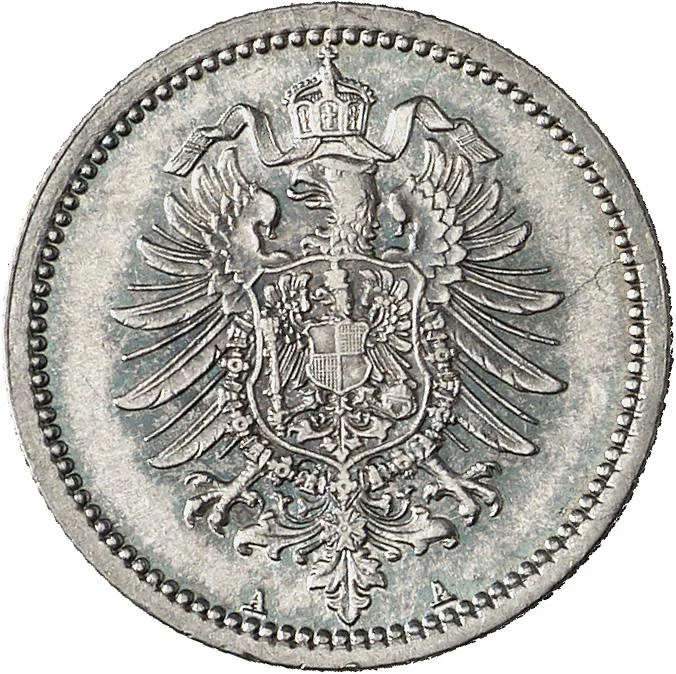
Obverse
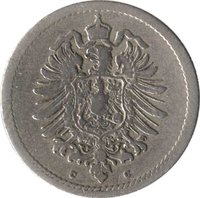
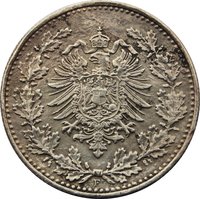
Description:
Imperial eagle with mintmarks beneath.
Inscription:
B B
Script: Latin
Engraver: Friedrich Wilhelm Kullrich
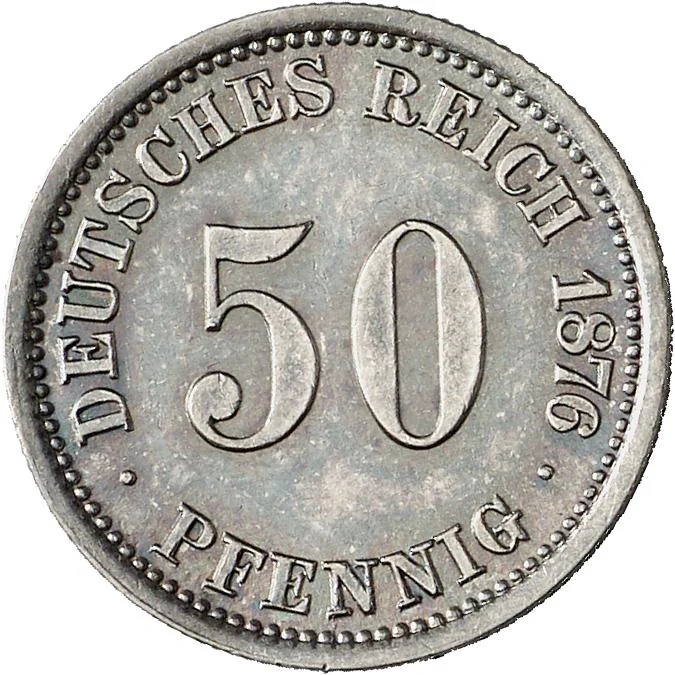
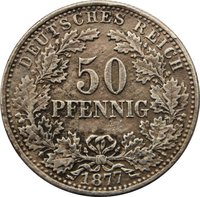
Reverse
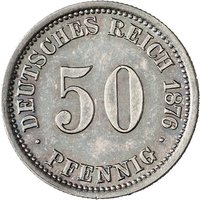
Description:
Issuer name, date to the right.
Inscription:
DEUTSCHES REICH 1876
50
• PFENNIG •
50
• PFENNIG •
Translation:
German Empire 1876
50
• Pfennig •
50
• Pfennig •
Script: Latin
Language: German
Engraver: Emil Weigand
Edge
Reeded
Mints
| Name | Mark |
|---|---|
| Berlin | A |
| Hanover | B |
| Frankfurt am Main | C |
| Munich | D |
| Dresden | E |
| Staatliche Münze Baden-Württemberg | F |
| Staatliche Münze Baden-Württemberg | G |
| Darmstadt | H |
| Hamburgische Münze | J |
Mintings
| Year | Mint Mark | Mintage | Quality | Collection |
|---|---|---|---|---|
| 1875 | A | 7,094,851 | ||
| 1875 | B | 2,799,238 | ||
| 1875 | C | 2,046,658 | ||
| 1875 | D | 4,668,000 | ||
| 1875 | E | 353,000 | ||
| 1875 | F | 874,000 | ||
| 1875 | G | 2,034,000 | ||
| 1875 | H | 175,000 | ||
| 1875 | J | 2,411,000 | ||
| 1876 | H | 1,877,000 | ||
| 1876 | J | 3,589,000 | ||
| 1876 | G | 1,797,000 | ||
| 1876 | A | 34,475,394 | ||
| 1876 | B | 11,016,100 | ||
| 1876 | C | 10,945,173 | ||
| 1876 | D | 3,641,000 | ||
| 1876 | E | 4,127,000 | ||
| 1876 | F | 4,448,000 | ||
| 1877 | H | 622,000 | ||
| 1877 | J | 1,526,000 | ||
| 1877 | B | 3,691,904 | ||
| 1877 | C | 2,388,753 | ||
| 1877 | F | 1,311,000 | ||
| 1877 | E | 1,121,000 | ||
| 1877 | A | 3,249,711 | ||
| 1877 | D | 3,004,000 |
Historical background
By 1875, Germany stood on the brink of a monumental monetary reform that would unify its disparate currency systems into a single, modern standard. Following unification in 1871, the new Reich was a patchwork of currencies, including the Vereinsthaler, South German gulden, Hamburg mark banco, and others, all with complex exchange rates. This fragmentation hindered national commerce and economic integration, creating a pressing need for a uniform currency to solidify political unity with economic cohesion.
The legislative foundation for this transformation was laid with the introduction of the gold standard through the Coinage Act of December 1873. This law demonetized silver and established the new gold Mark as the sole Reich currency, divided into 100 Pfennig. The year 1875 was a critical transitional period, as the newly founded Reichsbank began operations on January 1st, tasked with managing the conversion and issuing the new banknotes. The old thalers and gulden remained legal tender temporarily, but their value was now fixed irrevocably to the gold mark (1 Vereinsthaler = 3 Marks).
Thus, the currency situation in 1875 was one of active implementation and managed transition. The chaotic pre-unification systems were being systematically phased out under central state control, paving the way for the full emergence of a stable, gold-backed national currency. This reform was a cornerstone of Chancellor Otto von Bismarck's policy to create a powerful, integrated German economy, positioning the Reich as a major financial power on the European stage.
The legislative foundation for this transformation was laid with the introduction of the gold standard through the Coinage Act of December 1873. This law demonetized silver and established the new gold Mark as the sole Reich currency, divided into 100 Pfennig. The year 1875 was a critical transitional period, as the newly founded Reichsbank began operations on January 1st, tasked with managing the conversion and issuing the new banknotes. The old thalers and gulden remained legal tender temporarily, but their value was now fixed irrevocably to the gold mark (1 Vereinsthaler = 3 Marks).
Thus, the currency situation in 1875 was one of active implementation and managed transition. The chaotic pre-unification systems were being systematically phased out under central state control, paving the way for the full emergence of a stable, gold-backed national currency. This reform was a cornerstone of Chancellor Otto von Bismarck's policy to create a powerful, integrated German economy, positioning the Reich as a major financial power on the European stage.
🌱 Common