

20 Pfennigs – Germany
Germany

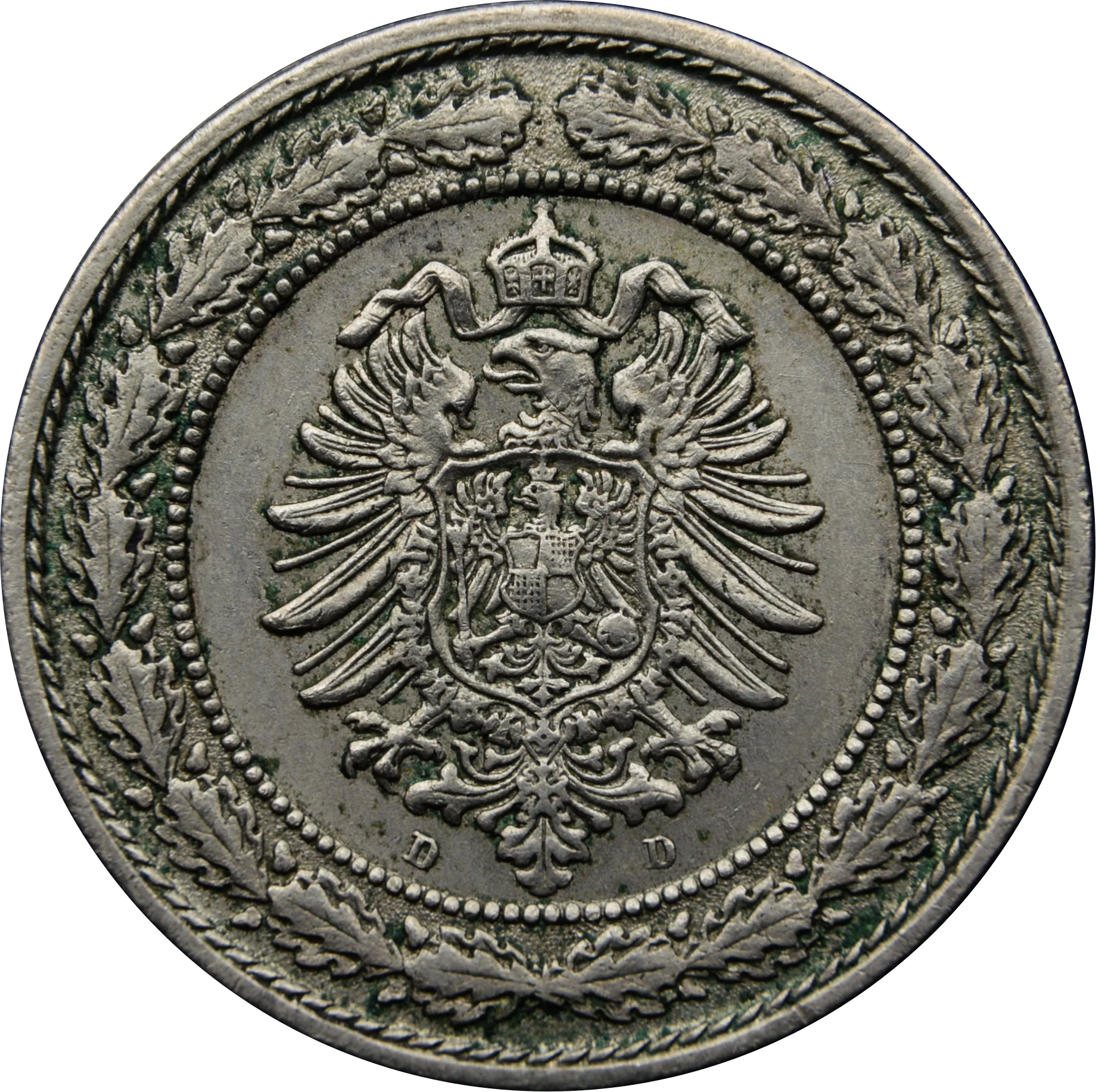
Obverse
Description:
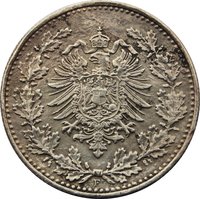
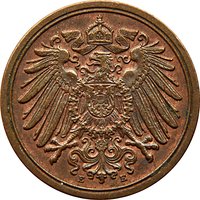
Imperial eagle left, crowned, with Black Eagle collar, Prussian arms on breast, banners above. Exergue: workshops. Encircled by oak wreath between inner beaded and outer corded borders.
Inscription:
D D
Script: Latin
Engraver: Emil Weigand
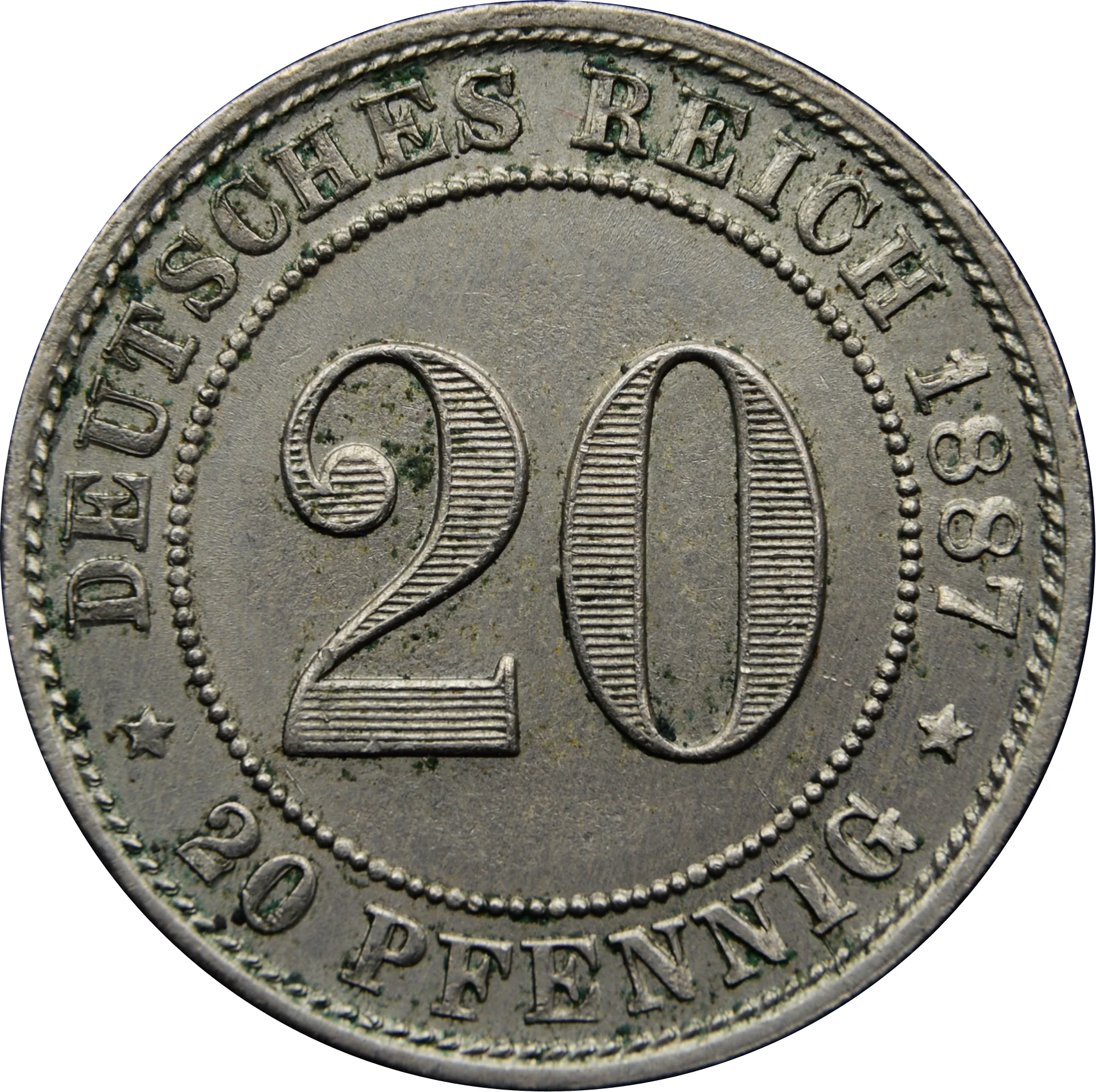
Reverse
Description:
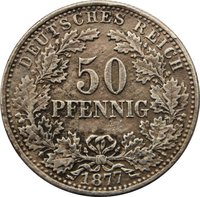
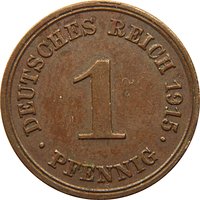
Value in circle, lettering around.
Inscription:
DEUTSCHES REICH 1887
20
20 PFENNIG
20
20 PFENNIG
Translation:
German Empire 1887
20
20 Pfennig
20
20 Pfennig
Script: Latin
Language: German
Engraver: Friedrich Wilhelm Kullrich
Edge
Plain
Mintings
| Year | Mint Mark | Mintage | Quality | Collection |
|---|---|---|---|---|
| 1887 | — | — | ||
| 1887 | D | 703,710 | ||
| 1887 | G | 305,539 | ||
| 1887 | J | 408,209 | ||
| 1887 | A | 2,711,596 | ||
| 1887 | E | 372,890 | ||
| 1887 | F | 502,883 | ||
| 1888 | D | 1,406,120 | ||
| 1888 | F | 1,005,396 | ||
| 1888 | G | 610,983 | ||
| 1888 | J | 818,138 | ||
| 1888 | A | 5,426,207 | ||
| 1888 | E | 744,314 |
Historical background
In 1887, Germany's currency situation was defined by the ongoing transition to the gold standard, a process initiated by the Coinage Act of 1873 following unification. This move abandoned the previous silver-based thaler systems of the constituent states in favor of the new national currency, the gold mark. While the legal framework was established, the transition was not yet complete; old silver thalers and minor coins remained in circulation alongside the new gold coins, creating a practical bimetallic system that was gradually being phased out.
This shift was part of a broader European trend and was driven by Chancellor Otto von Bismarck's desire for economic stability, international credibility, and to align Germany with major trading partners like Britain. However, the demonetization of silver had significant consequences, contributing to a fall in global silver prices and causing economic strain for countries still on silver standards. Domestically, it favored industrial and financial interests over agrarian ones, leading to political friction, particularly from Junker landowners who felt disadvantaged by the deflationary pressures of the gold-backed currency.
By 1887, the Reichsbank, established in 1875, was firmly managing the monetary system, but the period was one of consolidation rather than crisis. The German economy was experiencing strong industrial growth, and the gold mark was gaining acceptance. The primary "currency situation" was thus one of successful implementation of a modern monetary system, though it was still bedding down and its deflationary bias would continue to be a point of political contention in the years ahead.
This shift was part of a broader European trend and was driven by Chancellor Otto von Bismarck's desire for economic stability, international credibility, and to align Germany with major trading partners like Britain. However, the demonetization of silver had significant consequences, contributing to a fall in global silver prices and causing economic strain for countries still on silver standards. Domestically, it favored industrial and financial interests over agrarian ones, leading to political friction, particularly from Junker landowners who felt disadvantaged by the deflationary pressures of the gold-backed currency.
By 1887, the Reichsbank, established in 1875, was firmly managing the monetary system, but the period was one of consolidation rather than crisis. The German economy was experiencing strong industrial growth, and the gold mark was gaining acceptance. The primary "currency situation" was thus one of successful implementation of a modern monetary system, though it was still bedding down and its deflationary bias would continue to be a point of political contention in the years ahead.
🌱 Common