

20 escudos – Angola
Add to wishlist
Angola
Obverse
Description:
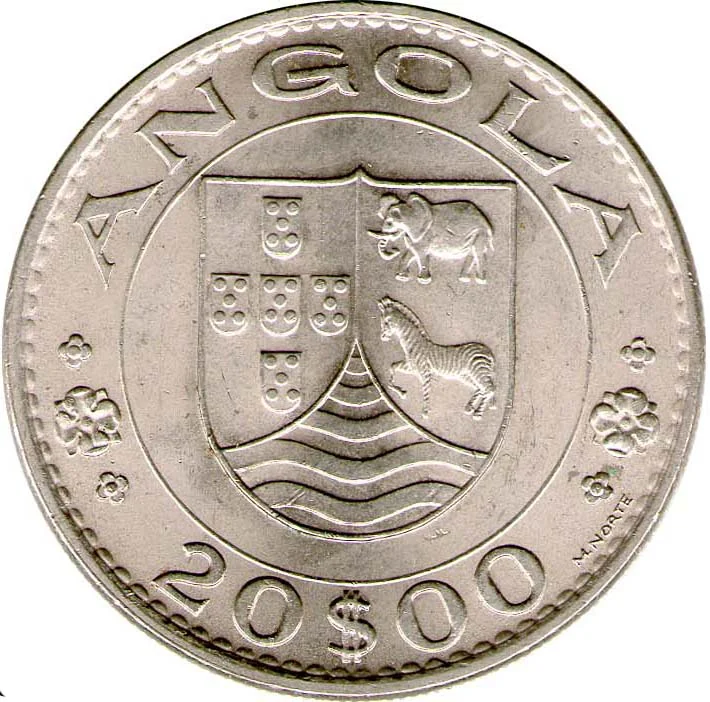
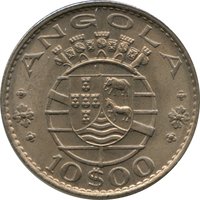
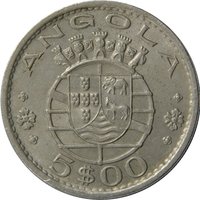
Angolan coat of arms on decorated shield, value beneath.
Inscription:
ANGOLA
20$00
20$00
Script: Latin
Reverse
Description:
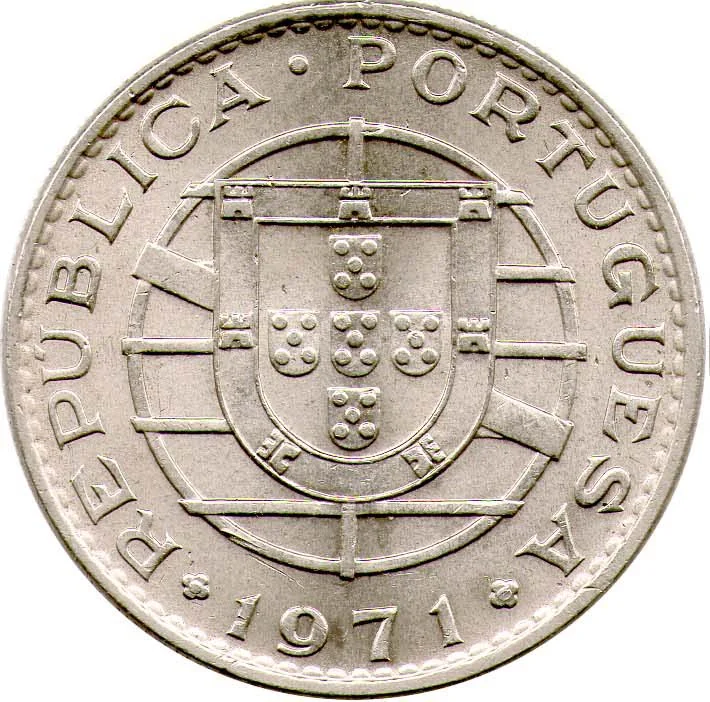
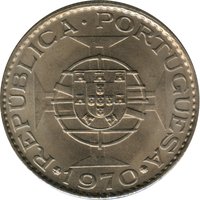
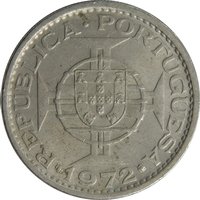
Portuguese coat of arms on an embellished shield with date beneath.
Inscription:
REPÚBLICA·PORTUGUESA
1971
1971
Translation:
Portuguese Republic
1971
1971
Script: Latin
Language: Portuguese
Edge
Reeded
Mintings
| Year | Mint Mark | Mintage | Quality | Collection |
|---|---|---|---|---|
| 1971 | — | 2,000,000 | ||
| 1972 | — | 428,000 |
Historical background
In 1971, Angola was a Portuguese overseas province, and its currency situation was entirely governed by Lisbon. The official currency was the Angolan Escudo (AOE), which was pegged at par with the Portuguese Escudo (PTE). This arrangement was a direct manifestation of colonial economic integration, ensuring that Angola's monetary policy, money supply, and exchange rates were set by the Banco de Portugal to serve the interests of the metropolitan economy. The escudo banknotes and coins used in Angola were physically distinct, often featuring local imagery, but they held equal value to those circulating in Portugal itself.
The economy was heavily oriented towards exporting primary commodities—particularly coffee, diamonds, and nascent oil production—to finance imports of manufactured goods and to generate foreign exchange for Portugal. This extractive model meant that Angola's currency stability was largely dependent on commodity prices and the fiscal health of the metropole. Furthermore, the escudo was part of the "Escudo Area," a closed currency zone that strictly controlled the flow of capital and aimed to keep foreign exchange within the Portuguese empire, limiting Angola's independent financial interactions with the global market.
Beneath this surface of imposed stability, significant economic and social disparities existed. The currency system facilitated the transfer of wealth to Portugal and benefited the colonial administration and settler population, while the majority of Angolans were marginalized from the formal financial system. This period immediately preceded the major oil price shocks of the 1970s, which would soon dramatically increase Angola's export revenues, and occurred amidst an ongoing war for independence (beginning in 1961) that created localized economic disruption, though the central monetary system in Luanda remained firmly under Portuguese control until independence in 1975.
The economy was heavily oriented towards exporting primary commodities—particularly coffee, diamonds, and nascent oil production—to finance imports of manufactured goods and to generate foreign exchange for Portugal. This extractive model meant that Angola's currency stability was largely dependent on commodity prices and the fiscal health of the metropole. Furthermore, the escudo was part of the "Escudo Area," a closed currency zone that strictly controlled the flow of capital and aimed to keep foreign exchange within the Portuguese empire, limiting Angola's independent financial interactions with the global market.
Beneath this surface of imposed stability, significant economic and social disparities existed. The currency system facilitated the transfer of wealth to Portugal and benefited the colonial administration and settler population, while the majority of Angolans were marginalized from the formal financial system. This period immediately preceded the major oil price shocks of the 1970s, which would soon dramatically increase Angola's export revenues, and occurred amidst an ongoing war for independence (beginning in 1961) that created localized economic disruption, though the central monetary system in Luanda remained firmly under Portuguese control until independence in 1975.
🌱 Common