

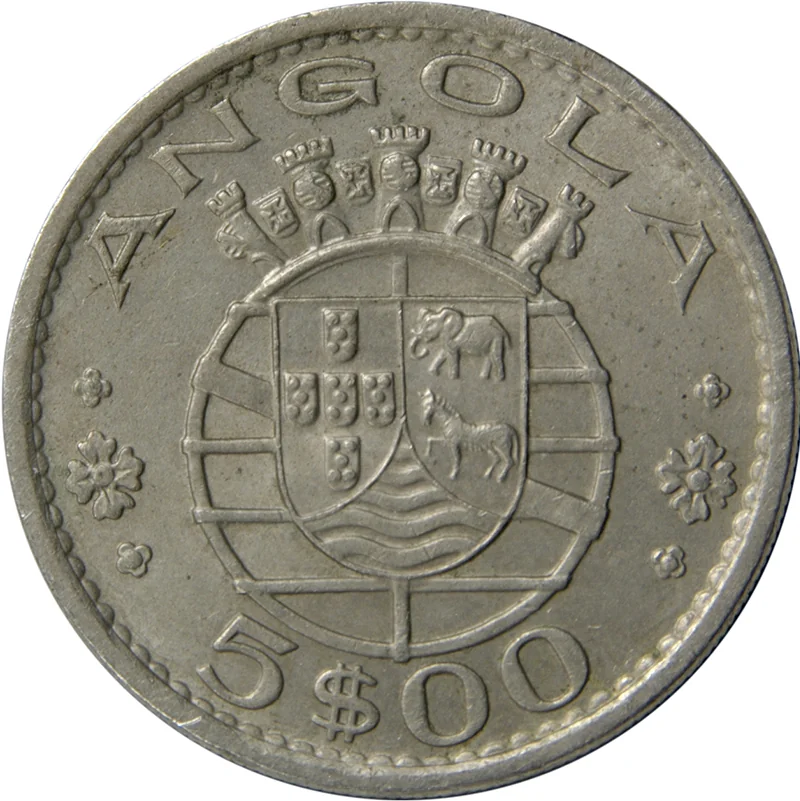
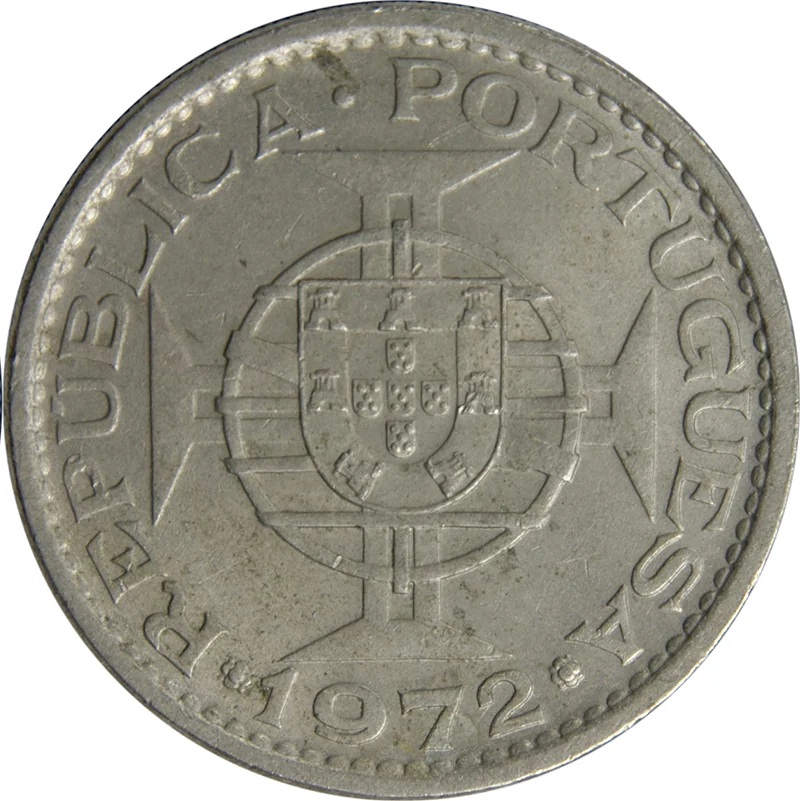
5 escudos – Angola
Add to wishlist
Angola
Context
Years: 1972–1974
Issuer: Angola
Period:
(1951—1975)
Currency:
(1958—1977)
Demonetized: Yes
Total mintage: 11,343,000
Material
Diameter: 24.5 mm
Weight: 7.1 g
Thickness: 2 mm
Shape: Round
Composition: Copper-nickel
Technique: Milled
Alignment: Coin alignment
flip
References
KM: #
Numista: #6432
Obverse
Reverse
Description:
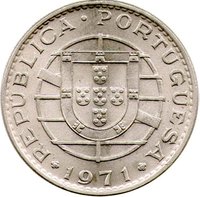
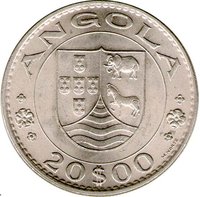
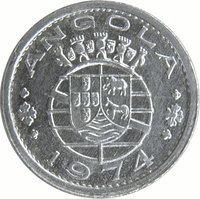
Arms, date beneath.
Inscription:
REPÚBLICA·PORTUGUESA
1972
1972
Translation:
Portuguese Republic
1972
1972
Script: Latin
Language: Portuguese
Edge
Reeded
Categories
| Animal> Elephant |
| Animal> Horse |
| Symbols> Coat of Arms |
| Symbol> Cross |
| Building> Castle or fortification |
Mintings
| Year | Mint Mark | Mintage | Quality | Collection |
|---|---|---|---|---|
| 1972 | — | 8,000,000 | ||
| 1974 | — | 3,343,000 |
Historical background
In 1972, Angola remained under Portuguese colonial rule, and its currency was fully integrated into the metropolitan system. The official currency was the Angolan escudo, which was pegged at par with the Portuguese escudo. This arrangement meant that monetary policy was entirely dictated by Lisbon, with the Banco de Angola (Bank of Angola) functioning as a central bank but ultimately subordinate to Portugal's financial interests. The currency's value and stability were therefore intrinsically linked to the economic health and decisions of the colonial power, primarily serving to facilitate the export of Angola's raw materials—like coffee, diamonds, and nascent oil—to benefit Portugal.
Economically, the early 1970s were a period of significant growth for Angola, fueled by an oil boom that began in the late 1960s. This influx of petrodollars strengthened the external position of the Angolan escudo and financed substantial infrastructure projects. However, this prosperity was unevenly distributed, largely accruing to the Portuguese settler population and international companies, while the majority of Angolans remained in poverty. Furthermore, the ongoing War of Independence (which began in 1961) created a stark duality: a booming, modern sector in coastal cities coexisted with a rural hinterland disrupted by conflict and military expenditure, which placed a constant strain on public finances.
The currency situation in 1972, while ostensibly stable, was built on fragile and contested foundations. The escudo's peg and the integrated financial system symbolized colonial control, a point of contention for the emerging nationalist movements. The economic structure was highly dependent on a single commodity (oil) and subject to the political fate of the Portuguese Estado Novo regime. Within two years, the 1974 Carnation Revolution in Portugal would set in motion a rapid decolonization process, leading to Angolan independence in 1975. This would promptly trigger a fierce civil war and the eventual abandonment of the Angolan escudo, replaced by the new national currency, the kwanza, in a deeply divided and war-torn nation.
Economically, the early 1970s were a period of significant growth for Angola, fueled by an oil boom that began in the late 1960s. This influx of petrodollars strengthened the external position of the Angolan escudo and financed substantial infrastructure projects. However, this prosperity was unevenly distributed, largely accruing to the Portuguese settler population and international companies, while the majority of Angolans remained in poverty. Furthermore, the ongoing War of Independence (which began in 1961) created a stark duality: a booming, modern sector in coastal cities coexisted with a rural hinterland disrupted by conflict and military expenditure, which placed a constant strain on public finances.
The currency situation in 1972, while ostensibly stable, was built on fragile and contested foundations. The escudo's peg and the integrated financial system symbolized colonial control, a point of contention for the emerging nationalist movements. The economic structure was highly dependent on a single commodity (oil) and subject to the political fate of the Portuguese Estado Novo regime. Within two years, the 1974 Carnation Revolution in Portugal would set in motion a rapid decolonization process, leading to Angolan independence in 1975. This would promptly trigger a fierce civil war and the eventual abandonment of the Angolan escudo, replaced by the new national currency, the kwanza, in a deeply divided and war-torn nation.
🌱 Common