

2 skilling – Norway
Add to wishlist
Norway
Context
Year: 1825
Issuer: Norway
Ruler: Charles III John
Currency:
(1816—1875)
Demonetized: Yes
Total mintage: 240,000
Material
References
KM: #
Numista: #55893
Obverse
Description:
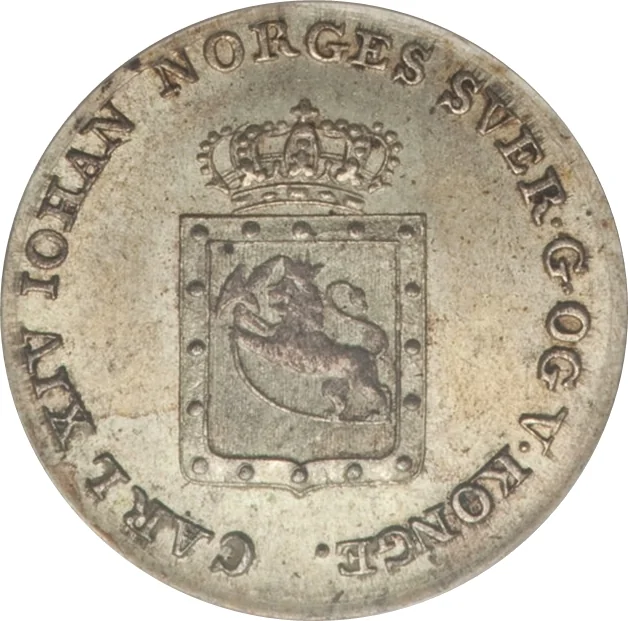
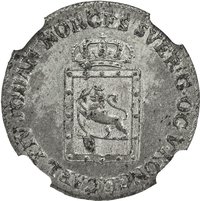
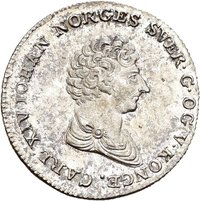
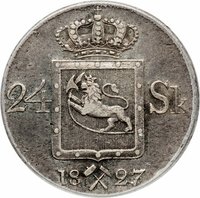
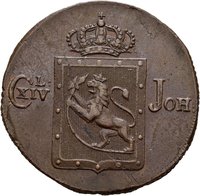
Crowned shield with beaded border, containing a crowned Norwegian lion facing left and holding a halberd on a vertically lined field, encircled by an inscription.
Inscription:
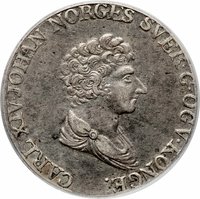
CARL XIV JOHAN NORGES SVER· G· OG V· KONGE.
Translation:
CARL XIV JOHAN NORWAY'S SWEDEN'S GOTHIC AND VENDIC KING.
Script: Latin
Reverse
Description:
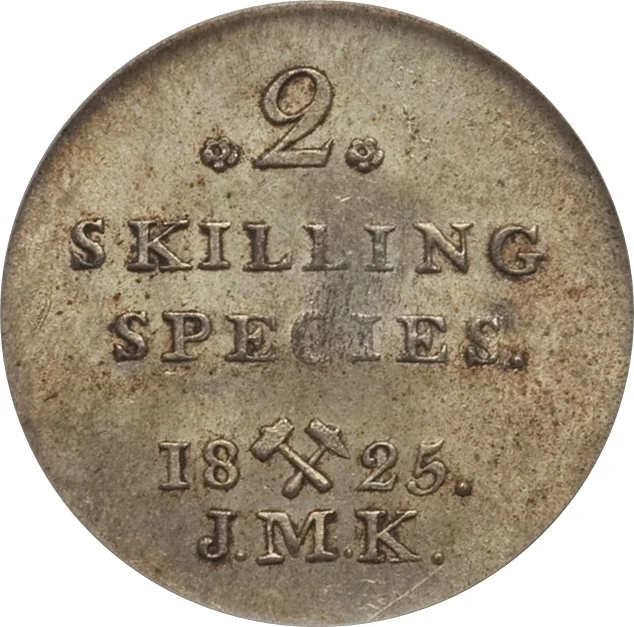
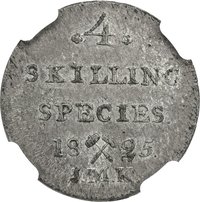
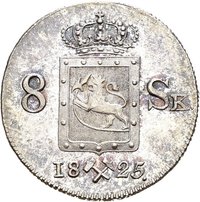
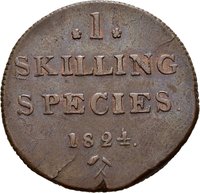
Value and date in four lines.
Date split by mintmark.
Mintmaster initials below.
Date split by mintmark.
Mintmaster initials below.
Inscription:
🏵2🏵
SKILLING
SPECIES.
18 ⚒ 25.
J. M. K.
SKILLING
SPECIES.
18 ⚒ 25.
J. M. K.
Script: Latin
Edge
Mints
| Name | Mark |
|---|---|
| Norwegian Mint | — |
Mintings
| Year | Mint Mark | Mintage | Quality | Collection |
|---|---|---|---|---|
| 1825 | — | 240,000 |
Historical background
In 1825, Norway found itself in a complex monetary situation, navigating the aftermath of its union with Sweden (established in 1814) while still grappling with the legacy of previous Danish rule. The country operated on a dual currency system, a source of significant practical confusion. The official currency was the riksdaler specie, a silver-based coin, but the widely used everyday currency was the riksdaler courant, a depreciated paper money. The riksdaler courant was not backed by silver and traded at a fluctuating and unfavorable rate against the specie, leading to instability and complicating trade and contracts.
This problematic system was a direct inheritance from the Napoleonic Wars. During the war, the Danish-Norwegian state had issued vast amounts of paper money (kursdaler) to finance its efforts, leading to severe inflation. After 1814, Norway was left responsible for a substantial share of this common debt. The riksdaler courant was the successor to this depreciated paper money, and its poor value reflected the lingering financial burden. Economic actors had to constantly calculate between the two standards, hindering commerce and economic planning.
Recognizing the untenable nature of this arrangement, the Norwegian Storting (parliament) took decisive action in 1824 by passing a law for a comprehensive monetary reform, which was implemented in 1825. This reform aimed to establish a single, stable, silver-based currency. The new system introduced the speciedaler as the sole legal tender, divided into 120 skilling, and mandated the gradual withdrawal and conversion of the old paper riksdaler courant. Thus, 1825 stands as a pivotal year of transition, marking the end of a chaotic dual system and the beginning of a modern, unified monetary standard for Norway.
This problematic system was a direct inheritance from the Napoleonic Wars. During the war, the Danish-Norwegian state had issued vast amounts of paper money (kursdaler) to finance its efforts, leading to severe inflation. After 1814, Norway was left responsible for a substantial share of this common debt. The riksdaler courant was the successor to this depreciated paper money, and its poor value reflected the lingering financial burden. Economic actors had to constantly calculate between the two standards, hindering commerce and economic planning.
Recognizing the untenable nature of this arrangement, the Norwegian Storting (parliament) took decisive action in 1824 by passing a law for a comprehensive monetary reform, which was implemented in 1825. This reform aimed to establish a single, stable, silver-based currency. The new system introduced the speciedaler as the sole legal tender, divided into 120 skilling, and mandated the gradual withdrawal and conversion of the old paper riksdaler courant. Thus, 1825 stands as a pivotal year of transition, marking the end of a chaotic dual system and the beginning of a modern, unified monetary standard for Norway.
Series: 1825 Norway circulation coins
💎 Extremely Rare