

1 dollar – United States
Add to wishlist
United States
Context
Years: 1921–1964
Issuer: United States
Period:
(since 1776)
Currency:
(since 1785)
Total mintage: 189,322,655
Material
References
KM: #
Numista: #5580
Value
Exchange value: 1 USD = $1.00
Bullion value: $58.55
Inflation-adjusted value: 16.02 USD
Obverse
Description:
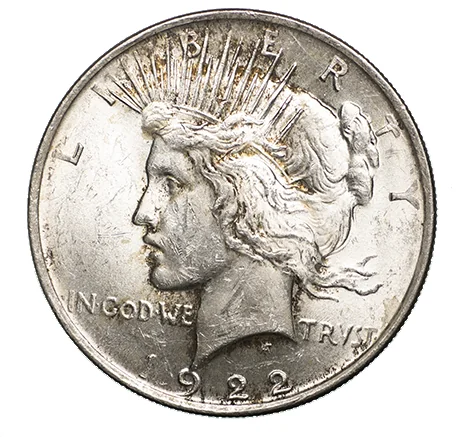
Liberty head left, radiate cap.
Inscription:
LIBERTY
IN GOD WE TRVST
AF
1925
IN GOD WE TRVST
AF
1925
Script: Latin
Engraver: Anthony de Francisci
Reverse
Description:
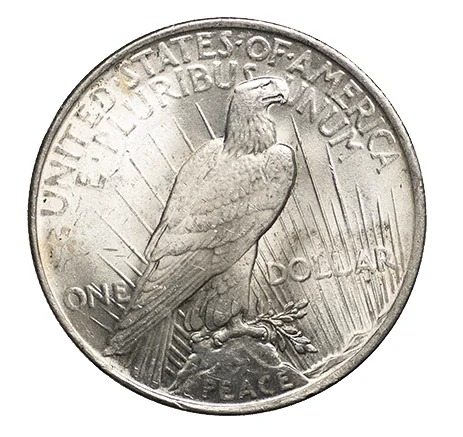
Eagle on rock, wings folded, back view, holding branch with sun rays behind and "PEACE" below.
Inscription:
UNITED STATES OF AMERICA
E PLURIBUS UNUM
ONE DOLLAR
PEACE
E PLURIBUS UNUM
ONE DOLLAR
PEACE
Translation:
UNITED STATES OF AMERICA
OUT OF MANY, ONE
ONE DOLLAR
PEACE
OUT OF MANY, ONE
ONE DOLLAR
PEACE
Script: Latin
Engraver: Anthony de Francisci
Edge
Reeded
Mints
| Name | Mark |
|---|---|
| United States Mint of Philadelphia | — |
| United States Mint of Denver | D |
| United States Mint of San Francisco | S |
Mintings
| Year | Mint Mark | Mintage | Quality | Collection |
|---|---|---|---|---|
| 1921 | — | 1,006,473 | ||
| 1922 | — | 51,737,000 | ||
| 1922 | D | 15,063,000 | ||
| 1922 | S | 17,475,000 | ||
| 1923 | D | 6,811,000 | ||
| 1923 | S | 19,020,000 | ||
| 1923 | — | 30,800,000 | ||
| 1924 | S | 1,728,000 | ||
| 1924 | — | 11,811,000 | ||
| 1925 | — | 10,198,000 | ||
| 1925 | S | 1,610,000 | ||
| 1926 | S | 6,980,000 | ||
| 1926 | — | 1,939,000 | ||
| 1926 | D | 2,348,700 | ||
| 1927 | — | 848,000 | ||
| 1927 | S | 866,000 | ||
| 1927 | D | 1,268,000 | ||
| 1928 | — | 360,349 | ||
| 1928 | S | 1,632,000 | ||
| 1928 | s | — | ||
| 1934 | — | 954,057 | ||
| 1934 | D | — | ||
| 1934 | S | 1,011,000 | ||
| 1935 | — | 1,576,000 | ||
| 1935 | S | 1,964,000 | ||
| 1964 | D | 316,076 |
Historical background
In 1921, the United States was navigating a complex currency landscape shaped by the aftermath of World War I and the recent establishment of the Federal Reserve System. The nation was on a de facto gold standard, though the official gold standard had been suspended during the war to allow for monetary flexibility. The Federal Reserve, operational since 1914, was still refining its role in managing the money supply and interest rates. A key feature of the era was the existence of both Federal Reserve Notes (the new national paper currency) and gold certificates, with the public and banks holding significant amounts of both. The financial system was also dealing with a large overhang of war finance instruments, like Liberty Bonds, which influenced liquidity.
The immediate post-war period brought severe deflation, with the economy plunging into a sharp depression in 1920-1921. Prices collapsed, and unemployment rose, partly due to the Federal Reserve's decision to raise discount rates in 1919 and 1920 to curb wartime inflation and defend the gold standard. This tight monetary policy successfully stabilized the dollar and attracted gold inflows, but at the cost of a severe economic contraction. By 1921, the currency situation was thus characterized by a strong and stable dollar in terms of gold, but also by a scarcity of money in circulation that exacerbated the economic downturn, particularly for farmers and debtors.
Looking ahead, the currency situation of 1921 set the stage for the "Roaring Twenties." The Federal Reserve's success in stabilizing the currency and the subsequent easing of policy in mid-1921 helped foster a period of price stability and economic growth. The gold standard was fully restored internationally with the U.S. at its center, as the country held a large portion of the world's gold reserves. This environment of hard currency credibility facilitated the expansion of credit and set the monetary foundation for the boom that followed, though it also created imbalances that would later contribute to the instability of the Great Depression.
The immediate post-war period brought severe deflation, with the economy plunging into a sharp depression in 1920-1921. Prices collapsed, and unemployment rose, partly due to the Federal Reserve's decision to raise discount rates in 1919 and 1920 to curb wartime inflation and defend the gold standard. This tight monetary policy successfully stabilized the dollar and attracted gold inflows, but at the cost of a severe economic contraction. By 1921, the currency situation was thus characterized by a strong and stable dollar in terms of gold, but also by a scarcity of money in circulation that exacerbated the economic downturn, particularly for farmers and debtors.
Looking ahead, the currency situation of 1921 set the stage for the "Roaring Twenties." The Federal Reserve's success in stabilizing the currency and the subsequent easing of policy in mid-1921 helped foster a period of price stability and economic growth. The gold standard was fully restored internationally with the U.S. at its center, as the country held a large portion of the world's gold reserves. This environment of hard currency credibility facilitated the expansion of credit and set the monetary foundation for the boom that followed, though it also created imbalances that would later contribute to the instability of the Great Depression.
🌱 Very Common