

¼ Dollar – United States
United States
Context
Years: 1917–1930
Issuer: United States 
Period:
(since 1776)
Currency:
(since 1785)
Subdivision: ¼ Dollar = 25 Cents
Total mintage: 203,414,800
Material
References
KM: #Click to copy to clipboard145
Numista: #3573
Value
Exchange value: ¼ USD = $0.25
Bullion value: $15.91
Inflation-adjusted value: 7.37 USD
Obverse
Description:
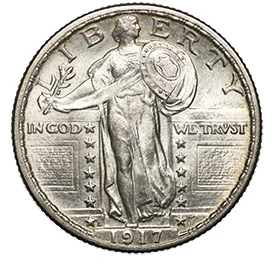
Standing Liberty faces left, her right breast covered by chainmail. She holds a shield in her left hand and an olive branch in her right, with 13 stars flanking her.
Inscription:
LIBERTY
IN GOD WE TRVST
1924 M
IN GOD WE TRVST
1924 M
Script: Latin
Engraver: Hermon Atkins MacNeil
Reverse
Description:
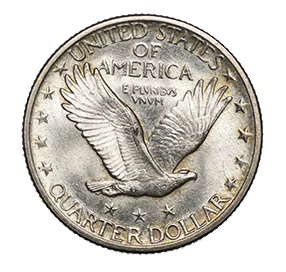
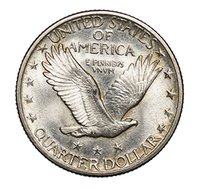
Eagle flying right, flanked by ten stars on each side, with three stars below.
Inscription:
UNITED STATES OF AMERICA
E PLVRIBVS VNVM
QUARTER DOLLAR
E PLVRIBVS VNVM
QUARTER DOLLAR
Translation:
UNITED STATES OF AMERICA
OUT OF MANY, ONE
QUARTER DOLLAR
OUT OF MANY, ONE
QUARTER DOLLAR
Script: Latin
Engraver: Hermon Atkins MacNeil
Edge
Reeded
Mints
| Name | Mark |
|---|---|
| United States Mint of Philadelphia | — |
| United States Mint of Denver | D |
| United States Mint of San Francisco | S |
Mintings
| Year | Mint Mark | Mintage | Quality | Collection |
|---|---|---|---|---|
| 1917 | — | 13,880,000 | ||
| 1917 | D | 6,224,400 | ||
| 1917 | S | 5,522,000 | ||
| 1918 | — | 14,240,000 | ||
| 1918 | D | 7,380,000 | ||
| 1918 | S | — | ||
| 1919 | — | 11,324,000 | ||
| 1919 | D | 1,944,000 | ||
| 1919 | S | 1,836,000 | ||
| 1920 | — | 27,860,000 | ||
| 1920 | D | 3,586,400 | ||
| 1920 | S | 6,380,000 | ||
| 1921 | — | 1,916,000 | ||
| 1923 | S | 1,360,000 | ||
| 1923 | — | 9,716,000 | ||
| 1924 | — | 10,920,000 | ||
| 1924 | D | 3,112,000 | ||
| 1924 | S | 2,860,000 | ||
| 1925 | — | 12,280,000 | ||
| 1926 | — | 11,316,000 | ||
| 1926 | D | 1,716,000 | ||
| 1926 | S | 2,700,000 | ||
| 1927 | D | 976,400 | ||
| 1927 | S | 396,000 | ||
| 1927 | — | 11,912,000 | ||
| 1928 | — | 6,336,000 | ||
| 1928 | D | 1,627,600 | ||
| 1928 | S | 2,644,000 | ||
| 1929 | — | 11,140,000 | ||
| 1929 | D | 1,358,000 | ||
| 1929 | S | 1,764,000 | ||
| 1930 | — | 5,632,000 | ||
| 1930 | S | 1,556,000 |
Historical background
In 1917, the United States' currency system was a hybrid, operating under the framework of the Aldrich-Vreeland Act and the newly established Federal Reserve System. The nation was on a de facto gold standard, with paper currency consisting of Gold Certificates, Silver Certificates, and United States Notes ("greenbacks"), all redeemable in specie. However, the immediate financial pressure of entering World War I in April 1917 triggered a critical shift. To prevent a run on gold reserves and to finance the war effort through massive borrowing, the Treasury and the Federal Reserve effectively suspended gold exports and discouraged domestic redemption. This marked the beginning of the end for the classical gold standard in the U.S., moving toward a managed currency system for the duration of the conflict.
The primary monetary instrument of the war effort was the Liberty Bond. To facilitate their sale and ensure the government could borrow at low rates, the Federal Reserve maintained artificially low discount rates and encouraged member banks to borrow from it to purchase Treasury debt. Crucially, these bonds could then be used as collateral for banks to obtain new Federal Reserve Bank Notes, effectively monetizing the debt. This expansion of credit and currency in circulation, while fueling the wartime economy, also planted the seeds for significant inflation. The money supply increased dramatically, but with industrial production focused on munitions and war matériel, consumer goods became scarce, driving prices upward.
Consequently, 1917 was a year of profound transition from a constrained, commodity-backed currency to an expanding, debt-based fiduciary system. The legal and institutional groundwork for a central bank had been laid with the 1913 Federal Reserve Act, but it was the exigencies of total war that forced its first major test and defined its operational role. By year's end, the dollar was no longer freely convertible for international gold shipments, its quantity was rapidly expanding, and inflation was becoming a pressing domestic concern—all hallmarks of a modern fiat currency system managed to serve national policy, in this case, the unprecedented financial demands of a world war.
The primary monetary instrument of the war effort was the Liberty Bond. To facilitate their sale and ensure the government could borrow at low rates, the Federal Reserve maintained artificially low discount rates and encouraged member banks to borrow from it to purchase Treasury debt. Crucially, these bonds could then be used as collateral for banks to obtain new Federal Reserve Bank Notes, effectively monetizing the debt. This expansion of credit and currency in circulation, while fueling the wartime economy, also planted the seeds for significant inflation. The money supply increased dramatically, but with industrial production focused on munitions and war matériel, consumer goods became scarce, driving prices upward.
Consequently, 1917 was a year of profound transition from a constrained, commodity-backed currency to an expanding, debt-based fiduciary system. The legal and institutional groundwork for a central bank had been laid with the 1913 Federal Reserve Act, but it was the exigencies of total war that forced its first major test and defined its operational role. By year's end, the dollar was no longer freely convertible for international gold shipments, its quantity was rapidly expanding, and inflation was becoming a pressing domestic concern—all hallmarks of a modern fiat currency system managed to serve national policy, in this case, the unprecedented financial demands of a world war.
🌱 Very Common