

2 drachmai – Greece
Add to wishlist
Greece
Obverse
Description:
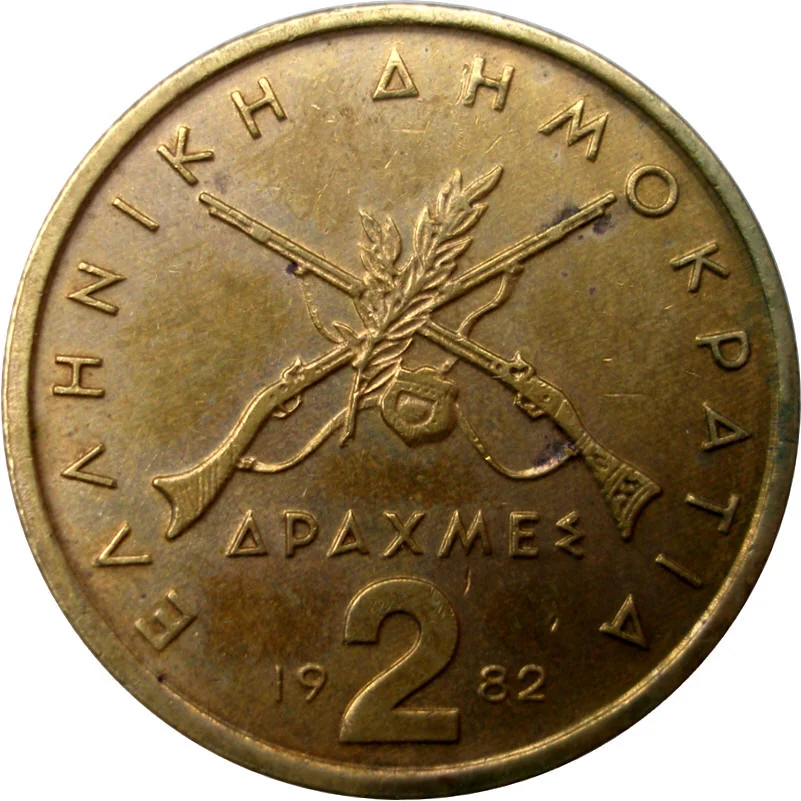
Crossed rifles over a branch, with denomination and date below.
Inscription:
ΕΛΛΗΝΙΚΗ ΔΗΜΟΚΡΑΤΙΑ
ΔΡΑΧΜΕΣ
19 2 82
ΔΡΑΧΜΕΣ
19 2 82
Translation:
HELLENIC REPUBLIC
DRACHMAS
19 8 2
DRACHMAS
19 8 2
Script: Greek
Language: Greek
Engraver: N. Perantinos
Reverse
Edge
Reeded
Categories
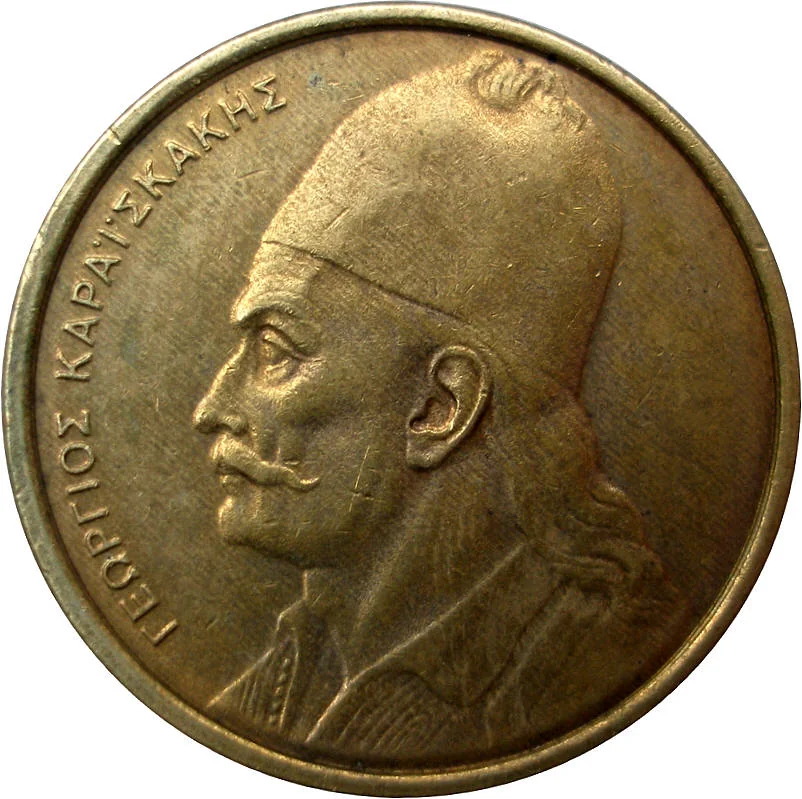
| Person> Military leader |
| Mustache/Beard |
| Object> Firearms |
Mints
| Name | Mark |
|---|---|
| National Mint of the Bank of Greece | — |
Mintings
| Year | Mint Mark | Mintage | Quality | Collection |
|---|---|---|---|---|
| 1982 | — | 64,414,000 | ||
| 1984 | — | 37,816,000 | ||
| 1986 | — | 21,019,000 |
Historical background
In 1982, Greece’s currency situation was defined by its recent entry into the European Monetary System (EMS) in 1979 and the ongoing struggle to control high inflation and a volatile drachma. Membership in the EMS’s Exchange Rate Mechanism (ERM) was intended to impose monetary discipline and stabilize the drachma against other European currencies, notably the German Deutsche Mark. However, Greece operated under a "special status," meaning it did not fully participate in the ERM’s fixed parity grid, reflecting the economy's fragility and the government's need for greater flexibility.
Domestically, the currency was under significant pressure from persistent structural issues. Inflation remained stubbornly high, averaging around 21% in 1982, severely eroding the drachma's purchasing power. This was fueled by expansive fiscal policies, substantial public sector deficits, and widespread indexation of wages to prices, creating a vicious cycle. Consequently, the drachma experienced multiple devaluations within the EMS framework to restore competitiveness, as the country struggled to balance the external constraint of the EMS with internal economic realities.
The broader context was Greece's political and economic integration into the European Community (EC), which it had joined in 1981. The socialist PASOK government, elected that same year, faced the difficult task of reconciling its populist welfare promises with the need for austerity to meet European monetary standards. Thus, the currency situation in 1982 was a tense balancing act: an attempt to anchor the drachma to a more stable European system while grappling with deep-rooted domestic inflation and political pressures, setting the stage for future monetary challenges.
Domestically, the currency was under significant pressure from persistent structural issues. Inflation remained stubbornly high, averaging around 21% in 1982, severely eroding the drachma's purchasing power. This was fueled by expansive fiscal policies, substantial public sector deficits, and widespread indexation of wages to prices, creating a vicious cycle. Consequently, the drachma experienced multiple devaluations within the EMS framework to restore competitiveness, as the country struggled to balance the external constraint of the EMS with internal economic realities.
The broader context was Greece's political and economic integration into the European Community (EC), which it had joined in 1981. The socialist PASOK government, elected that same year, faced the difficult task of reconciling its populist welfare promises with the need for austerity to meet European monetary standards. Thus, the currency situation in 1982 was a tense balancing act: an attempt to anchor the drachma to a more stable European system while grappling with deep-rooted domestic inflation and political pressures, setting the stage for future monetary challenges.
Series: 1982 Greece circulation coins
🌱 Very Common