

50 Drachmai – Greece
Greece
Context
Year: 1980
Issuer: Greece 
Period:
(since 1974)
Currency:
(1954—2001)
Demonetization: 28 February 2002
Total mintage: 32,950,999
Material
References
KM: #Click to copy to clipboard124
Numista: #565
Value
Exchange value: 50 GRD
Inflation-adjusted value: 1419.38 GRD
Obverse
Description:
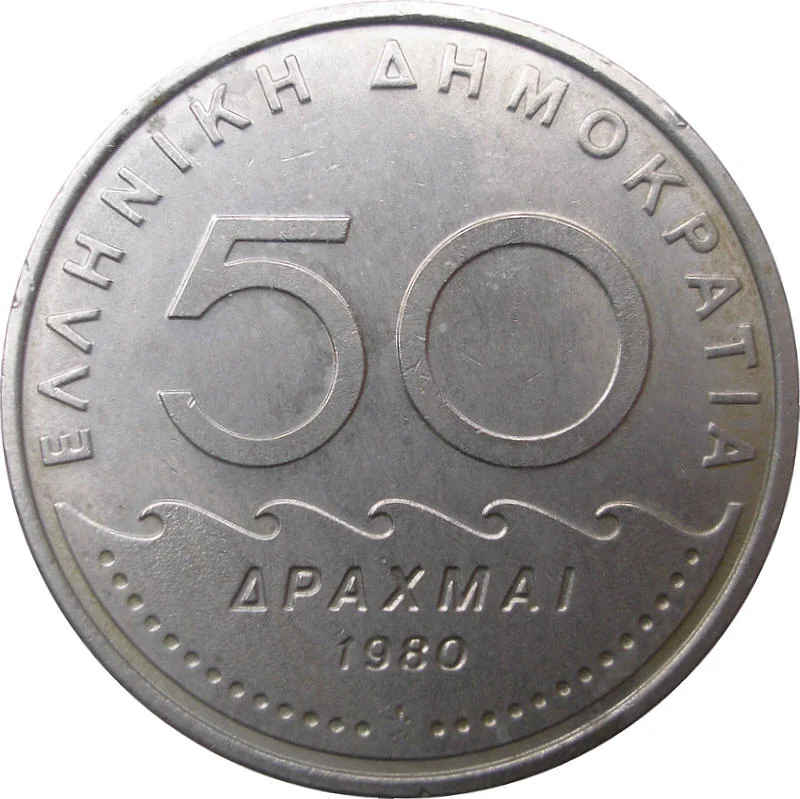
Country name above, value over sea, mintmark between dots below.
Inscription:
ΕΛΛΗΝΙΚΗ ΔΗΜΟΚΡΑΤΙΑ
50
ΔΡΑΧΜΑΙ
1980
50
ΔΡΑΧΜΑΙ
1980
Translation:
HELLENIC REPUBLIC
50
DRACHMAS
1980
50
DRACHMAS
1980
Script: Greek
Language: Greek
Engraver: V. Sampatakos
Reverse
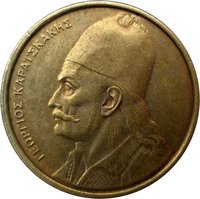
Description:
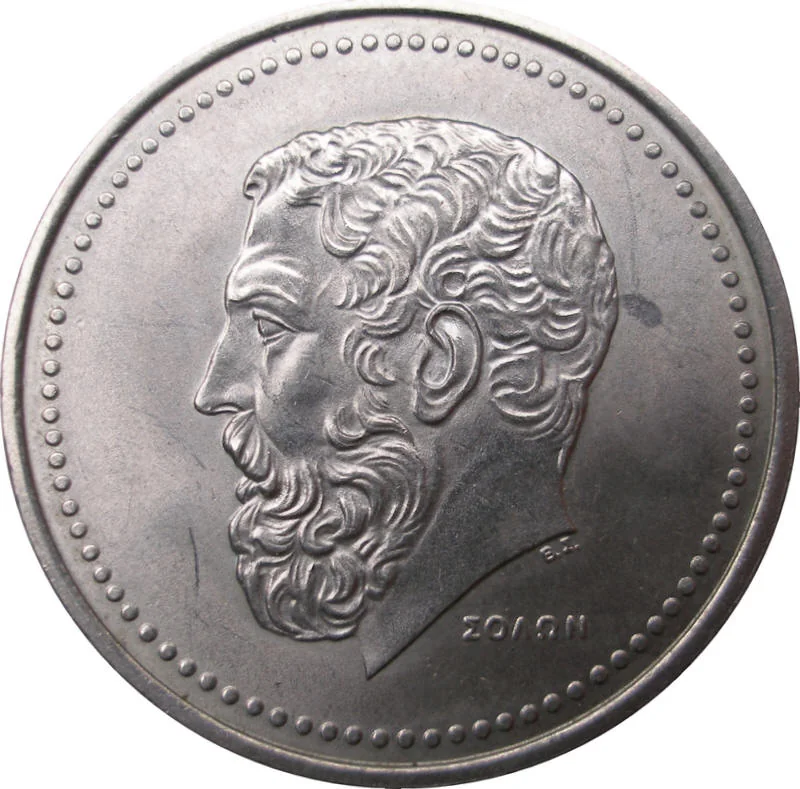
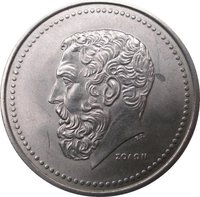
Portrait of Solon (c. 638–558 BC), the Athenian statesman and poet, facing left with his Greek name (ΣΟΛΩΝ).
Inscription:
Β. Σ.
ΣΟΛΩΝ
ΣΟΛΩΝ
Translation:
Solon
Script: Greek
Language: Greek
Engraver: V. Sampatakos
Edge
Plain
Categories
| Person> Artist |
| Person> Politician |
Mints
| Name | Mark |
|---|---|
| National Mint of the Bank of Greece | — |
Mintings
| Year | Mint Mark | Mintage | Quality | Collection |
|---|---|---|---|---|
| 1980 | — | 32,950,999 |
Historical background
In the early 1980s, Greece's currency situation was defined by its use of the drachma within a complex framework of strict capital controls and a managed exchange rate. Having joined the European Community (EC) in 1981, the country was nominally committed to European monetary cooperation but operated a heavily regulated financial system. The Bank of Greece maintained an official, fixed parity for the drachma against a basket of currencies, primarily the US dollar and European units, but this rate was often unsustainable. A parallel, much weaker "free" market rate existed for certain transactions, creating a de facto dual exchange rate system that reflected underlying economic pressures.
This monetary environment was a direct response to profound macroeconomic imbalances. The 1980s began with the aftereffects of the 1979 oil shock, and the new PASOK government pursued expansionary fiscal policies, leading to widening budget deficits and soaring public debt. Consequently, inflation surged into the high teens and often exceeded 20%, eroding the drachma's real value and creating persistent downward pressure. To defend the official exchange rate and prevent capital flight, authorities relied on stringent controls, limiting the convertibility of the drachma for Greek citizens and businesses and restricting foreign currency movements.
The result was a currency under siege, with frequent, discreet devaluations of the official rate becoming a recurring feature of the decade. These devaluations, such as the 15% drop in 1983 and further adjustments in 1985, were necessary to correct growing trade imbalances but also fueled inflationary cycles. Thus, the Greek drachma in the 1980s was characterized by a volatile combination of high inflation, periodic devaluations, and restrictive controls—a clear indicator of an economy struggling with structural weaknesses while navigating its new political commitment to European integration.
This monetary environment was a direct response to profound macroeconomic imbalances. The 1980s began with the aftereffects of the 1979 oil shock, and the new PASOK government pursued expansionary fiscal policies, leading to widening budget deficits and soaring public debt. Consequently, inflation surged into the high teens and often exceeded 20%, eroding the drachma's real value and creating persistent downward pressure. To defend the official exchange rate and prevent capital flight, authorities relied on stringent controls, limiting the convertibility of the drachma for Greek citizens and businesses and restricting foreign currency movements.
The result was a currency under siege, with frequent, discreet devaluations of the official rate becoming a recurring feature of the decade. These devaluations, such as the 15% drop in 1983 and further adjustments in 1985, were necessary to correct growing trade imbalances but also fueled inflationary cycles. Thus, the Greek drachma in the 1980s was characterized by a volatile combination of high inflation, periodic devaluations, and restrictive controls—a clear indicator of an economy struggling with structural weaknesses while navigating its new political commitment to European integration.
🌱 Very Common