

25 centimos – Spain
Add to wishlist
Spain
Context
Year: 1925
Issuer: Spain
Ruler: Alfonso XIII
Currency:
(1868—2001)
Demonetization: 1 July 1951
Total mintage: 8,001,000
Material
References
KM: #
Numista: #5464
Value
Exchange value: 0.25 ESP
Obverse
Description:
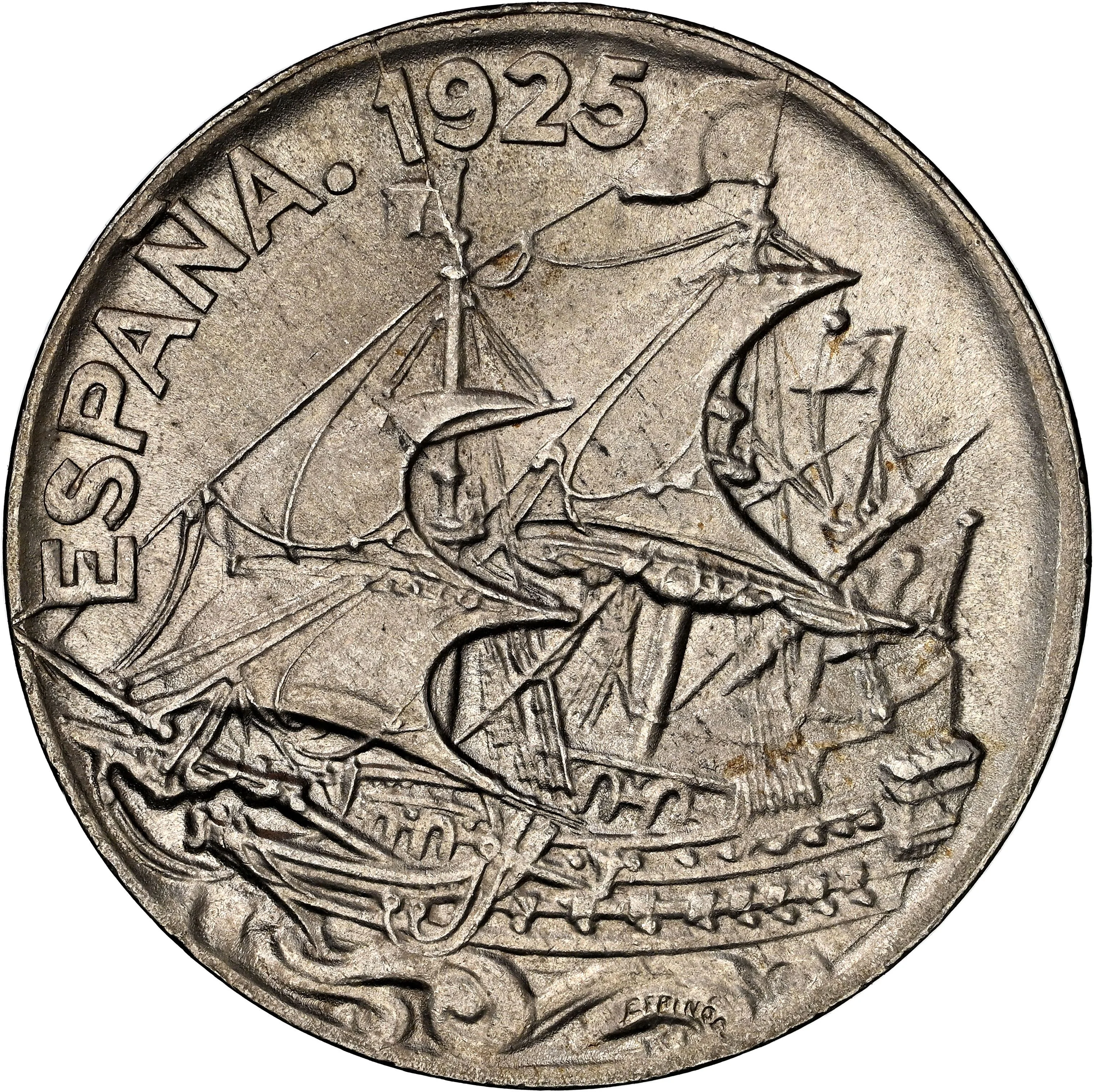
Caravel sailing left on waves.
Inscription:
ESPAÑA. 1925
ESPINOS
ESPINOS
Translation:
Spain. 1925
Espinos
Espinos
Script: Latin
Language: Spanish
Engraver: José Eusebio Espinós Gisbert
Designer: Manuel Castro Gil
Reverse
Description:
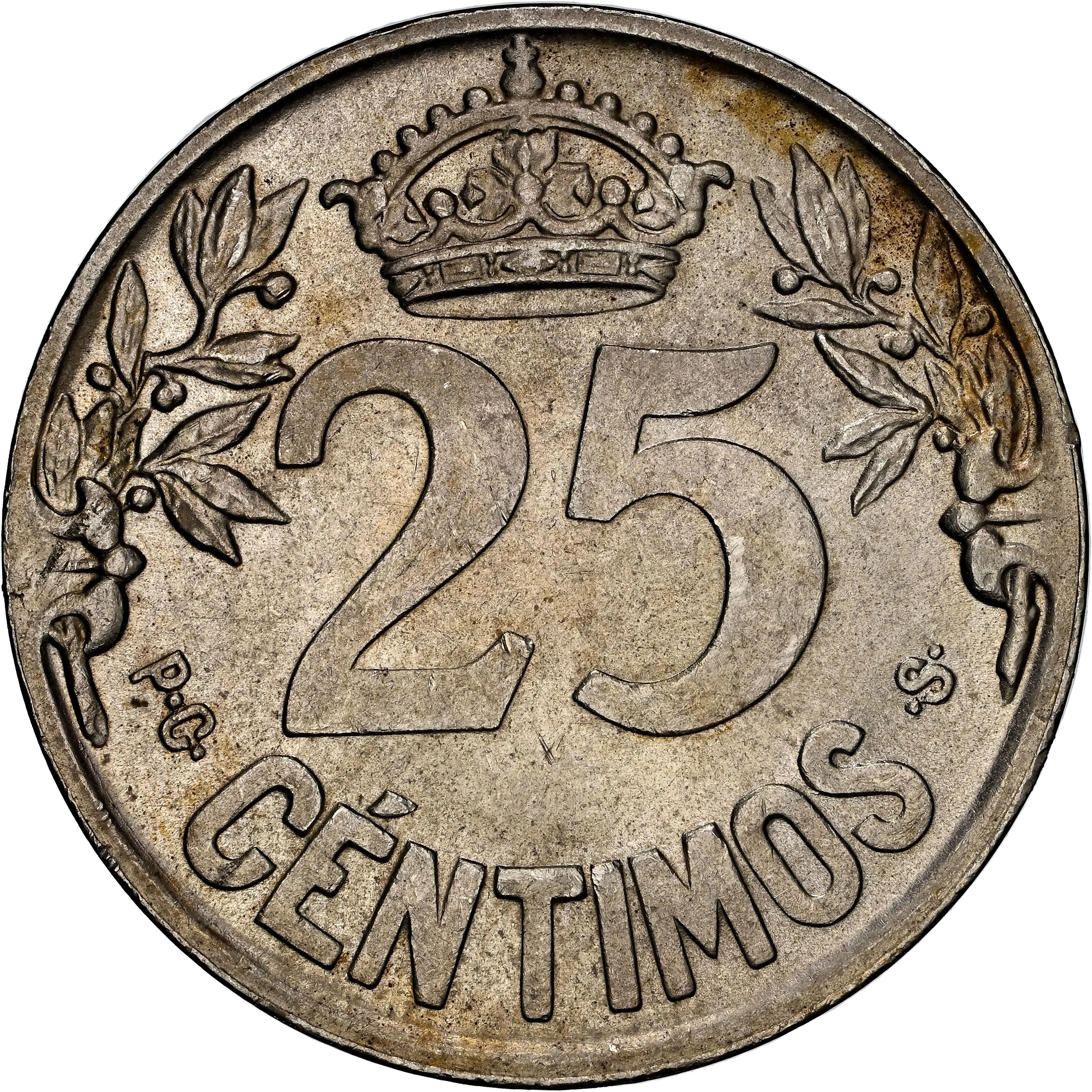
Large central denomination with crown above and leaves on both sides.
Inscription:
25
P·C· CÉNTIMOS ·S·
P·C· CÉNTIMOS ·S·
Translation:
P·C· 25 CÉNTIMOS ·S·
Script: Latin
Engraver: José Eusebio Espinós Gisbert
Designer: Manuel Castro Gil
Edge
Plain
Categories
| Transportation> Watercraft |
| Symbol> Crown |
Mints
| Name | Mark |
|---|---|
| Royal Mint of Madrid | — |
Mintings
| Year | Mint Mark | Mintage | Quality | Collection |
|---|---|---|---|---|
| 1925 | — | 8,001,000 |
Historical background
In 1925, Spain’s currency situation was defined by the persistent instability of the peseta and the monetary policies of the dictatorship of General Miguel Primo de Rivera, who had seized power in 1923. The peseta, which had been on a gold standard prior to World War I, experienced significant depreciation and volatility throughout the early 1920s due to factors including a large public debt, budget deficits, and a negative balance of payments. This period was marked by a loss of confidence in the currency, speculative attacks, and high inflation, which eroded purchasing power and complicated both domestic economic planning and international trade.
Primo de Rivera’s regime responded with interventionist measures aimed at强行 stabilizing the currency. In 1925, a key policy was the creation of the Comité de Intervención de Cambios (Committee for Exchange Intervention), which established a system of exchange controls to peg the peseta to the British pound sterling. This was not a return to the classical gold standard but a managed, de facto peg intended to halt the peseta’s fall and restore confidence. The government supported this peg by using reserves, including funds obtained from a favorable settlement of a long-running dispute with France over Moroccan mining rights, to actively buy pesetas in the foreign exchange market.
The immediate effect in 1925 was a successful, if artificial, stabilization of the exchange rate. The peseta strengthened significantly, rising from approximately 10 to the US dollar in early 1924 to around 7 by the end of 1925. However, this stability was achieved through stringent controls and came at a cost. It did not address underlying structural weaknesses in the Spanish economy, such as industrial protectionism and agricultural inefficiency. The peg also made Spanish exports more expensive, hurting competitiveness. Consequently, while providing a short-term respite, the policies of 1925 stored up vulnerabilities that would contribute to severe economic difficulties when the peseta came under renewed pressure after the dictatorship's end and during the Great Depression.
Primo de Rivera’s regime responded with interventionist measures aimed at强行 stabilizing the currency. In 1925, a key policy was the creation of the Comité de Intervención de Cambios (Committee for Exchange Intervention), which established a system of exchange controls to peg the peseta to the British pound sterling. This was not a return to the classical gold standard but a managed, de facto peg intended to halt the peseta’s fall and restore confidence. The government supported this peg by using reserves, including funds obtained from a favorable settlement of a long-running dispute with France over Moroccan mining rights, to actively buy pesetas in the foreign exchange market.
The immediate effect in 1925 was a successful, if artificial, stabilization of the exchange rate. The peseta strengthened significantly, rising from approximately 10 to the US dollar in early 1924 to around 7 by the end of 1925. However, this stability was achieved through stringent controls and came at a cost. It did not address underlying structural weaknesses in the Spanish economy, such as industrial protectionism and agricultural inefficiency. The peg also made Spanish exports more expensive, hurting competitiveness. Consequently, while providing a short-term respite, the policies of 1925 stored up vulnerabilities that would contribute to severe economic difficulties when the peseta came under renewed pressure after the dictatorship's end and during the Great Depression.
🌱 Very Common