

50 centimos – Spain
Add to wishlist
Spain
Context
Year: 1926
Issuer: Spain
Ruler: Alfonso XIII
Currency:
(1868—2001)
Demonetization: 20 February 1939
Total mintage: 4,000,000
Material
References
KM: #
Numista: #7981
Value
Exchange value: 0.50 ESP
Bullion value: $5.24
Obverse
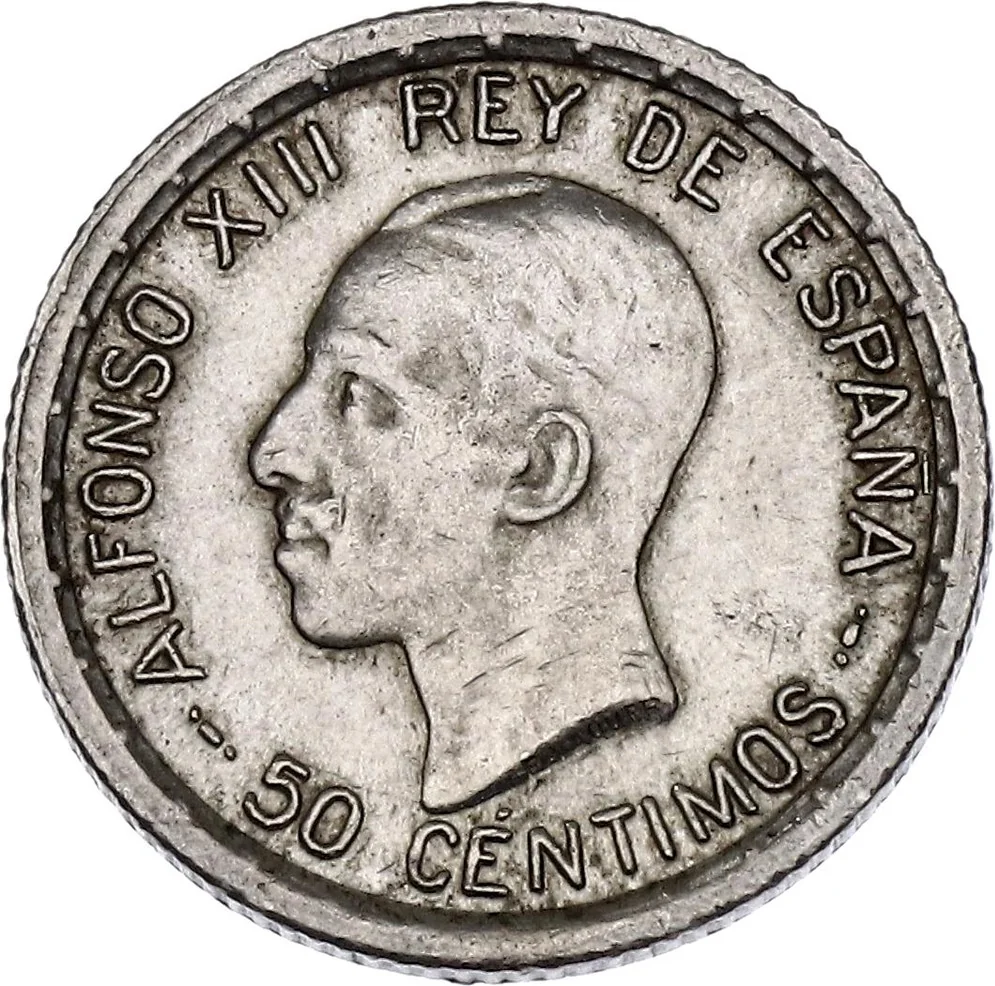
Description:
King Alfonso III facing left.
Inscription:
ALFONSO XIII REY DE ESPAÑA
E. VAQUER
50 CÉNTIMOS
E. VAQUER
50 CÉNTIMOS
Translation:
Alfonso XIII King of Spain
E. Vaquer
50 Céntimos
E. Vaquer
50 Céntimos
Script: Latin
Language: Spanish
Engraver: Enrique Vaquer Atencia
Reverse
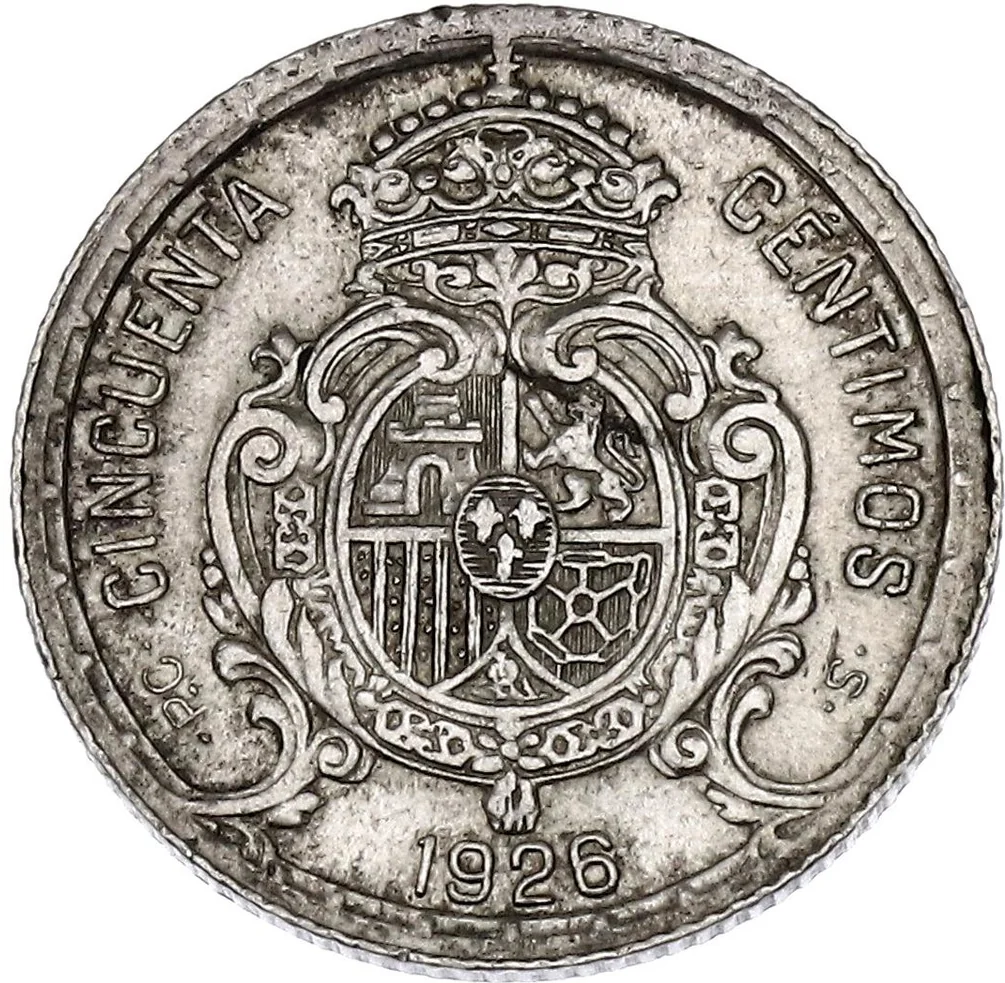
Description:
Crowned Spanish coat of arms in a wreath.
Inscription:
CINCUENTA CÉNTIMOS
·P. C· ·S·
1926
·P. C· ·S·
1926
Translation:
FIFTY CENTS
·P. C· ·S·
1926
·P. C· ·S·
1926
Script: Latin
Language: Spanish
Engraver: Enrique Vaquer Atencia
Edge
Reeded
Categories
| Person> Monarch |
| Symbols> Coat of Arms |
Mints
| Name | Mark |
|---|---|
| Royal Mint of Madrid | — |
Mintings
| Year | Mint Mark | Mintage | Quality | Collection |
|---|---|---|---|---|
| 1926 | — | 4,000,000 |
Historical background
In 1926, Spain's currency situation was defined by the persistent instability of the peseta and the monetary policies of Miguel Primo de Rivera's dictatorship. The peseta, which had been on a gold standard prior to World War I, experienced significant depreciation during the 1920s due to budget deficits, inflation, and a lack of foreign confidence. This decline was exacerbated by the costly Rif War in Morocco, which drained state resources and led to a balance of payments deficit, further pressuring the currency's external value.
Primo de Rivera's regime, established in 1923, sought to stabilize the economy and the peseta. A key move was the creation of the Comité de Intervención de Cambios (Foreign Exchange Intervention Committee) in 1926. This body implemented strict exchange controls, requiring all foreign currency earnings from exports to be surrendered to the Bank of Spain at an official, fixed rate. The goal was to centralize foreign reserves, curb capital flight, and artificially support the peseta's exchange rate, particularly against the British pound and French franc.
While these protectionist measures provided short-term stability and a temporary boost in reserves, they were largely a façade that masked underlying economic weaknesses. The artificial peg was difficult to maintain, and the controls created a thriving black market for foreign currency. The situation reflected a broader European context of monetary uncertainty in the interwar period, as Spain, like many nations, struggled to return to pre-war financial norms. The currency controls of 1926 thus represented a temporary, state-directed intervention that postponed, rather than solved, the structural problems facing the Spanish economy.
Primo de Rivera's regime, established in 1923, sought to stabilize the economy and the peseta. A key move was the creation of the Comité de Intervención de Cambios (Foreign Exchange Intervention Committee) in 1926. This body implemented strict exchange controls, requiring all foreign currency earnings from exports to be surrendered to the Bank of Spain at an official, fixed rate. The goal was to centralize foreign reserves, curb capital flight, and artificially support the peseta's exchange rate, particularly against the British pound and French franc.
While these protectionist measures provided short-term stability and a temporary boost in reserves, they were largely a façade that masked underlying economic weaknesses. The artificial peg was difficult to maintain, and the controls created a thriving black market for foreign currency. The situation reflected a broader European context of monetary uncertainty in the interwar period, as Spain, like many nations, struggled to return to pre-war financial norms. The currency controls of 1926 thus represented a temporary, state-directed intervention that postponed, rather than solved, the structural problems facing the Spanish economy.
🌱 Common