

2 centimos – Spain
Add to wishlist
Spain
Context
Years: 1911–1912
Issuer: Spain
Ruler: Alfonso XIII
Currency:
(1868—2001)
Demonetization: 29 October 1941
Total mintage: 7,500,000
Material
References
KM: #
Numista: #9104
Value
Exchange value: 0.02 ESP
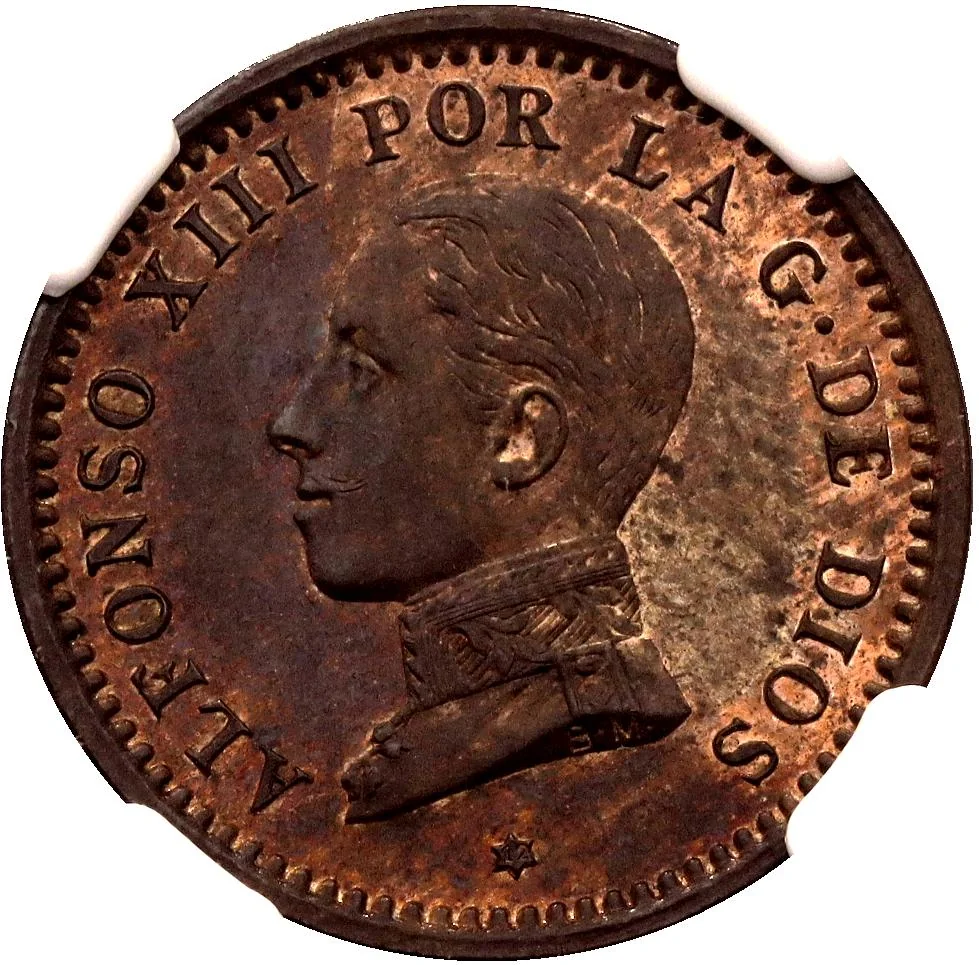
Obverse
Description:
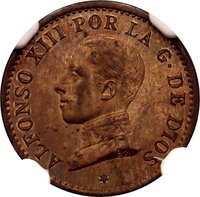
King Alfonso III facing left.
Inscription:
ALFONSO XIII POR LA G· DE DIOS
B· M·
🟌
B· M·
🟌
Translation:
By the Grace of God, Alfonso XIII
B. M.
B. M.
Script: Latin
Language: Spanish
Engraver: Bartolomé Maura Montaner
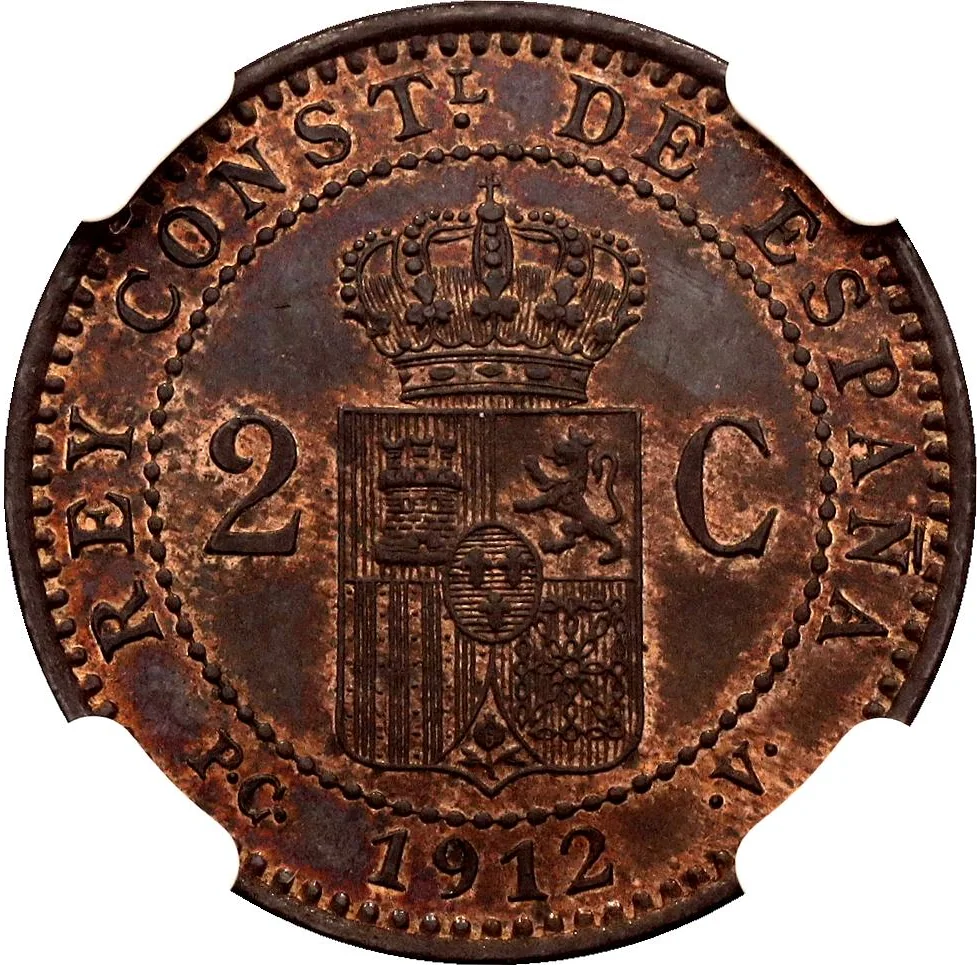
Reverse
Description:
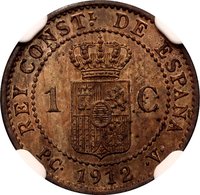
Spanish coat of arms in beaded circle.
Inscription:
REY CONSTL. DE ESPAÑA
2 C
P·C· 1911 ·V·
2 C
P·C· 1911 ·V·
Translation:
King Constitutional of Spain
2 Centimos
P·C· 1911 ·V·
2 Centimos
P·C· 1911 ·V·
Script: Latin
Language: Spanish
Engraver: Bartolomé Maura Montaner
Edge
Plain
Categories
| Person> Monarch |
| Symbols> Coat of Arms |
Mints
| Name | Mark |
|---|---|
| Royal Mint of Madrid | (🟌) |
Mintings
| Year | Mint Mark | Mintage | Quality | Collection |
|---|---|---|---|---|
| 1911 | 🟌 | 2,284,000 | ||
| 1912 | 🟌 | 5,216,000 |
Historical background
In 1911, Spain's currency system was firmly anchored to the bimetallic standard of the Latin Monetary Union, though the nation was not a formal member. The official currency was the silver peseta, introduced in 1868 to replace the old real and unify the national monetary system. By law, the peseta was defined as containing 4.5 grams of silver or 0.290322 grams of gold, establishing a fixed exchange rate between the two metals. However, the global phenomenon of "the disappearance of silver"—where the market value of silver bullion fell well below its official coinage value—had rendered silver coinage impractical. Consequently, while the silver standard remained legally in place, Spain operated a de facto gold standard, with gold coins circulating as the primary high-value currency.
This period was characterized by monetary stability relative to the turbulent 19th century, but the system faced underlying strains. The Bank of Spain (Banco de España), having been granted the monopoly on note issuance in 1874, maintained a conservative policy, backing its banknotes with substantial gold reserves. This ensured the peseta's credibility in international exchange. However, Spain's economy was less industrialized than its European counterparts, and persistent budget deficits, coupled with the financial burdens from the colonial wars and the loss of its remaining empire in 1898, created constant pressure on the treasury. Public debt was high, and the economy relied heavily on agricultural exports, making it vulnerable to external shocks.
Therefore, the seemingly stable currency picture of 1911 was fragile. The system depended heavily on confidence and the Bank of Spain's ability to maintain gold convertibility. The pressures of financing modernization and social changes, combined with the rigidities of the gold standard, would soon be tested. Within a few years, the economic disruptions of World War I (1914) would force Spain, like many nations, to suspend gold convertibility, ending this era of monetary stability and leading to a period of inflation and peseta depreciation in the 1920s.
This period was characterized by monetary stability relative to the turbulent 19th century, but the system faced underlying strains. The Bank of Spain (Banco de España), having been granted the monopoly on note issuance in 1874, maintained a conservative policy, backing its banknotes with substantial gold reserves. This ensured the peseta's credibility in international exchange. However, Spain's economy was less industrialized than its European counterparts, and persistent budget deficits, coupled with the financial burdens from the colonial wars and the loss of its remaining empire in 1898, created constant pressure on the treasury. Public debt was high, and the economy relied heavily on agricultural exports, making it vulnerable to external shocks.
Therefore, the seemingly stable currency picture of 1911 was fragile. The system depended heavily on confidence and the Bank of Spain's ability to maintain gold convertibility. The pressures of financing modernization and social changes, combined with the rigidities of the gold standard, would soon be tested. Within a few years, the economic disruptions of World War I (1914) would force Spain, like many nations, to suspend gold convertibility, ending this era of monetary stability and leading to a period of inflation and peseta depreciation in the 1920s.
🌱 Common