

25 haléřů / halierov – Czechoslovakia
Add to wishlist
Context
Years: 1962–1964
Issuer: Czechoslovakia
Period:
(1960—1990)
Currency:
(1953—1992)
Demonetization: 31 December 1972
Total mintage: 69,880,000
Material
References
KM: #
Numista: #5457
Value
Exchange value: 0.25 CSK
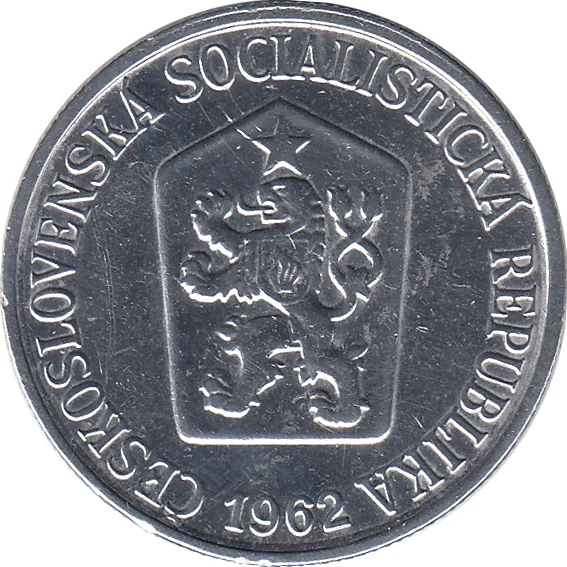
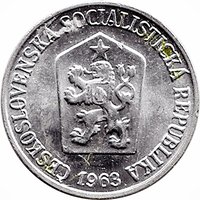
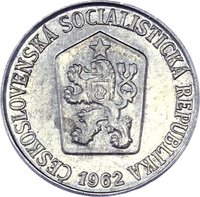
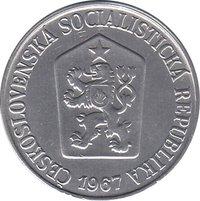
Obverse
Description:
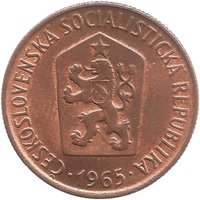
Czech lion, socialist shield.
Inscription:
ČESKOSLOVENSKÁ SOCIALISTICKÁ REPUBLIKA
1962
1962
Translation:
Czechoslovak Socialist Republic
1962
1962
Script: Latin
Engraver: Andrej Peter
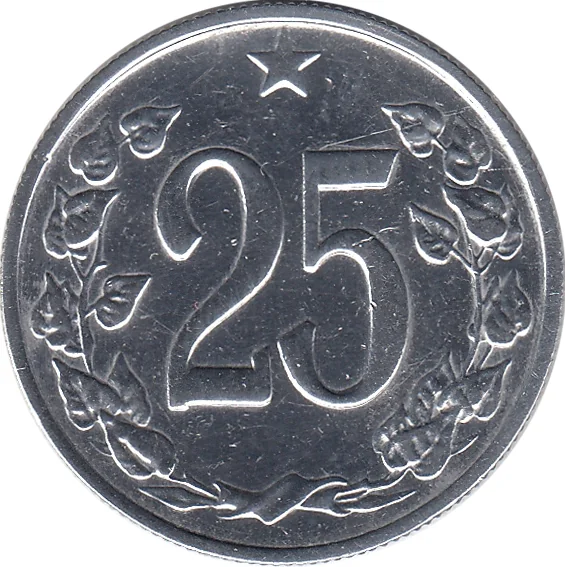
Reverse
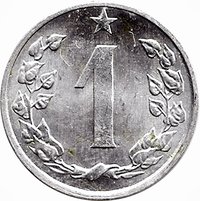
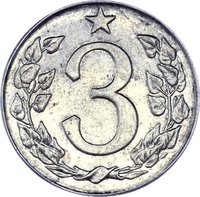
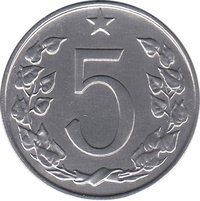
Description:
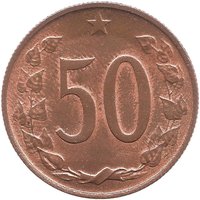
Linden wreath, star above.
Inscription:
25
Translation:
In the 25th year of King George.
Script: Latin
Language: Latin
Engraver: Andrej Peter
Edge
Reeded
Mints
| Name | Mark |
|---|---|
| Kremnica | — |
Mintings
| Year | Mint Mark | Mintage | Quality | Collection |
|---|---|---|---|---|
| 1962 | — | 69,880,000 | ||
| 1963 | — | — | ||
| 1964 | — | — |
Historical background
In 1962, Czechoslovakia's currency situation was characterized by the rigidities and contradictions of its centrally planned economy under Communist rule. The Czechoslovak koruna (KCS) was a non-convertible currency, meaning it could not be freely exchanged for foreign currencies on the international market. Its value was administratively set by the state at an artificially high official exchange rate, primarily for accounting purposes within the Council for Mutual Economic Assistance (COMECON) bloc. This system masked the currency's true weakness and the economy's growing inefficiencies, insulating it from global market pressures but also severely limiting foreign trade with non-communist countries.
Internally, the currency faced significant inflationary pressures, though these were suppressed rather than openly expressed. Chronic shortages of consumer goods, a hallmark of the planned economy, meant that while wages were paid, there was often little of value to purchase, leading to a phenomenon known as "repressed inflation." Savings accumulated in bank accounts with few outlets, undermining the koruna's purchasing power and creating a growing monetary overhang. The government maintained strict price controls on essential goods, but this further distorted production incentives and led to a burgeoning black market where goods and foreign hard currencies (like US dollars or West German marks) traded at a significant premium.
The year 1962 itself did not see a major monetary reform, but it existed within a context of economic stagnation that would soon force a reckoning. The Third Five-Year Plan (1961-1965) had collapsed by 1962, revealing the failure of extensive industrial growth policies. This economic crisis set the stage for the reform debates of the mid-1960s, which would include proposals for limited economic liberalization and more realistic exchange rates. Thus, the currency situation in 1962 was one of precarious stability, underpinned by controls that were increasingly unable to conceal the economy's structural decline and the koruna's lack of genuine value.
Internally, the currency faced significant inflationary pressures, though these were suppressed rather than openly expressed. Chronic shortages of consumer goods, a hallmark of the planned economy, meant that while wages were paid, there was often little of value to purchase, leading to a phenomenon known as "repressed inflation." Savings accumulated in bank accounts with few outlets, undermining the koruna's purchasing power and creating a growing monetary overhang. The government maintained strict price controls on essential goods, but this further distorted production incentives and led to a burgeoning black market where goods and foreign hard currencies (like US dollars or West German marks) traded at a significant premium.
The year 1962 itself did not see a major monetary reform, but it existed within a context of economic stagnation that would soon force a reckoning. The Third Five-Year Plan (1961-1965) had collapsed by 1962, revealing the failure of extensive industrial growth policies. This economic crisis set the stage for the reform debates of the mid-1960s, which would include proposals for limited economic liberalization and more realistic exchange rates. Thus, the currency situation in 1962 was one of precarious stability, underpinned by controls that were increasingly unable to conceal the economy's structural decline and the koruna's lack of genuine value.
🌱 Very Common