

50 haléřů / halierov – Czechoslovakia
Add to wishlist
Context
Years: 1963–1971
Issuer: Czechoslovakia
Issuing organization: Czechoslovak State Bank
Period:
(1960—1990)
Currency:
(1953—1992)
Demonetization: 31 December 1979
Total mintage: 142,772,000
Material

References
KM: #
Numista: #3273
Value
Exchange value: 0.50 CSK
Obverse
Description:
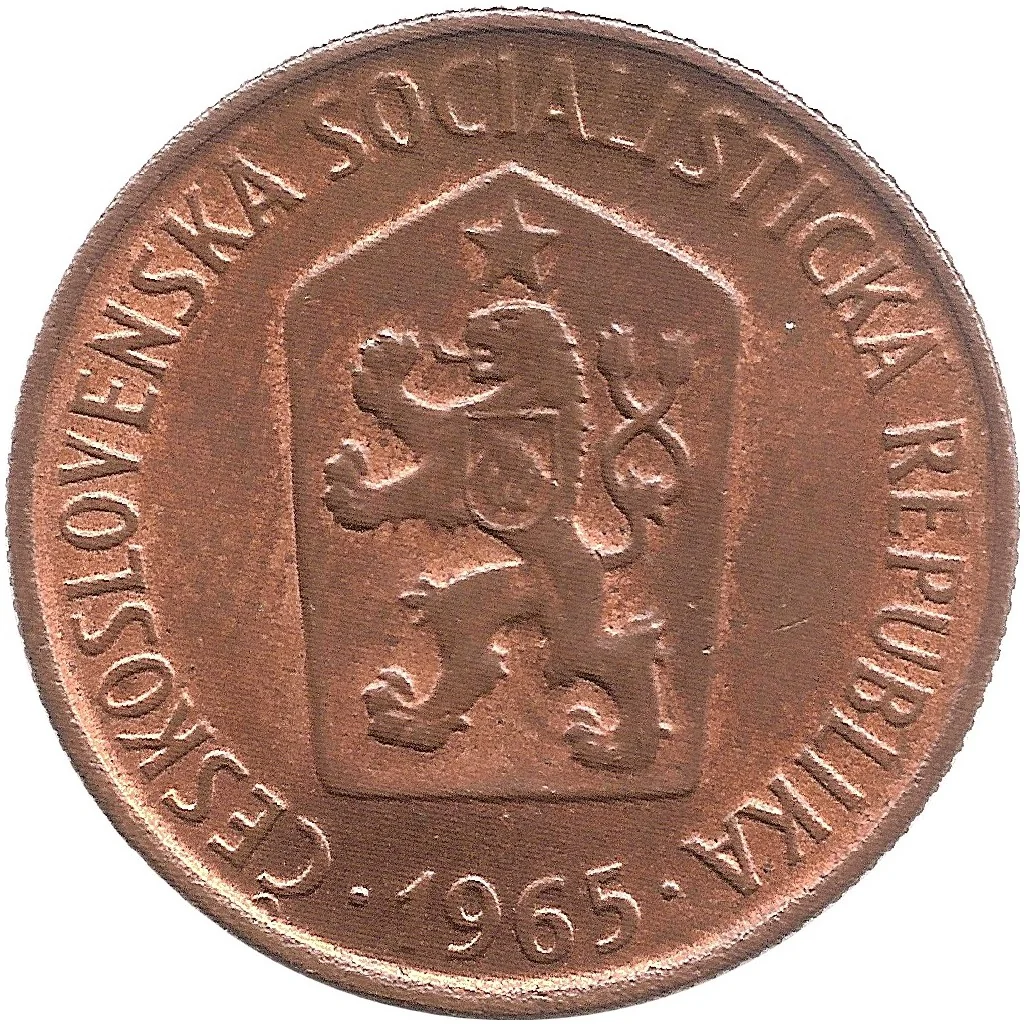
Czech lion with Slovak shield on a socialist emblem.
Inscription:
ČESKOSLOVENSKÁ SOCIALISTICKÁ REPUBLIKA
·1965·
·1965·
Translation:
Czechoslovak Socialist Republic
·1965·
·1965·
Script: Latin
Language: Czech/Slovak
Engraver: Andrej Peter
Reverse
Description:
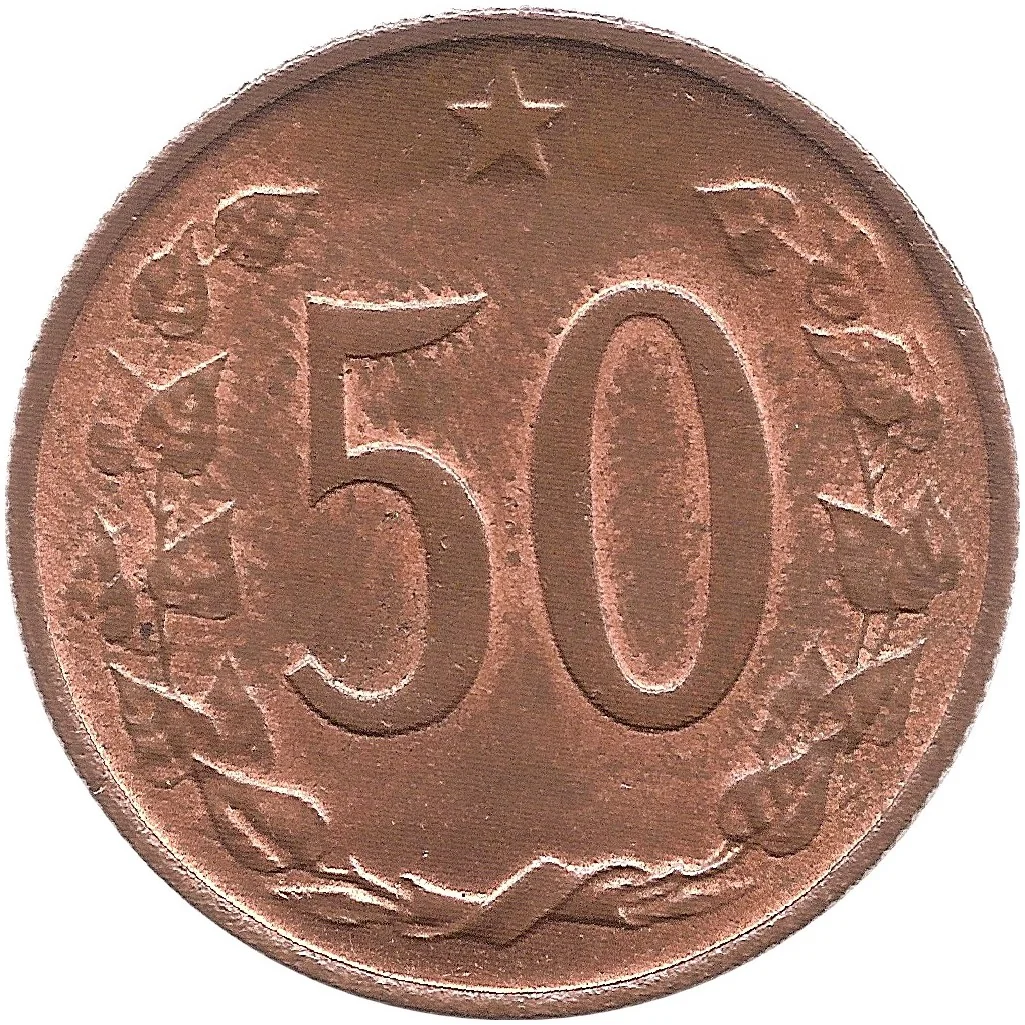
Linden wreath with star above.
Inscription:
50
Translation:
Of the Emperor Caesar Marcus Aurelius Commodus Antoninus Augustus, Conqueror of the Germans, Conqueror of the Britons, Pius, Felix.
Script: Latin
Language: Latin
Engraver: Andrej Peter
Edge
Reeded
Categories
| Symbols> Coat of Arms |
| Symbol> Wreath |
Mints
| Name | Mark |
|---|---|
| Kremnica | — |
Mintings
| Year | Mint Mark | Mintage | Quality | Collection |
|---|---|---|---|---|
| 1963 | — | 80,560,000 | ||
| 1964 | — | — | ||
| 1965 | — | — | ||
| 1969 | — | 9,876,000 | ||
| 1970 | — | 31,536,000 | ||
| 1971 | — | 20,800,000 |
Historical background
In 1963, Czechoslovakia's currency situation was characterized by the rigidities and growing imbalances of its centrally planned economy under Communist rule. Officially, the Czechoslovak koruna (KCS) maintained a fixed exchange rate set by the state, with no legal private foreign exchange market. However, this official rate was largely a fiction for international trade, as the economy struggled with declining competitiveness. A critical problem was the existence of multiple, vastly different exchange rates: one for foreign trade accounting with other socialist countries, another for trade with the West, and a separate, much weaker rate on the limited black market, which more accurately reflected the koruna's true purchasing power disparity with hard currencies.
The economic context was one of severe crisis and stagnation, following the failure of the Third Five-Year Plan (1961-1965). Ambitious industrial targets had collided with poor harvests and structural inefficiencies, leading to the first recorded economic recession in the Eastern Bloc. This downturn placed immense pressure on the currency system. Shortages of consumer goods and low-quality manufacturing reduced domestic purchasing power and export appeal, particularly to Western nations whose hard currency was desperately needed for technology imports. The state's response was to tighten currency controls further, isolating the koruna from genuine market forces and perpetuating a cycle of economic distortion.
Internally, the currency's stability for citizens was an illusion maintained by state subsidies and fixed prices for basic goods, but this came at the cost of innovation and quality. Externally, the inability to obtain meaningful hard currency reserves limited the country's ability to modernize. The 1963 economic difficulties, including the currency imbalances, became a key catalyst for the reformist movement that would later culminate in the Prague Spring of 1968, as economists began to openly critique the unsustainable command model and advocate for measures that would introduce realistic valuation and market mechanisms.
The economic context was one of severe crisis and stagnation, following the failure of the Third Five-Year Plan (1961-1965). Ambitious industrial targets had collided with poor harvests and structural inefficiencies, leading to the first recorded economic recession in the Eastern Bloc. This downturn placed immense pressure on the currency system. Shortages of consumer goods and low-quality manufacturing reduced domestic purchasing power and export appeal, particularly to Western nations whose hard currency was desperately needed for technology imports. The state's response was to tighten currency controls further, isolating the koruna from genuine market forces and perpetuating a cycle of economic distortion.
Internally, the currency's stability for citizens was an illusion maintained by state subsidies and fixed prices for basic goods, but this came at the cost of innovation and quality. Externally, the inability to obtain meaningful hard currency reserves limited the country's ability to modernize. The 1963 economic difficulties, including the currency imbalances, became a key catalyst for the reformist movement that would later culminate in the Prague Spring of 1968, as economists began to openly critique the unsustainable command model and advocate for measures that would introduce realistic valuation and market mechanisms.
🌱 Very Common