

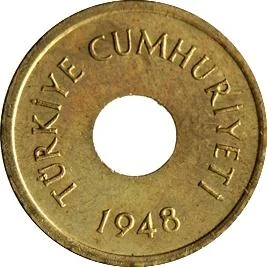
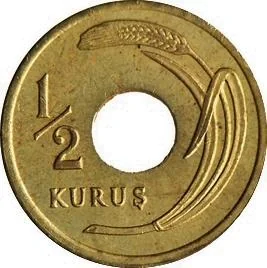
½ kuruş – Turkey
Add to wishlist
Turkey
Context
Material
Diameter: 16 mm
Weight: 1.7 g
Thickness: 1.15 mm
Shape: Round with a round hole
Magnetic: No
Technique: Milled
References
KM: #
Numista: #54297
Value
Exchange value: 0.005 TRL
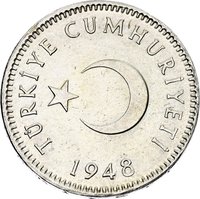
Obverse
Edge
Mintings
| Year | Mint Mark | Mintage | Quality | Collection |
|---|---|---|---|---|
| 1948 | — | 150 |
Historical background
In 1948, Turkey's currency situation was defined by the aftermath of World War II and the early stages of its alignment with the Western bloc. The Turkish lira, which had been relatively stable during the war due to Turkey's neutrality, faced significant inflationary pressures in the post-war period. A growing trade deficit, shortages of consumer goods, and a large, inefficient state economic enterprise sector strained the economy. The government maintained a strict system of multiple exchange rates and extensive controls, but these measures proved inadequate in stabilizing the currency or curbing the black market for foreign exchange.
This economic instability occurred within a crucial geopolitical context. In 1947, Turkey became a recipient of American aid under the Truman Doctrine, seeking support against Soviet pressure. The pivotal shift came with Turkey's inclusion in the European Recovery Program (Marshall Plan) in 1948. This membership came with conditions, requiring Turkey to liberalize its economy and stabilize its currency as part of a broader integration into the Western economic system. Consequently, 1948 was a year of preparation under American guidance for a major economic reform.
Therefore, the currency situation in 1948 was one of controlled crisis and impending transformation. The existing system was unsustainable, but the path forward was being charted with direct U.S. involvement. The groundwork laid in 1948 would lead directly to the landmark devaluation and economic liberalization of September 1949, when the lira was devalued by over 50% and a single, unified exchange rate was established, marking the end of the wartime economic model and the beginning of a new, outward-oriented phase for the Turkish economy.
This economic instability occurred within a crucial geopolitical context. In 1947, Turkey became a recipient of American aid under the Truman Doctrine, seeking support against Soviet pressure. The pivotal shift came with Turkey's inclusion in the European Recovery Program (Marshall Plan) in 1948. This membership came with conditions, requiring Turkey to liberalize its economy and stabilize its currency as part of a broader integration into the Western economic system. Consequently, 1948 was a year of preparation under American guidance for a major economic reform.
Therefore, the currency situation in 1948 was one of controlled crisis and impending transformation. The existing system was unsustainable, but the path forward was being charted with direct U.S. involvement. The groundwork laid in 1948 would lead directly to the landmark devaluation and economic liberalization of September 1949, when the lira was devalued by over 50% and a single, unified exchange rate was established, marking the end of the wartime economic model and the beginning of a new, outward-oriented phase for the Turkish economy.
💎 Extremely Rare