

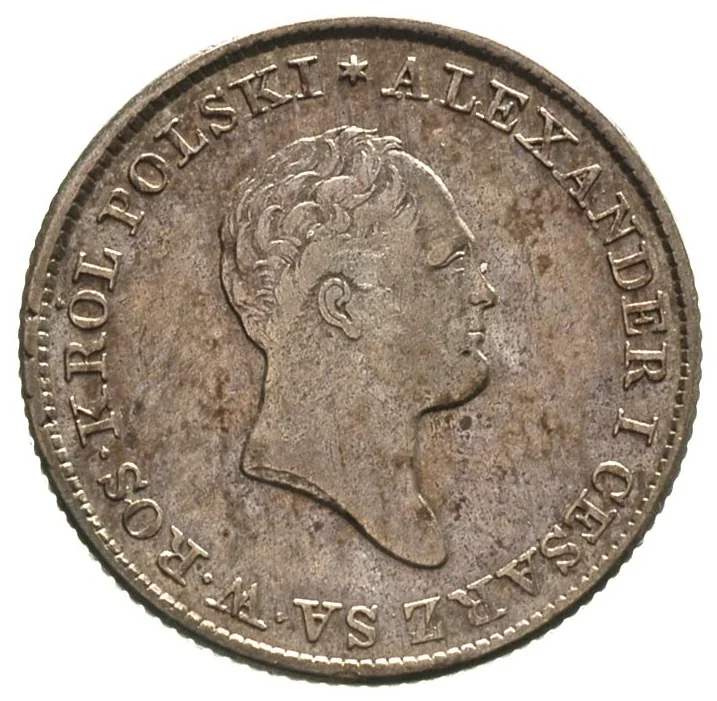
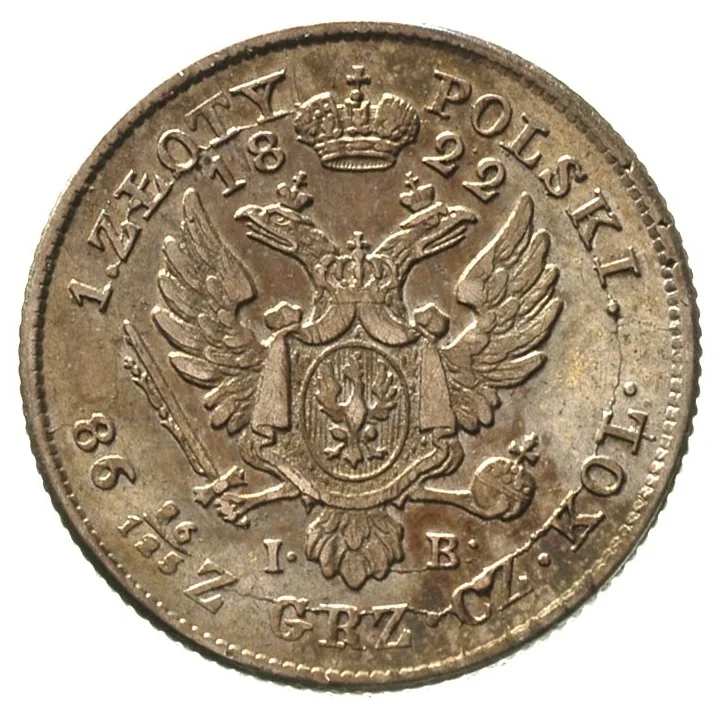
1 zloty – Congress Kingdom of Poland
Add to wishlist
Poland
Context
Years: 1818–1825
Country: Poland
Issuer: Congress Kingdom of Poland
Ruler: Alexander I
Currency:
(1815—1841)
Demonetized: Yes
Total mintage: 4,029,173
Material
References
Numista: #53682
Value
Bullion value: $6.77
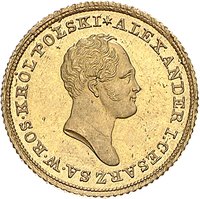
Obverse
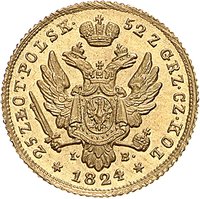
Reverse
Edge
Milled
Mintings
| Year | Mint Mark | Mintage | Quality | Collection |
|---|---|---|---|---|
| 1818 | IB | 2,252,718 | ||
| 1819 | IB | 1,208,278 | ||
| 1822 | IB | 286,673 | ||
| 1823 | IB | 52,369 | ||
| 1824 | IB | 118,582 | ||
| 1825 | IB | 110,553 |
Historical background
The currency situation in the Congress Kingdom of Poland in 1818 was defined by a period of transition and monetary integration within the Russian Empire. Following the Kingdom's creation in 1815, its initial financial system operated with a degree of autonomy. The official currency was the Polish złoty, established by a decree of 1815, which was subdivided into 30 groszy. This system was, however, firmly pegged to the Russian monetary system at a fixed rate of 1 Polish złoty to 15 Russian kopeks, or 6⅔ złoty to 1 silver ruble, ensuring economic alignment with the empire.
The year 1818 was pivotal, as it saw the opening of the Bank Polski (Bank of Poland) in Warsaw. This institution was granted the exclusive privilege of issuing currency for the Kingdom. One of its first major tasks was to replace the various coins still in circulation from earlier Polish partitions and the Duchy of Warsaw with a new, unified coinage bearing the image of Tsar Alexander I, who was also the King of Poland. The bank issued silver złoty and groszy coins, as well as gold ducats, which were intended to stabilize the currency and facilitate commerce.
Despite this formal structure, the monetary reality was complex. The fixed parity with the Russian ruble, while promoting trade with the empire, also meant that the Kingdom's monetary policy was ultimately subordinate to Russian financial interests and the value of the ruble. Furthermore, alongside the new official coinage, older and foreign coins, particularly Prussian thalers and Russian rubles, remained in widespread practical use, creating a de facto multi-currency environment. Thus, 1818 marked a step toward a centralized currency under the Bank Polski, but within a framework of constrained sovereignty and ongoing monetary diversity.
The year 1818 was pivotal, as it saw the opening of the Bank Polski (Bank of Poland) in Warsaw. This institution was granted the exclusive privilege of issuing currency for the Kingdom. One of its first major tasks was to replace the various coins still in circulation from earlier Polish partitions and the Duchy of Warsaw with a new, unified coinage bearing the image of Tsar Alexander I, who was also the King of Poland. The bank issued silver złoty and groszy coins, as well as gold ducats, which were intended to stabilize the currency and facilitate commerce.
Despite this formal structure, the monetary reality was complex. The fixed parity with the Russian ruble, while promoting trade with the empire, also meant that the Kingdom's monetary policy was ultimately subordinate to Russian financial interests and the value of the ruble. Furthermore, alongside the new official coinage, older and foreign coins, particularly Prussian thalers and Russian rubles, remained in widespread practical use, creating a de facto multi-currency environment. Thus, 1818 marked a step toward a centralized currency under the Bank Polski, but within a framework of constrained sovereignty and ongoing monetary diversity.
💎 Very Rare