

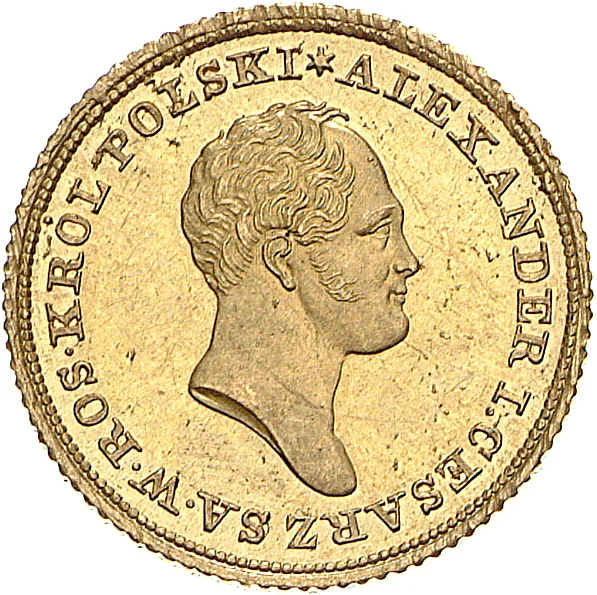
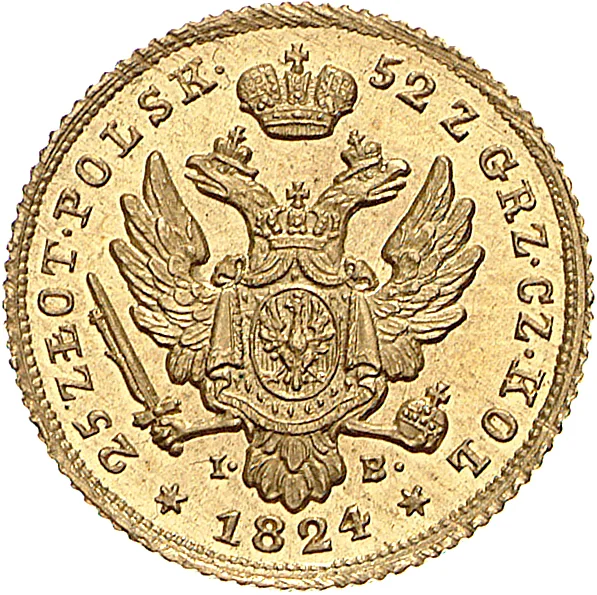
25 zlotys – Congress Kingdom of Poland
Add to wishlist
Poland
Context
Years: 1817–1825
Country: Poland
Issuer: Congress Kingdom of Poland
Ruler: Alexander I
Currency:
(1815—1841)
Demonetized: Yes
Total mintage: 239,860
Material
References
Numista: #63677
Value
Bullion value: $698.12
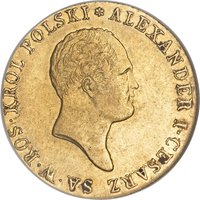
Obverse
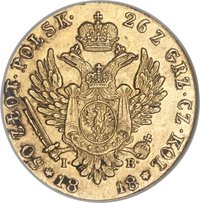
Reverse
Edge
Reeded
Mintings
| Year | Mint Mark | Mintage | Quality | Collection |
|---|---|---|---|---|
| 1817 | IB | 96,164 | ||
| 1818 | IB | 54,627 | ||
| 1819 | IB | 86,218 | ||
| 1822 | IB | 1,124 | ||
| 1823 | IB | 479 | ||
| 1824 | IB | 612 | ||
| 1825 | IB | 636 |
Historical background
The currency situation in the Congress Kingdom of Poland in 1817 was defined by a period of transition and integration into the Russian monetary system, following the Kingdom's creation at the 1815 Congress of Vienna. Initially, the Kingdom operated with a diverse circulation of coins from its previous partitions, including Prussian, Austrian, and residual Duchy of Warsaw issues, creating commercial confusion. To establish economic order and symbolize political allegiance, the Kingdom's government, under the auspices of Russian Tsar Alexander I, embarked on a formal monetary reform.
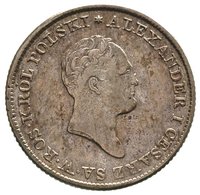
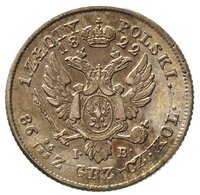
The cornerstone of this reform was the introduction of the Polish złoty (often called the złotówka), established by a decree on December 1, 1815, but fully implemented in the following years, including 1817. This new currency was not independent; it was pegged at a fixed rate to the Russian monetary system. The standard was set at 1 Russian silver ruble = 6⅔ Polish złotys, creating a clear and stable exchange. The złoty was subdivided into 30 groszy, and the first series of coins, minted in Warsaw, bore the portrait of Tsar Alexander I and the coat of arms of the Congress Kingdom, visually reinforcing the political union.
Thus, by 1817, the Kingdom was actively replacing the old mosaic of currencies with this new, unified coinage. The system was effectively a regional branch of the Russian imperial currency, ensuring monetary stability and facilitating trade within the Russian sphere of influence. This arrangement provided the Congress Kingdom with a predictable financial environment for its early economic development, albeit one that explicitly underscored its subordinate status within the Russian Empire.
The cornerstone of this reform was the introduction of the Polish złoty (often called the złotówka), established by a decree on December 1, 1815, but fully implemented in the following years, including 1817. This new currency was not independent; it was pegged at a fixed rate to the Russian monetary system. The standard was set at 1 Russian silver ruble = 6⅔ Polish złotys, creating a clear and stable exchange. The złoty was subdivided into 30 groszy, and the first series of coins, minted in Warsaw, bore the portrait of Tsar Alexander I and the coat of arms of the Congress Kingdom, visually reinforcing the political union.
Thus, by 1817, the Kingdom was actively replacing the old mosaic of currencies with this new, unified coinage. The system was effectively a regional branch of the Russian imperial currency, ensuring monetary stability and facilitating trade within the Russian sphere of influence. This arrangement provided the Congress Kingdom with a predictable financial environment for its early economic development, albeit one that explicitly underscored its subordinate status within the Russian Empire.
✨ Legendary